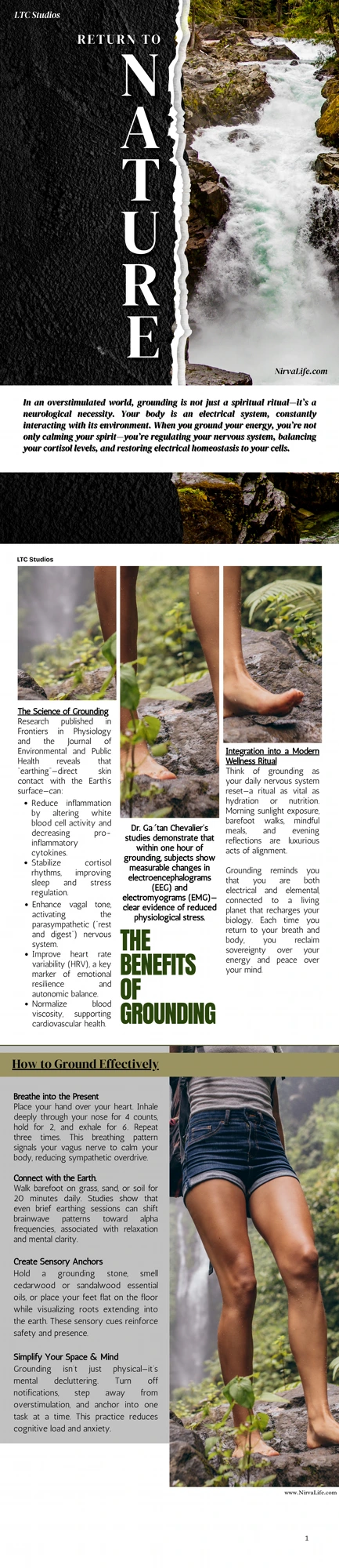
In an overstimulated world, grounding is not just a spiritual ritual — it's a neurological necessity. Your body is an electrical system, constantly interacting with its environment. When you ground your energy, you're not only calming your spirit — you're regulating your nervous system, balancing your cortisol levels, and restoring electrical homeostasis to your cells. The question is not whether grounding works, but why we ever thought we could live without it.
The Electrical Body
We think of ourselves as solid, bounded, separate. But at the cellular level, you are a symphony of electrical impulses. Every heartbeat, every thought, every muscle contraction depends on the movement of charged particles across membranes. Your nervous system is a network of signals firing at speeds that would make fiber optics jealous. You are, in the most literal sense, electric.
The Earth, too, is electric. Its surface carries a negative charge, maintained by lightning strikes and solar radiation. When your bare skin makes contact with soil, grass, sand, or even concrete that touches the ground, you complete a circuit. Electrons flow. Potentials equalize. What sounds like metaphor is, in fact, physics.
For most of human history, this connection was constant. We walked barefoot. We slept on the ground. Our bodies were in perpetual contact with the planet's electrical field. Then came rubber-soled shoes, synthetic flooring, high-rise apartments. We insulated ourselves, quite literally, from the Earth. And our nervous systems have been paying the price.
The modern body is chronically inflamed, perpetually wired, unable to fully rest. We treat these symptoms with pharmaceuticals and therapy and weekend retreats, rarely considering that the problem might be as simple as disconnection. Not emotional disconnection, though that too. Physical, electrical disconnection from the ground beneath our feet.
The Science of Earthing
Research into grounding — sometimes called earthing — has been quietly accumulating for two decades. Studies published in journals like Frontiers in Physiology and the Journal of Environmental and Public Health describe a range of physiological changes that occur when the body is grounded. These are not subtle shifts. They are measurable, reproducible, and in some cases, rapid.
Inflammation decreases. White blood cell activity changes. Pro-inflammatory cytokines drop. Cortisol rhythms stabilize, which means better sleep and more regulated stress responses. Heart rate variability improves, a key marker of resilience and autonomic balance. Blood viscosity normalizes, supporting cardiovascular health. These are not the outcomes of placebo. They are the outcomes of restoring an electrical relationship that evolution assumed would always be there.
Dr. Gaétan Chevalier, a researcher who has spent years studying the effects of grounding, has demonstrated that within one hour of skin contact with the Earth, subjects show measurable changes in electroencephalograms and electromyograms. Brain waves shift. Muscle tension drops. The body, in other words, recognizes the ground and responds accordingly.
“The modern body is chronically inflamed, perpetually wired, unable to fully rest.”
What grounding appears to do, at the most fundamental level, is activate the parasympathetic nervous system — the rest-and-digest branch that counterbalances our fight-or-flight wiring. It enhances vagal tone, the measure of how well your vagus nerve can downregulate arousal. In a culture that glorifies hustle and pathologizes rest, grounding offers a biological permission slip to slow down.
Inflammation and the Grounded Body
Chronic inflammation is the silent architecture of modern disease. It underlies autoimmune conditions, cardiovascular disease, depression, anxiety, metabolic disorders. We know this. What we talk about less is why inflammation has become so pervasive, and why the body seems unable to turn it off.
One theory, proposed by researchers studying grounding, is that free radicals — unstable molecules generated by normal metabolism and stress — accumulate in tissues and trigger inflammatory responses. The Earth's surface, rich in free electrons, acts as a kind of antioxidant reservoir. When you ground, electrons flow into your body, neutralizing free radicals before they can do damage.
This is not fringe science. It is biophysics. And while the research is still emerging, the implications are staggering. If something as simple as standing barefoot on grass can reduce systemic inflammation, then we have been overlooking one of the most accessible interventions available.
It also raises uncomfortable questions. How much of our collective unwellness is a function of lifestyle choices we don't even recognize as choices? We accept that we will live indoors, wear shoes all day, sleep on elevated beds, work under artificial light. We accept these things as neutral, as progress. But the body does not experience them as neutral. The body experiences them as exile.
The Nervous System Reset
Think of grounding as a daily nervous system reset. Not a luxury. Not a wellness trend. A biological necessity, as fundamental as hydration or nutrition. Your nervous system is designed to oscillate between activation and rest, between sympathetic arousal and parasympathetic recovery. But modern life keeps the dial turned to high. We wake to alarms, scroll through news designed to provoke, commute through traffic, work under fluorescent lights, eat lunch at our desks, return home to screens, and wonder why we can't sleep.
Grounding interrupts that cycle. It gives the nervous system a signal it understands: you are safe. You are held. You can rest. This is not metaphorical comfort. It is a shift in autonomic tone, a recalibration of the systems that govern arousal and recovery.
The beauty of grounding is that it requires almost nothing. No equipment. No expertise. No subscription. Just your body and the Earth. In a wellness landscape cluttered with expensive interventions and complicated protocols, grounding is radically simple. And perhaps that simplicity is why it gets overlooked. We have been conditioned to believe that healing must be hard-won, that it requires effort and investment. But some of the most powerful interventions are the ones we've forgotten.
“Grounding gives the nervous system a signal it understands: you are safe, you are held, you can rest.”
When you walk barefoot on grass, when you sit with your back against a tree, when you swim in the ocean, you are not performing self-care. You are restoring a connection that should never have been severed. You are remembering that you are not separate from the world, but continuous with it.
Grounding as Ritual
Ritual, at its best, is not about belief. It is about repetition, about creating conditions in which the body can remember what the mind has forgotten. Grounding can be a ritual in this sense — a daily practice that anchors you in your body and in the present moment.
Morning sunlight exposure. A barefoot walk before breakfast. Sitting on the ground with your coffee. These are not indulgences. They are acts of alignment, small recalibrations that set the tone for the day. They remind the nervous system that it is safe to be awake, that the world is not a threat, that rest and activation can coexist.
Evening grounding rituals work differently. They signal closure, a transition from doing to being. Placing your feet flat on the floor. Holding a smooth stone. Breathing with your hand over your heart. These gestures are simple, but simplicity is not the same as insignificance. The nervous system responds to consistency, to cues it can trust. Ritual provides those cues.
What makes grounding different from other wellness practices is that it does not require you to transcend your body or fix your mind. It asks only that you return. Return to sensation. Return to breath. Return to the ground beneath you. In a culture obsessed with optimization and improvement, grounding is an act of acceptance. You do not need to be better. You need to be here.
The Mental Dimension
Grounding is not only physical. It is also mental, a practice of anchoring attention in the present rather than letting it scatter across past and future, across notifications and obligations and hypothetical disasters. The mind, left to its own devices, will spin. It will catastrophize. It will replay conversations and rehearse anxieties. This is not a flaw. It is how the mind protects you. But protection, unchecked, becomes prison.
Mental grounding is the practice of bringing attention back to what is real and immediate. The weight of your body in the chair. The temperature of the air on your skin. The sound of your breath. These are not distractions from your thoughts. They are anchors that prevent your thoughts from carrying you away.
This is where grounding overlaps with mindfulness, but without the spiritual baggage that sometimes accompanies it. You do not need to empty your mind or achieve a state of bliss. You need only to notice where you are. The body is always in the present. The mind is the part that wanders. Grounding is the thread that pulls them back together.
Simplifying your space is part of this. Grounding is harder in chaos. When your environment is cluttered, when your phone is pinging, when you are trying to do three things at once, your nervous system stays in a state of low-grade activation. It cannot rest because it is constantly scanning for the next demand. Turning off notifications is not about productivity. It is about creating the conditions in which your body can downregulate.
Reclaiming Sovereignty
There is something quietly radical about grounding. In a world that profits from your distraction, your anxiety, your sense of inadequacy, grounding is an act of refusal. It says: I do not need to be entertained. I do not need to be improved. I do not need to be anywhere other than here.
This is what sovereignty looks like. Not control over external circumstances, but agency over your own attention, your own energy, your own nervous system. You cannot control the world. But you can control whether you meet it from a place of groundedness or a place of reactivity. That difference is everything.
“Grounding is an act of refusal: I do not need to be anywhere other than here.”
Each time you return to your breath, each time you place your feet on the ground and feel the Earth beneath you, you are practicing that sovereignty. You are reminding yourself that you are not at the mercy of every stimulus, every thought, every surge of cortisol. You have a body. You have a breath. You have the ground. That is enough.
Grounding will not solve all your problems. It will not erase trauma or cure disease or make the world less difficult. But it will give you a place to stand. And from that place, you can begin to discern what is yours to carry and what is not, what deserves your energy and what does not, what is real and what is noise.
The Living Planet
There is a tendency, in wellness culture, to treat the Earth as a resource. A backdrop for your morning walk. A setting for your yoga practice. Something to be used, appreciated, perhaps even revered, but ultimately separate from you. Grounding asks you to reconsider that separation.
You are not on the Earth. You are of it. Your body is made from the same elements that make up soil and stone and water. The iron in your blood was forged in a star. The calcium in your bones came from the ocean. You are not a visitor here. You are part of the system.
When you ground, you are not connecting to something external. You are reconnecting to something you never stopped being. The Earth's electrical field is not foreign to your body. It is the field in which your body evolved, the field it still expects to encounter. Grounding is not a supplement. It is a restoration of baseline.
This perspective shifts everything. It means that caring for the Earth is not altruism. It is self-preservation. It means that environmental degradation is not just an ecological crisis, but a physiological one. When we poison the soil, pave over the grass, insulate ourselves from the ground, we are not just harming the planet. We are harming ourselves.
The Practice of Return
Grounding is ultimately a practice of return. Return to the body. Return to the breath. Return to the Earth. Return to the present moment. In a culture that valorizes forward motion, return can feel like failure. But return is not regression. It is reorientation.
You will lose your ground. This is not a question of if, but when. Life will pull you into your head, into your plans, into your fears. You will forget to breathe deeply. You will forget to feel your feet on the floor. You will spend days, maybe weeks, in a state of low-grade activation, wondering why you feel so tired, so wired, so disconnected.
And then you will remember. You will take off your shoes and walk on grass. You will sit on the ground and feel the coolness of the earth against your skin. You will place your hand over your heart and breathe. And your nervous system will recognize the signal. It will soften. It will remember that it is safe to rest.
This is the practice. Not perfection, but return. Not constant groundedness, but the willingness to come back when you notice you have drifted. The ground is always there. It does not judge you for forgetting. It simply waits.
A Quiet Revolution
Grounding will not trend. It will not go viral. It is too simple, too quiet, too free. There is no product to sell, no certification to earn, no before-and-after photos to post. It offers no status, no identity, no community to join. It is just you and the Earth, in the oldest relationship there is.
And perhaps that is why it matters. In a world that commodifies everything, grounding remains uncommercialized. It cannot be packaged or optimized or turned into content. It can only be practiced. And in that practice, there is a kind of freedom.
You do not need permission to ground. You do not need instruction or equipment or the right conditions. You need only to remember that you are electrical and elemental, wired and earthbound, a creature of both synapse and soil. You need only to take off your shoes and stand on the ground and let the Earth do what it has always done: hold you, balance you, bring you home.
This is not self-care. This is survival. This is sanity. This is the quiet revolution of remembering that you are not a machine to be optimized, but a body to be lived in. And the ground beneath your feet is not just a surface. It is a source.
Before you go
Two quiet questions.
How much of what you just read named something you already know inside your own body?
How much did this open a new question you didn’t have before?
— End —
NirvaLife Magazine · January 2026