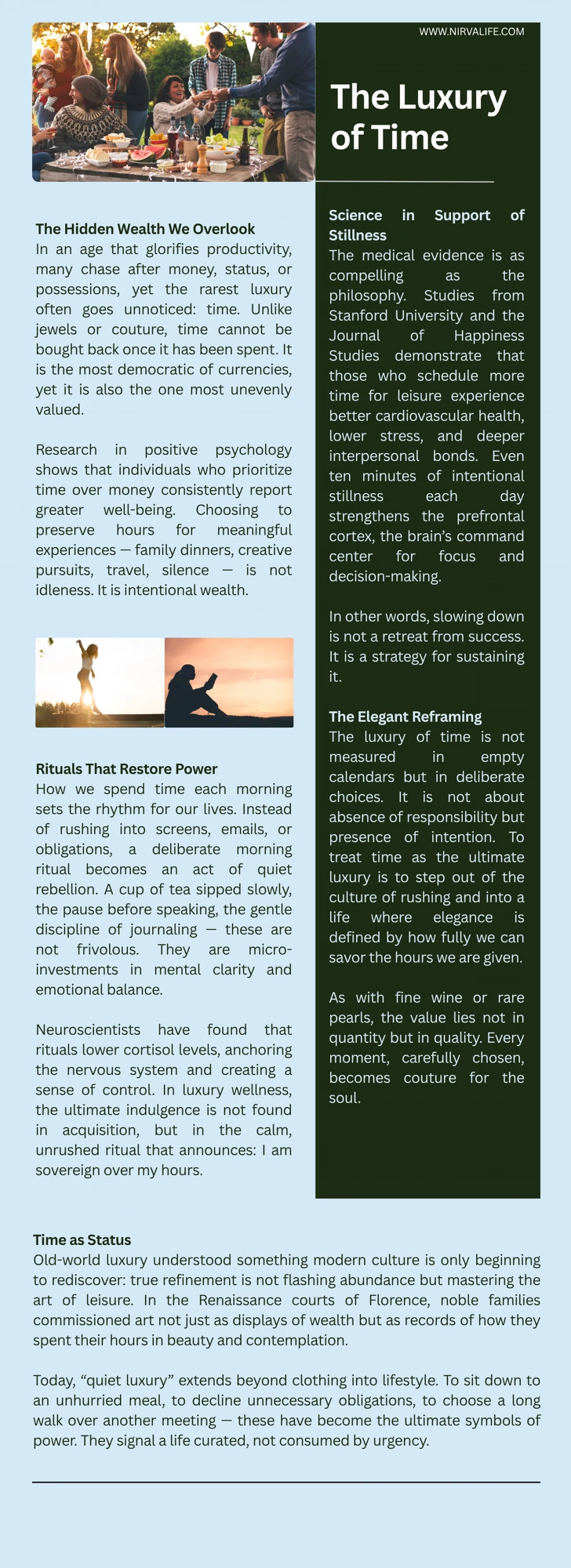
In an age that glorifies productivity, many chase after money, status, or possessions, yet the rarest luxury often goes unnoticed: time. Unlike jewels or couture, time cannot be bought back once it has been spent. It cannot be stored, borrowed, or inherited. It arrives in fixed measure, indifferent to wealth or ambition, and vanishes whether we use it well or squander it entirely. This is what makes it both the most democratic currency and the one most unevenly valued.
The Hidden Wealth We Overlook
Research in positive psychology shows that individuals who prioritize time over money consistently report greater well-being. The finding is not new, but it remains underutilized. In study after study, those who choose an extra hour of sleep over an extra hour of overtime, who turn down a higher salary for a shorter commute, who guard their weekends as fiercely as their bank accounts — these people report deeper satisfaction, stronger relationships, and a more durable sense of meaning.
Choosing to preserve hours for meaningful experiences — family dinners, creative pursuits, travel, silence — is not idleness. It is intentional wealth. It is the decision to live as though time were the asset it actually is, rather than treating it as an inexhaustible resource to be traded for things that depreciate the moment they are acquired.
Yet the culture resists this logic. We are taught to monetize, optimize, and maximize. Rest is rebranded as recovery. Leisure must justify itself as productivity in disguise. Even vacation is framed as an investment in future performance, as though lying on a beach were only acceptable if it made us better workers when we returned.
The truth is simpler and more radical: time spent well needs no justification. It is the point, not the means.
Rituals That Restore Power
How we spend time each morning sets the rhythm for our lives. The first hour of the day is rarely neutral. It either anchors us or scatters us, and the effects compound. Instead of rushing into screens, emails, or obligations, a deliberate morning ritual becomes an act of quiet rebellion.
A cup of tea sipped slowly. The pause before speaking. The gentle discipline of journaling. These are not frivolous. They are micro-investments in mental clarity and emotional balance. They are the small, repeated gestures that tell the nervous system: we are not in crisis. We have time.
Neuroscientists have found that rituals lower cortisol levels, anchoring the nervous system and creating a sense of control. The predictability of ritual is soothing to the brain, which is always scanning for threat. When we perform the same sequence each morning — lighting a candle, stretching, writing three pages by hand — we signal safety. We create a container for the day.
“The luxury of time is not measured in empty calendars but in deliberate choices.”
In luxury wellness, the ultimate indulgence is not found in acquisition, but in the calm, unrushed ritual that announces: I am sovereign over my hours. This is not about perfection. It is about consistency. It is about treating the first moments of the day as though they belong to you, not to the world's demands.
Science in Support of Stillness
Studies from Stanford University and the Journal of Happiness Studies demonstrate that those who schedule more time for leisure experience better cardiovascular health, lower stress, and deeper interpersonal bonds. The data is unambiguous. Leisure is not a luxury in the frivolous sense. It is a biological necessity.
Even ten minutes of intentional stillness each day strengthens the prefrontal cortex, the brain's command center for focus and decision-making. Meditation, breathwork, or simply sitting without distraction — these practices thicken the neural tissue responsible for executive function. They make us better at everything else we do, not because they are productive, but because they are restorative.
In other words, slowing down is not a retreat from success. It is a strategy for sustaining it. The executives who build walking meetings into their schedules, the artists who protect their mornings, the parents who turn off notifications after six — they are not opting out. They are opting in to a different definition of achievement, one that includes longevity, presence, and joy.
The nervous system, after all, does not distinguish between a real threat and a packed calendar. Both trigger the same cascade of stress hormones. Both erode our capacity for connection, creativity, and clear thought. The antidote is not more efficiency. It is more space.
Time as Status
Old-world luxury understood something modern culture is only beginning to rediscover: true refinement is not flashing abundance but mastering the art of leisure. In the Renaissance courts of Florence, noble families commissioned art not just as displays of wealth but as records of how they spent their hours in beauty and contemplation. To have time for philosophy, for music, for long meals — this was the mark of a life well lived.
Today, quiet luxury extends beyond clothing into lifestyle. To sit down to an unhurried meal, to decline unnecessary obligations, to choose a long walk over another meeting — these have become the ultimate symbols of power. They signal a life curated, not consumed by urgency.
The shift is subtle but profound. Where once status was measured in visible accumulation — the car, the watch, the square footage — it is now increasingly measured in invisible restraint. The ability to say no. The freedom to move slowly. The confidence to leave the phone in another room.
“True refinement is not flashing abundance but mastering the art of leisure.”
This is not about wealth in the traditional sense, though wealth certainly makes it easier. It is about values. It is about deciding that your attention is not for sale, that your evenings are not up for negotiation, that your life will not be structured around someone else's urgency.
The Elegant Reframing
The luxury of time is not measured in empty calendars but in deliberate choices. It is not about absence of responsibility but presence of intention. To treat time as the ultimate luxury is to step out of the culture of rushing and into a life where elegance is defined by how fully we can savor the hours we are given.
This requires a shift in perspective. We are conditioned to see busyness as virtue, rest as laziness, and ambition as incompatible with ease. But the most compelling lives are not the most frantic. They are the most intentional. They are built around a few core commitments, honored deeply, rather than a hundred shallow ones.
As with fine wine or rare pearls, the value lies not in quantity but in quality. Every moment, carefully chosen, becomes couture for the soul. This is not a metaphor. It is a practice. It is the daily work of asking: What deserves my time today? What can wait? What should never have been on the list at all?
The answers will vary. But the question remains constant. And in asking it, we reclaim something essential: the right to live as though our hours matter, as though we are more than the sum of our output, as though time itself — not what we produce with it — is the inheritance we leave behind.
The Architecture of a Slower Life
Building a life that honors time requires architecture, not aspiration. It is not enough to wish for more margin. We must design for it. This means examining the structures that shape our days — the defaults, the commitments, the unspoken agreements we have made with work, family, and society.
Start with the calendar. Not as a record of what happened, but as a blueprint for what matters. Block time for the non-negotiables: sleep, movement, meals eaten sitting down. Then add the things that nourish rather than deplete. A weekly call with a friend. An hour of reading before bed. A Saturday morning with no agenda.
These are not indulgences. They are load-bearing walls. Remove them, and the structure collapses. Protect them, and everything else finds its place around them.
The goal is not minimalism for its own sake. It is clarity. It is the ability to see what we are actually spending our lives on, and to decide whether that spending aligns with what we say we value.
The Neuroscience of Enough
There is a reason why more rarely feels like enough. The brain is wired for novelty, for striving, for the next thing. Dopamine rewards pursuit, not attainment. This served us well in environments where resources were scarce and survival uncertain. It serves us poorly in environments where the pursuit never ends.
As neuroscientist Andrew Huberman has noted, the dopamine system is not designed to make us happy. It is designed to make us want. The result is a constant low-grade dissatisfaction, a sense that we are always one achievement, one purchase, one experience away from contentment.
The antidote is not to eliminate desire but to cultivate satisfaction. To train the brain to notice what is already here. To practice gratitude not as a platitude but as a neurological intervention. Studies show that people who regularly reflect on what they are grateful for exhibit increased activity in the prefrontal cortex and decreased activity in the amygdala — the brain's fear center.
“The most compelling lives are not the most frantic. They are the most intentional.”
In practical terms, this means pausing. It means noticing the warmth of morning light, the taste of coffee, the sound of a loved one's voice. It means treating these moments not as interruptions to productivity but as the substance of a life.
What We Pass Down
In the end, time is the only thing we truly own, and the only thing we cannot keep. We can hoard money, collect possessions, build empires — but we cannot stockpile hours. They arrive and depart on their own schedule, indifferent to our plans.
What we can do is choose how we spend them. And in that choosing, we teach the people around us — our children, our colleagues, our communities — what a life can be. We model either the frantic pursuit of more or the quiet confidence of enough. We demonstrate either that time is a resource to be exploited or a gift to be honored.
This is not a small thing. The way we live our days is the way we live our lives, as Annie Dillard wrote. And the way we live our lives becomes the inheritance we leave behind — not in what we accumulated, but in how we were present. In whether we rushed past the people we loved or sat down beside them. In whether we filled every hour or left room for wonder.
The luxury of time, then, is not about having more of it. It is about using it as though it mattered. As though we mattered. As though the quiet, uncelebrated hours of an ordinary life were worth savoring, protecting, and — when the moment calls for it — spending lavishly on the things and people we love.
The Practice of Presence
If time is the ultimate luxury, presence is its highest expression. To be fully where we are, undistracted and unhurried, is a skill that must be practiced. It does not come naturally in a world designed to fragment our attention.
Presence begins with the body. The breath. The weight of your feet on the floor. The temperature of the air. These are not poetic abstractions. They are anchors. When the mind spirals into past regrets or future anxieties, the body remains here, now, available.
This is not meditation in the formal sense. It is a reset. A way of returning to the moment when the moment has been lost. Done regularly, it trains the nervous system to recognize the difference between urgency and importance, between reaction and response.
Over time, presence becomes less effortful. It becomes the default rather than the exception. And with it comes a quiet confidence, a sense that no matter what the day demands, you are equal to it — not because you are faster or more efficient, but because you are here.
Coda: The Art of the Unhurried Life
There is an art to living unhurried in a hurried world. It is not about opting out or retreating. It is about moving through the world at a different pace, with a different set of priorities. It is about refusing to let urgency dictate value, or busyness masquerade as importance.
This is countercultural work. It will be misunderstood. People will assume you are less ambitious, less serious, less committed. Let them. The truth is the opposite. To live deliberately requires more discipline, not less. It requires the courage to disappoint, to say no, to let opportunities pass because they do not serve the life you are building.
“Every moment, carefully chosen, becomes couture for the soul.”
But the reward is a life that feels like yours. A life where time is not something you are always running out of, but something you are learning to spend well. Where the hours are not a blur but a series of moments, each one noticed, each one chosen.
In the end, the luxury of time is not about having more. It is about needing less. Less distraction. Less obligation. Less of what does not matter. And in that spaciousness, discovering what does: the people we love, the work that calls us, the quiet pleasure of a life lived at a human pace.
This is the inheritance worth leaving. Not a fortune, but a way of being. Not a legacy of accomplishments, but a record of presence. Not a life spent chasing time, but a life that honored it — slowly, deliberately, and with the kind of attention that transforms the ordinary into the unforgettable.
Before you go
Two quiet questions.
How much of what you just read named something you already know inside your own body?
How much did this open a new question you didn’t have before?
— End —
NirvaLife Magazine · November 2025