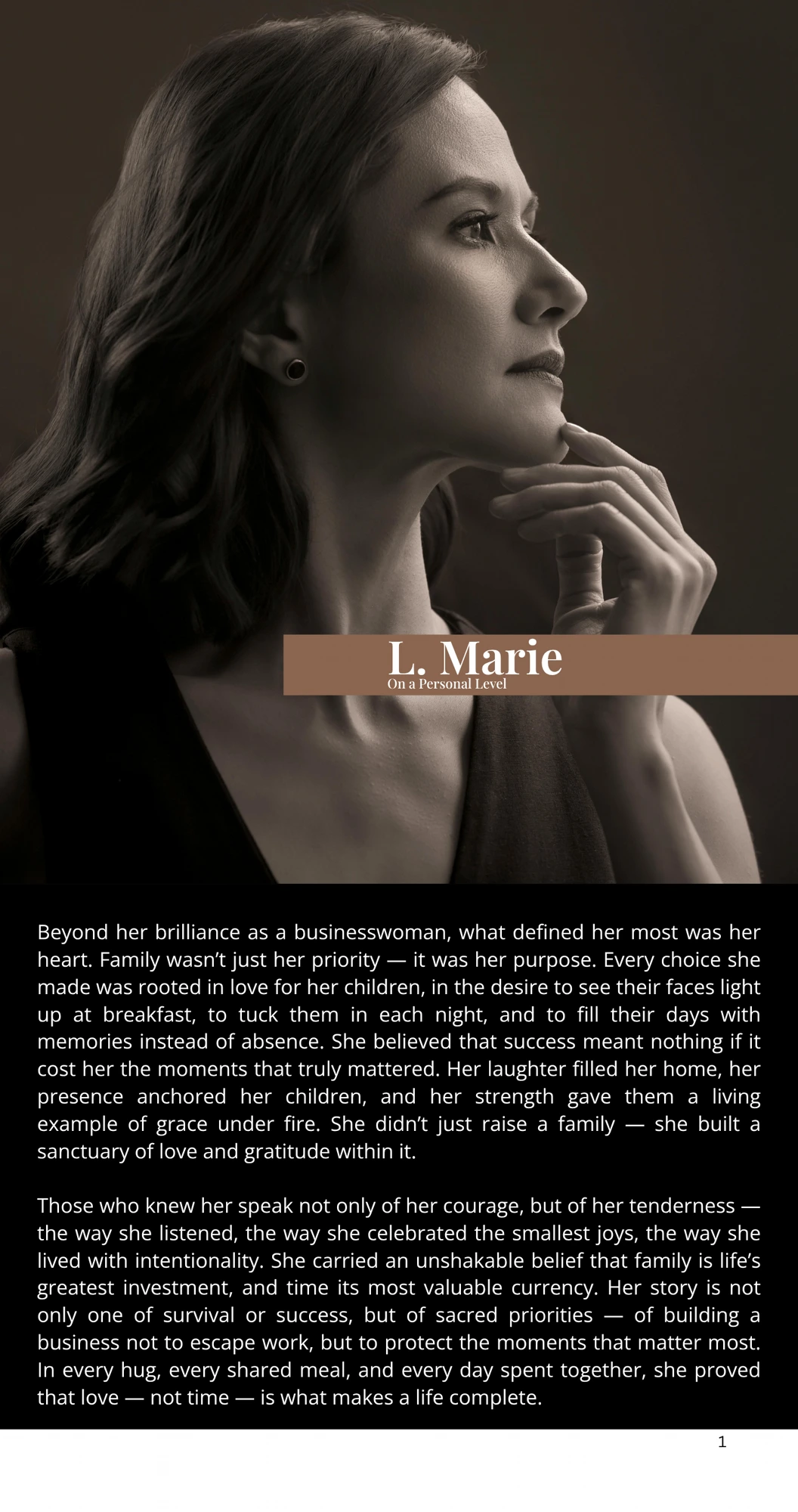
L. Marie speaks the way she moves — unhurried, considered, and utterly herself. Over coffee in her sunlit study, she agrees to talk on the record about the version of her life that no camera has ever seen. She is wearing linen the color of sand, no jewelry, and her hair is pulled back in a way that suggests function over style. The room smells faintly of bergamot. Outside, the city hums at a distance, but here, in this deliberate quiet, she is willing to say things she has never said publicly before.
"I do not perform composure," she says, folding her hands on the table between us. "Composure was killing me. What I have now is regulation, which is a very different thing. Regulation lets me tell the truth."
The distinction matters to her. She returns to it several times over the course of our conversation, circling it the way one circles a wound that has finally begun to close. Composure, she explains, was the mask she wore for years — the seamless exterior that allowed her to move through rooms, through interviews, through grief itself, without ever letting anyone see the fissures beneath. Regulation, by contrast, is the work of tending to her nervous system with the same care she might give to a garden or a friendship. It is not about looking calm. It is about being able to stay present even when the ground shifts.
The Year She Disappeared
There was a year — she will not name it exactly, only gestures vaguely toward the recent past — when she disappeared. Not literally, though the tabloids tried to make it dramatic. She simply stopped. Stopped working, stopped appearing, stopped returning calls. She describes it now as a kind of necessary collapse, the moment when the architecture of her public life could no longer support the weight of her private one.
"I had been running on fumes for so long that I didn't even know what fuel felt like anymore," she says. "I thought exhaustion was just part of the deal. I thought if I could just get through one more project, one more season, I'd find some kind of equilibrium on the other side. But there was no other side. There was just more of the same, and my body finally said no."
The collapse, when it came, was not cinematic. There was no dramatic breakdown, no hospital stay. Just a morning when she woke up and could not imagine putting on the performance one more time. She called her manager, canceled everything, and went silent. For months, she did almost nothing. She read. She walked. She let herself be bored, which felt, at first, like a kind of death.
“I thought exhaustion was just part of the deal. My body finally said no.”
"People don't talk about how terrifying rest can be when you've been in motion your whole life," she says. "I didn't know who I was without the doing. I didn't know if there was anything underneath."
Her Mother's Influence
She speaks about her mother the way one speaks about a language learned young and never quite forgotten. Her mother, who died six years ago, was a woman of enormous self-discipline and very little self-compassion. She taught L. Marie to stand up straight, to speak clearly, to never let anyone see you falter. She also taught her, without meaning to, that feelings were a kind of weakness to be managed in private.
"She was extraordinary," L. Marie says, and there is no irony in her voice. "She survived things I will never fully understand. But she survived them by locking parts of herself away, and I think she hoped I would never have to do the same. Instead, I learned to do it anyway, just by watching."
It was only after her mother's death that L. Marie began to see the pattern clearly. The way she had learned to compartmentalize grief, to schedule it like an appointment, to cry only when it was convenient. The way she had mistaken stoicism for strength. Her mother had given her so much — resilience, work ethic, a spine made of steel — but she had also, inadvertently, handed down a nervous system calibrated for survival rather than presence.
"I don't blame her," L. Marie says quietly. "I just had to learn a different way."
The Practice That Brought Her Back
She is careful not to call it a cure or a revelation. She does not want to sound like a testimonial. But there is a practice she credits with bringing her back to herself, and it is rooted in something she had spent years dismissing as too simple to matter: the deliberate care of her nervous system.
It began with a therapist who specialized in somatic work, someone who understood that trauma lives not only in memory but in the body's own rhythms and responses. L. Marie was skeptical at first. She had done talk therapy. She had read the books. She did not see how paying attention to her breath or noticing the tension in her shoulders could possibly address the enormity of what she was carrying.
"But I was desperate," she says. "And desperation makes you willing to try things you would have rolled your eyes at a year earlier."
The work was unglamorous. It involved lying on the floor and noticing where she felt tight. It involved learning to track her own activation — the moments when her heart rate spiked, when her thoughts began to race, when she felt the old familiar urge to flee or perform or disappear. It involved, most of all, learning to stay with herself in those moments instead of overriding them with willpower.
“Regulation lets me tell the truth. Composure only let me survive.”
"I had spent my whole life thinking that discipline meant pushing through," she says. "What I learned was that real discipline is knowing when to stop. When to soften. When to let your nervous system reset instead of forcing it to keep going."
On Grief and Its Geometry
Grief, she has learned, does not follow a timeline. It does not resolve. It does not even necessarily soften with time, though it does change shape. She describes it now as something she carries with her, not as a burden but as a kind of ballast — a weight that keeps her grounded, that reminds her what matters.
"People want grief to have an arc," she says. "They want you to go through the stages and come out the other side, healed and whole and ready to move on. But I don't think that's how it works. I think grief just becomes part of the landscape. You learn to live with it. You learn to build a life that has room for it."
She pauses, looking out the window at the light slanting through the trees. "My mother used to say that you can't control what happens to you, only how you carry it. I used to think that meant you had to carry it alone, with your back straight and your face composed. Now I think it means you get to choose who helps you carry it. You get to choose when to set it down."
There is a tenderness in the way she speaks about her mother now, a softness that was not there in earlier interviews. She has stopped trying to make sense of the contradictions — the woman who was both fierce and fragile, who gave so much and withheld so much, who loved her daughter completely and yet could not always show it. She has learned to hold all of it at once.
The Nervous System as Teacher
L. Marie has become something of a student of her own nervous system. She talks about it the way a musician might talk about an instrument — with respect, with curiosity, with an awareness that it requires tuning. She has learned to notice the early signs of dysregulation: the tightness in her chest, the sharpness in her tone, the way her thoughts begin to spiral. She has learned, too, that these signs are not character flaws but information.
"Your nervous system is always trying to keep you safe," she says. "The problem is that it doesn't always know the difference between a real threat and a perceived one. It doesn't know the difference between a difficult conversation and a life-or-death situation. So it responds the same way to both, and you end up in fight-or-flight over things that don't actually require that level of activation."
She has learned to intervene gently, to offer her nervous system evidence that she is safe even when her body is convinced otherwise. Sometimes that means stepping outside for air. Sometimes it means placing a hand on her chest and breathing slowly until her heart rate settles. Sometimes it means simply naming what is happening — "I am activated right now, and that is okay" — and letting the acknowledgment itself be a form of regulation.
"It sounds so simple," she says, "but it has changed everything. I used to think I was broken because I couldn't just power through the way other people seemed to. Now I understand that powering through was the problem. My nervous system was trying to tell me something, and I kept ignoring it."
What She Knows Now
There are things she wishes she had known earlier. She wishes someone had told her that rest is not a reward for productivity but a biological necessity. She wishes she had understood that vulnerability is not the same as weakness, that letting people see you struggle does not diminish you. She wishes she had known that the body keeps score, as Bessel van der Kolk writes, and that no amount of mental discipline can override what the nervous system remembers.
But she is also wary of turning her experience into a prescription. She does not want to suggest that what worked for her will work for everyone, or that healing follows a predictable path. She is suspicious of the language of optimization, of the idea that the self is a project to be perfected rather than a life to be lived.
"I'm not interested in being the best version of myself," she says. "I'm interested in being the most honest version. And sometimes that version is tired. Sometimes that version is grieving. Sometimes that version doesn't have it all figured out. That's okay. That's human."
“I'm not interested in being the best version of myself. I'm interested in being the most honest version.”
She has also learned to be more discerning about what she allows into her life. She is slower to say yes, quicker to recognize when something is costing her more than it is giving. She has built boundaries that would have felt impossible a few years ago, and she has learned to hold them without apology.
The Discipline of Becoming
Becoming, she says, is not a destination. It is a practice, and like any practice, it requires discipline. But the discipline she speaks of now is not the rigid, punishing kind she learned as a child. It is softer, more spacious. It is the discipline of showing up for yourself even when no one is watching. The discipline of telling the truth even when it is inconvenient. The discipline of choosing presence over performance, again and again, even when the old patterns pull hard in the opposite direction.
"I used to think discipline meant control," she says. "Now I think it means commitment. Commitment to staying with yourself. Commitment to doing the work even when it's boring or uncomfortable or slow. Commitment to building a life that feels true, even if it doesn't look the way you thought it would."
She is still becoming. She does not pretend to have arrived. But there is a groundedness to her now, a quality of being fully inhabited, that was not there before. She is less interested in being admired and more interested in being known. Less interested in the performance of grace and more interested in the practice of it.
"Grace," she says, "is not something you achieve. It's something you extend — to others, yes, but also to yourself. And that has been the hardest part. Learning to be as gentle with myself as I would be with someone I love."
What Comes Next
She is working again, but differently. She is more selective, more intentional. She has learned to ask herself not just whether she can do something, but whether she wants to, whether it aligns with the life she is trying to build. She has learned to trust her own no.
There are projects in the works, though she is careful not to say too much. She is protective of her energy now, aware that every yes is also a no to something else. She is learning to move at her own pace, to resist the pressure to be constantly visible, constantly producing, constantly on.
"I don't know what the next chapter looks like," she says. "And I'm okay with that. I used to need to know. I used to need a plan, a timeline, a clear sense of where I was going. Now I'm more interested in how I'm moving. Am I moving from a place of fear or a place of trust? Am I moving because I want to or because I think I should? Those are the questions that matter to me now."
As our conversation winds down, she walks me to the door. The light has shifted, softened. She thanks me for listening, for not asking the usual questions. I thank her for her honesty, for letting me see this version of her life. She smiles, a small, private smile, and says, "This is the only version I have left."
Coda
Later, I will think about what she said about regulation versus composure. About the difference between looking calm and being able to stay with yourself. I will think about her mother, about the inheritance of survival strategies, about the courage it takes to choose a different path.
But in the moment, standing in her doorway, what strikes me most is how ordinary she seems. Not in a diminishing way, but in the way that groundedness always looks ordinary from the outside. She is not performing anything. She is simply here, fully, in her linen and her quiet and her hard-won peace.
And that, I realize, is the rarest thing of all.
Before you go
Two quiet questions.
How much of what you just read named something you already know inside your own body?
How much did this open a new question you didn’t have before?
— End —
NirvaLife Magazine · November 2025