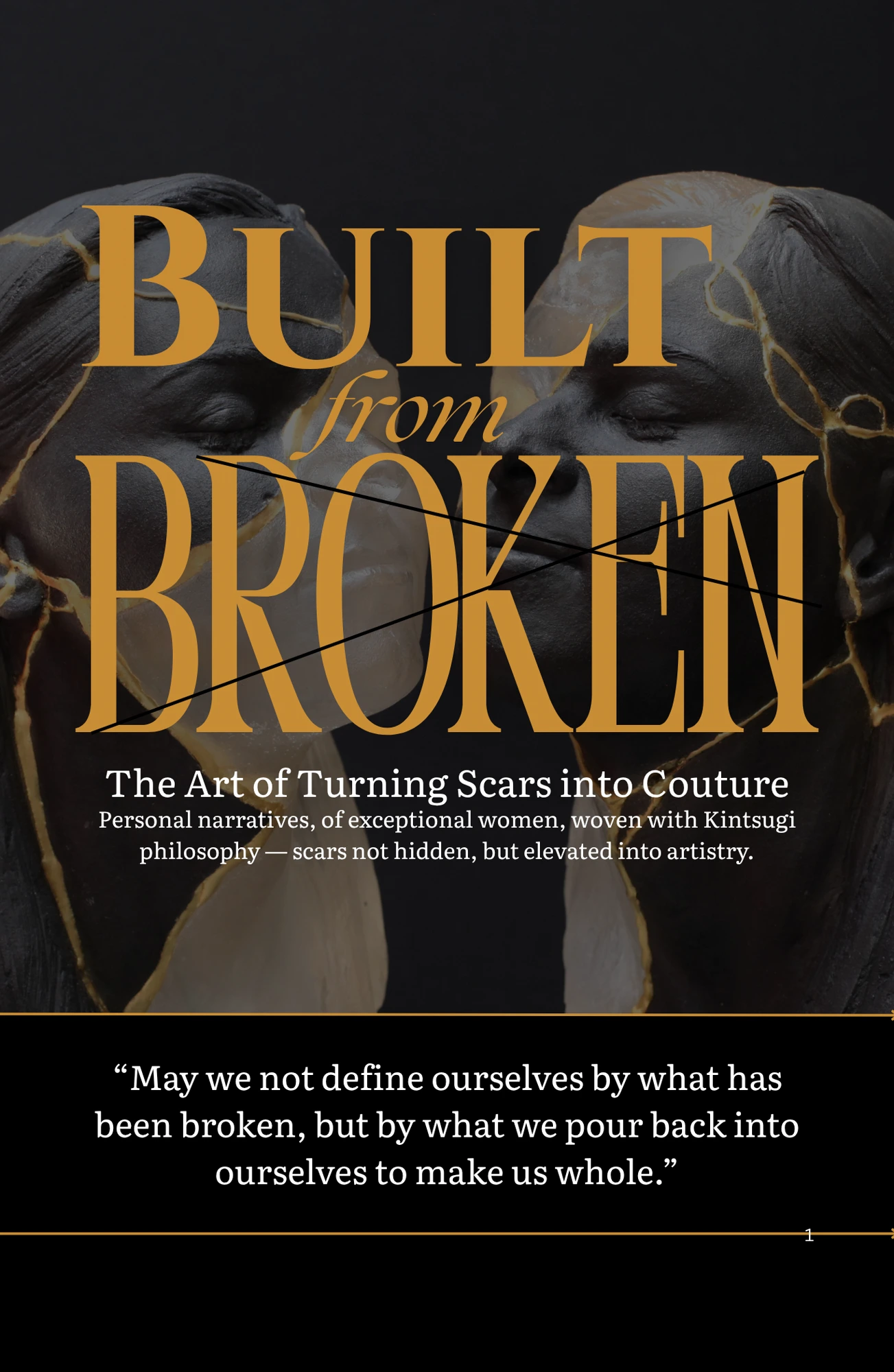
There is a particular kind of woman who has been broken — not merely bruised, but broken — and who has, in the years since, learned how to walk again. You know her when you meet her. She is not loud about it. She does not announce her survival or frame it in the language of triumph. She simply cannot be moved by trivial things. She has a stillness that is not passivity, a softness that is not weakness. She has been to a place most people only fear in the abstract, and she came back different. Not better, not worse — different. Built from broken.
The phrase "post-traumatic growth" entered the psychological literature in the mid-1990s, courtesy of researchers Richard Tedeschi and Lawrence Calhoun. It described something clinicians had observed but struggled to name: the phenomenon of people who, after profound suffering, did not merely recover but transformed. They reported deeper relationships, a greater appreciation for life, a sense of personal strength they had not possessed before. The research was careful, even cautious. It did not suggest that trauma was good, or necessary, or redemptive in any cosmic sense. It simply acknowledged that some people, under certain conditions, grew in its wake.
But the concept has been flattened in popular discourse, turned into something motivational, something you are supposed to aim for. As if growth were a guarantee, a reward for endurance. As if the women who do not grow have failed some moral test. The truth is more complicated, and far less tidy. Post-traumatic growth is not a return to the woman you were. It is the emergence of a woman who could not have existed without what happened. This is not a consolation prize. It is, for many, the truest self they have ever met.
The Architecture of Breaking
To be broken is not metaphorical. It is structural. The nervous system, that ancient and exquisitely sensitive network, is built to detect threat and organize response. When the threat is overwhelming — when it exceeds the body's capacity to fight or flee — the system does what it must: it fragments. Memory becomes nonlinear. Time collapses. The self, that coherent narrative we carry, splinters into before and after.
Bessel van der Kolk, in The Body Keeps the Score, describes trauma as a failure of integration. The event is not processed, not metabolized. It lives in the body as sensation, as startle, as a chronic hum of unsafety. The woman who has been broken knows this hum. She knows what it is to live in a body that no longer feels like home, to move through the world braced for the next rupture. She knows that healing is not about forgetting. It is about learning to hold the memory without being consumed by it.
The breaking can take many forms. Betrayal. Loss. Violence. Illness. The end of a marriage, a career, a version of the future that felt inevitable. What matters is not the event itself but the collapse of the world it precipitated. The shattering of the assumption that life is fair, that effort is rewarded, that love is enough. These are the foundational beliefs that organize a life. When they fall, everything falls.
And in the rubble, there is a choice — though it does not feel like a choice at the time. You can try to rebuild the same structure, or you can sit with the wreckage long enough to see what else might be possible.
“She is not rebuilt. She is re-made — in stronger materials, with better hinges.”
The Long Middle
There is no montage for this part. No time-lapse of the woman rising from the ashes, set to a soaring soundtrack. The middle is long and it is boring and it is often invisible. It is therapy sessions that feel like they go nowhere. It is mornings when getting out of bed is the day's only accomplishment. It is the slow, unglamorous work of learning to tolerate your own nervous system.
Neuroplasticity — the brain's capacity to reorganize itself — is real, but it is not fast. The pathways laid down by trauma are deep. They have been traveled many times. To build new pathways requires repetition, patience, and a kind of faith that feels irrational when you are in the thick of it. You have to practice safety when you do not feel safe. You have to practice trust when trust has been annihilated. You have to do this over and over, in small increments, until the new pathway is stronger than the old one.
Lisa Feldman Barrett, in How Emotions Are Made, argues that emotions are not reactions but predictions. The brain is constantly guessing what will happen next, based on past experience. The woman who has been broken is working with a prediction engine that has learned to expect disaster. Every neutral interaction is scanned for threat. Every moment of peace is provisional. The work is to teach the brain a different story. Not through logic — the brain does not care about logic — but through experience. Through enough moments of safety that the prediction begins to shift.
This is why the middle is so long. You are not just healing from what happened. You are rewriting the operating system.
The Emergence
And then, without announcement, something shifts. Not all at once. Not in a single moment of clarity. But gradually, over months or years, the woman realizes she is no longer who she was. She has different priorities. Different boundaries. A different relationship to time, to ambition, to the opinions of others. She has lost her tolerance for pretense. She can no longer perform enthusiasm for things that do not matter. She has become, in a word, essential.
This is not the same as being hard. She has not armored herself against the world. If anything, she is more permeable, more sensitive to beauty and grief and the strange tenderness of being alive. But she is no longer fragile. Fragility implies that breaking is the worst thing that can happen. She knows it is not. She has already broken. She knows she can survive it.
The built-from-broken woman moves through the world differently. She does not rush. She does not apologize for taking up space. She does not need you to understand her, though she is kind when you try. She has a quality that is hard to name — a groundedness, a gravity. She has been to the underworld and returned. She carries that knowledge in her body.
She is not interested in your inspiration porn. She is not here to make you feel better about your own suffering, or to prove that everything happens for a reason. She knows that some things happen for no reason at all, and that meaning is something you make, not something you find. She has made meaning. It cost her everything.
“Built-from-broken is a nervous system that has learned it can survive itself.”
The Paradox of Strength
The strength that comes from breaking is not the strength we are taught to admire. It is not loud or declarative. It does not announce itself. It is the strength of a tree that has survived a fire — scarred, asymmetrical, still standing. It is the strength of knowing that you are not in control, and that this is not a failure but a fact.
Western culture valorizes a particular kind of resilience: the ability to bounce back, to return to baseline, to keep going no matter what. But the built-from-broken woman has learned that bouncing back is not always possible, and not always desirable. Sometimes the baseline was the problem. Sometimes what looks like resilience is just denial in a more attractive package.
True strength, the kind that is forged in the aftermath of breaking, is the capacity to be changed by what happens to you. To let it reshape you. To allow the person you were to die so that the person you are becoming can live. This requires a kind of surrender that our culture mistakes for weakness. It is not. It is the hardest thing a person can do.
The built-from-broken woman has learned to hold paradox. She is both more vulnerable and more resilient. She is both softer and stronger. She has less patience for nonsense and more compassion for struggle. She knows that these things are not contradictions. They are the natural consequence of having lived through something that could have destroyed her, and choosing — again and again — to stay.
What She Knows About Safety
Safety, for the built-from-broken woman, is no longer about control. She has learned that you cannot control other people, or outcomes, or the future. You can only control your relationship to uncertainty. And so she has built a different kind of safety: one that lives inside her, independent of circumstance.
This is the gift of a nervous system that has been to the edge and returned. It knows its own capacity. It knows what it can tolerate, and what it cannot. It knows the difference between a real threat and an echo of an old one. It has learned to self-regulate, not perfectly, but well enough. Well enough to stay present. Well enough to choose.
She has also learned that safety is not the same as comfort. Comfort is the absence of discomfort. Safety is the presence of trust — in yourself, in your ability to handle what comes. The built-from-broken woman is not always comfortable. But she is, more often than not, safe. Because she has become her own secure base.
This does not mean she does not need other people. She does. But she needs them differently. She is not looking for someone to complete her, or fix her, or make her feel whole. She is whole. Scarred, yes. Changed, absolutely. But whole. She is looking for people who can meet her in that wholeness, who are not afraid of her depth, who do not need her to be smaller or quieter or easier.
The Quiet Authority
There is a particular authority that belongs to the woman who has been broken and rebuilt herself. It is not the authority of credentials or titles. It is the authority of lived experience. She speaks from the body, not from theory. She knows what she knows because she has lived it, in her cells, in her sleep, in the years it took to become someone who could hold her own story without flinching.
This authority is quiet. It does not need to be loud because it is not trying to convince you of anything. It simply is. And in a world that is constantly shouting, constantly performing certainty, this quietness is radical. It is a refusal to participate in the theater of confidence. It is a commitment to truth, even when truth is uncomfortable, even when it does not resolve neatly.
The built-from-broken woman has no interest in being palatable. She has spent too long contorting herself to fit other people's expectations. She has learned that the cost of being liked is often the loss of being known. And she would rather be known — by a few, by herself — than liked by many.
This is not bitterness. It is clarity. She has sorted through the wreckage and kept only what matters. Everything else has been burned away. What remains is essential: her values, her people, her work, her small daily practices of aliveness. She tends these things carefully. She does not take them for granted. She knows how quickly everything can be lost.
“She has become, in a word, essential.”
The Gift No One Asks For
To be clear: no one should have to break in order to become whole. The idea that suffering is necessary for growth is a dangerous one, often wielded by people who have not suffered, or who need to make sense of their own pain by turning it into a lesson. Trauma is not a gift. It is a violation. It is a theft. It takes things from you that you will never get back.
And yet. For some women, the person they became in the aftermath is someone they would not trade, even if they could undo what happened. This is the paradox that no one talks about. The simultaneous truth that you would give anything to not have gone through it, and that you would not give up who you are now. Both things are true. Both things can live in the same body.
The built-from-broken woman carries this paradox without needing to resolve it. She does not need her story to be tidy. She does not need it to have a moral. She has learned to live with ambiguity, with the both-and, with the knowledge that life is more complicated than any narrative can contain.
This is, perhaps, the deepest form of growth: the ability to hold complexity without collapsing into simplicity. To resist the pressure to make it all mean something. To let it be what it is — terrible and transformative, unbearable and survivable, the worst thing that ever happened and the beginning of a life you could not have imagined.
What She Carries Forward
The built-from-broken woman does not leave her past behind. She carries it with her, not as a burden but as a kind of ballast. It steadies her. It reminds her of what she is capable of. It informs her choices, her relationships, her work in the world. She is not defined by it, but she is shaped by it. There is a difference.
She has learned to honor both the woman she was and the woman she has become. She does not disavow her younger self, the one who did not yet know how to protect herself, who trusted the wrong people, who stayed too long. She has compassion for that woman. She knows she was doing the best she could with the tools she had. And she knows that the woman she is now exists because of her, not in spite of her.
She moves through the world with a peculiar softness, because she no longer has anything left to prove. She has already survived the unsurvivable. Everything else is extra. This does not make her reckless. If anything, it makes her more careful, more intentional. She knows how precious it all is — the ordinary days, the quiet mornings, the people who see her and stay.
She is not waiting for her life to begin. She is not waiting to be fixed, or saved, or validated. She is already here, already whole, already enough. She is built from broken, and she is standing.
The Recognition
You know her when you meet her. Not because she announces it, but because there is a quality to her presence that cannot be faked. A depth. A stillness. An ability to hold space for hard things without needing to fix them or flee from them. She has been to the bottom, and she knows the way back. She can sit with you in the dark because the dark does not frighten her anymore.
Other women who have been broken recognize her immediately. There is a wordless understanding, a nod across a room. They do not need to compare stories or compare scars. They know. They can feel it in each other — the particular gravity of having survived something that rewrote the terms of their lives.
And in that recognition, there is a kind of homecoming. Not to a place, but to a way of being. To a community of women who have learned that strength is not the absence of breaking, but the willingness to be remade. Who have learned that the truest version of yourself is often the one that emerges from the ruins. Who have learned that you do not have to be unbroken to be whole.
She is not rebuilt. She is re-made — in stronger materials, with better hinges. And she is here, standing in the wreckage and the beauty of a life that ended and a life that began, holding both, refusing to choose. This is what it means to be built from broken. This is what it looks like to survive yourself.
Before you go
Two quiet questions.
How much of what you just read named something you already know inside your own body?
How much did this open a new question you didn’t have before?
— End —
NirvaLife Magazine · November 2025