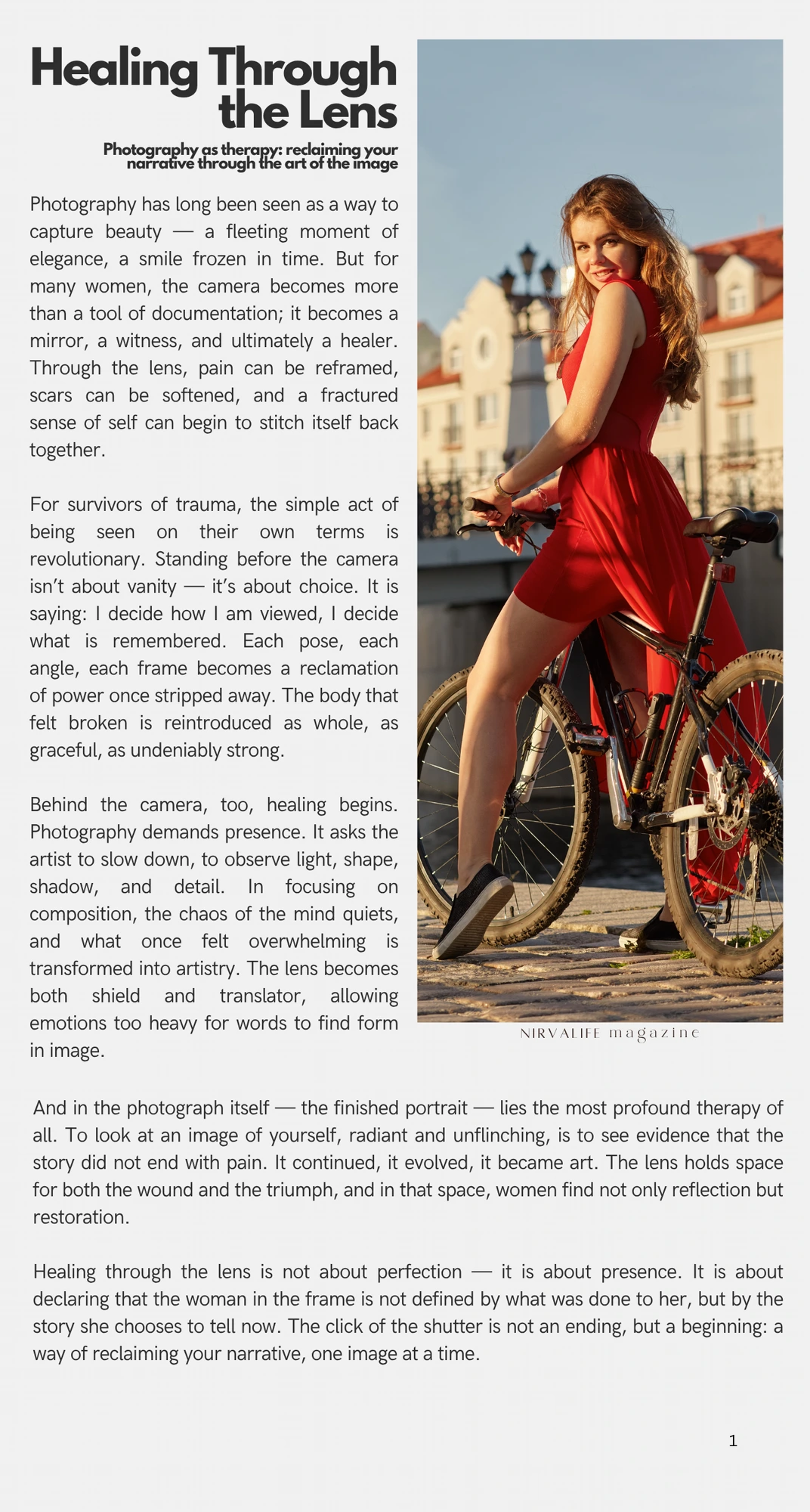
There is a moment, in every honest portrait, when the woman being photographed stops performing and simply is. Her shoulders drop half an inch. Her gaze softens or sharpens, but either way it becomes hers. That moment is not vanity. It is somatic. It is her nervous system agreeing, for a breath, to be seen.
I have been making portraits of women for nearly a decade, and I have learned to recognize that shift. It happens somewhere between the third and seventh frame. Before it, there is posture. After it, there is presence. The difference is measurable not in pixels but in breath.
To be photographed with care is to be told, without words, that you are worth looking at. For a woman who has spent decades editing herself for other people's comfort — shrinking in meetings, laughing at jokes that aren't funny, apologizing for taking up space — this is not a small thing. It is medicine.
The body keeps the score of invisibility
We know now, thanks to decades of research into trauma and the nervous system, that the body remembers what the mind tries to forget. Bessel van der Kolk's work has made this almost common knowledge: the body keeps the score. But what we talk about less is the quieter accumulation. Not trauma in the clinical sense, but the slow, steady message that you are too much or not enough. That your face is wrong. That your body is a problem to be managed.
This is not metaphor. The nervous system encodes these messages as surely as it encodes fear or safety. A woman learns to hold her stomach in without thinking. To angle her face just so. To never be caught unaware by a camera, because unaware means unguarded, and unguarded means vulnerable, and vulnerable means unsafe.
The lens, in this context, becomes another site of surveillance. Another place where she must perform acceptability. Another test she might fail.
But it does not have to be.
What the lens can do instead
The lens does not create you. It confirms that you were already there. This is the first principle of portraiture as a somatic practice: the camera is not a judge. It is a mirror, yes, but not the funhouse kind. It is a still surface. It reflects without distortion what is actually present.
When I photograph a woman, I am not trying to make her beautiful. I am trying to show her that she already is — not in the aspirational, Instagram-filter sense, but in the way that a tree is beautiful. Because it exists. Because it is itself.
“The camera is not a judge. It is a still surface that reflects without distortion what is actually present.”
This requires a different kind of looking. In her book On Photography, Susan Sontag wrote about the camera as a tool of possession, a way of controlling what we see. But it can also be a tool of release. A way of saying: I see you, and you do not need to do anything about it. You do not need to fix your hair or suck in your breath or smile if you do not feel like smiling.
The women who sit for me are not models. They are architects and teachers and mothers and writers. They are in their thirties and fifties and seventies. They come because someone told them about the work, or because they saw a portrait that looked like rest instead of performance, and they wanted to know what that felt like.
The session itself
We do not rush. The session is two hours, though we rarely use all of it. I do not play music. I do not direct much. I ask her to sit, to stand, to look toward the window. I ask her what feels comfortable. I tell her when I am about to press the shutter, so her body is not startled by the sound.
These are small things, but they matter. The nervous system is always listening. It is always asking: Am I safe here? Can I let down my guard? The answer comes not from what I say but from what I do. From the pace of my voice. From the fact that I do not fill the silence with chatter. From the way I move slowly and do not crowd her space.
Polyvagal theory, articulated by Stephen Porges, teaches us that safety is not a cognitive decision. It is a physiological state. The ventral vagal system — the part of our autonomic nervous system responsible for social engagement and calm — comes online only when the body perceives safety. And the body perceives safety through cues: tone of voice, facial expression, the rhythm of another person's breathing.
I cannot make a woman feel safe by telling her she is safe. I can only offer the conditions. And then wait.
The moment of shift
It happens differently for everyone. For some women, it is a sigh. For others, a laugh that is not performed but genuine. For others still, it is tears — not sad tears, but the kind that come when something clenched finally lets go.
One woman told me afterward that she had not realized she was holding her shoulders up near her ears until they dropped. Another said she felt, for the first time in years, that her face belonged to her. Not to her husband, not to her children, not to the men who had commented on it since she was twelve. Hers.
This is the somatic piece. The body learning, in real time, that it is allowed to be seen without being evaluated. That presence does not require performance. That she can take up space in the frame — in the room, in the world — and nothing bad will happen.
“The body learning, in real time, that it is allowed to be seen without being evaluated.”
Lisa Feldman Barrett, in How Emotions Are Made, describes the brain as a prediction machine. It is constantly running simulations based on past experience, trying to guess what will happen next. If a woman's past experience with being looked at has been objectification, criticism, or dismissal, her brain will predict more of the same. Her body will brace for it.
But when the prediction is wrong — when she is looked at with care instead of judgment — the brain updates its model. Slowly. One data point at a time.
Not for the internet
Here is where this work diverges from almost everything else happening with cameras right now. The portraits I make are not for Instagram. They are not for LinkedIn or dating apps or holiday cards. They are not for anyone but the woman herself.
I give her the images on a USB drive. I do not post them. I do not keep copies unless she asks me to. What she does with them is entirely her choice, but I encourage her to keep them private. To put one in a drawer, or frame one in a room where only she goes. To let it be a secret between her and herself.
This feels radical, and maybe it is. We live in an age of relentless display. The self has become a brand. The face has become content. To make an image and then not share it, not monetize it, not seek validation for it — this runs counter to everything we are taught about visibility.
But the point is not visibility. The point is witness.
Witness, not vanity
There is a long history of dismissing women's self-regard as vanity. Narcissus was a man, but it is women who are called vain for wanting to be seen. For caring about how they look. For taking up space in the visual field.
This work is not vanity. It is the opposite. Vanity is the performance of desirability for an external audience. This is the quiet, private act of looking at yourself and saying: I am here. I exist. I am worth my own attention.
The writer and philosopher Simone Weil wrote about attention as a form of prayer. To pay attention to something — truly, without agenda — is to honor it. To see it as it is, not as you wish it to be.
When a woman looks at her own portrait with that kind of attention, she is not admiring herself. She is meeting herself. And for many women, this is the first time.
“When a woman looks at her own portrait with that kind of attention, she is not admiring herself. She is meeting herself.”
The quiet work it does
I do not ask the women what they do with the images after they leave. But some tell me anyway. One keeps hers in a wooden box with her grandmother's letters. Another framed hers and hung it in her closet, where she sees it every morning while getting dressed. Another said she looks at hers on hard days, when she feels erased, to remind herself that she is solid. That she takes up space.
The work the image does is not dramatic. It does not fix anything. It does not undo decades of conditioning or erase the internalized male gaze or suddenly make a woman immune to the world's judgments.
But it offers something. A small, steady counterpoint. A piece of evidence that she exists outside of other people's needs. That her face, her body, her presence — these are not problems to be solved. They are facts. They are enough.
In somatic therapy, there is a concept called resourcing. It means finding something — a memory, a place, a sensation — that the body recognizes as safe. Something the nervous system can return to when it is overwhelmed. The portrait, for some women, becomes a resource. Not because it is flattering, but because it is true.
What I have learned
I did not set out to do therapeutic work. I set out to make pictures. But over time, I began to notice the pattern. The way women would cry, or laugh, or sit very still and say nothing for a long time. The way they would email me weeks later to say the session had shifted something they could not quite name.
I began to read about the nervous system. About trauma and attachment and the ways the body holds what the mind cannot process. I began to understand that what I was doing was not separate from that work. It was part of it.
The camera, in the right hands, can be a tool of repair. Not because it changes anything about the woman in front of it, but because it reflects her back to herself without distortion. Without demand. Without the need for her to be anything other than what she is.
I have also learned that this work is not for everyone. Some women are not ready. Some do not want to be seen, even gently. Some need to stay hidden a little longer, and that is okay. There is no moral imperative to be visible. But for those who are ready, the lens can be a doorway.
An invitation, not a prescription
This series is not a call to action. It is not a directive to go get your portrait taken, to post more selfies, to reclaim your image in some performative way. It is simply an offering. A suggestion that the camera does not have to be what it has been.
If you have spent your life avoiding the lens, or performing for it, or hating what you see in the frame — there is another way. It requires a different kind of photographer. A different kind of looking. A different relationship to the image itself.
It requires you to believe, even for an hour, that you are worth looking at. Not because you have earned it or because you look a certain way, but because you are here. Because you exist. Because your face is the map of your life, and that life is worth witnessing.
“Your face is the map of your life, and that life is worth witnessing.”
The portrait will not change your life. But it might change the way you see yourself. And that, in the end, is enough.
Coda
I keep one photograph from each session. Not of the woman, but of the room after she has left. The chair still holding the shape of her weight. The light coming through the window at the same angle. The air still warm.
I do this to remind myself that the work is not about the image. It is about the moment. The breath. The shift. The quiet agreement between a woman and her own nervous system that, for now, she is safe. She is seen. She is enough.
The lens does not create you. It confirms that you were already there.
Before you go
Two quiet questions.
How much of what you just read named something you already know inside your own body?
How much did this open a new question you didn’t have before?
— End —
NirvaLife Magazine · November 2025