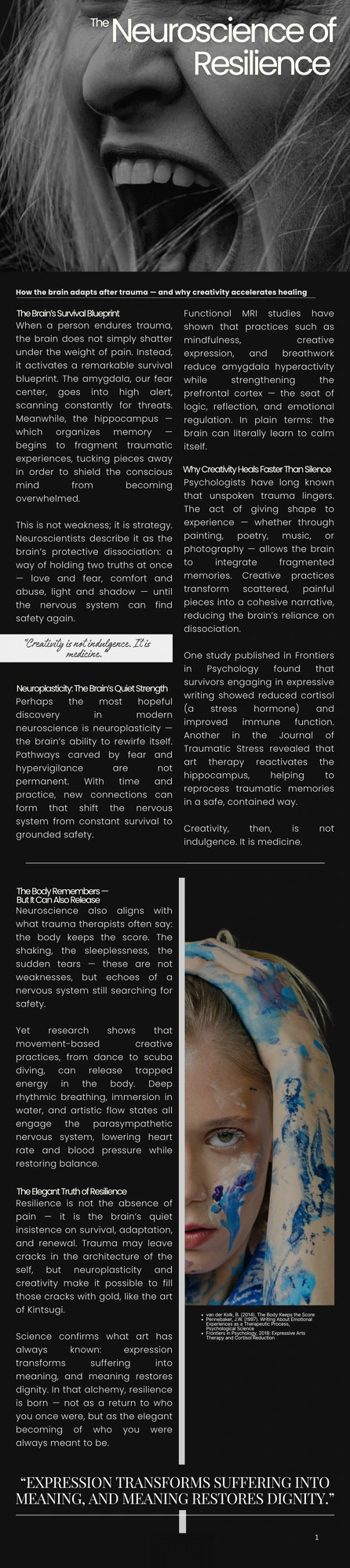
When a person endures trauma, the brain does not simply shatter under the weight of pain. Instead, it activates a remarkable survival blueprint — one written in neural code, refined over millennia, and designed to protect the self even when the world has failed to do so. This is not a story of breaking. It is a story of adaptation, of the nervous system's quiet insistence on continuity even in the face of rupture. What neuroscience reveals about trauma is both humbling and hopeful: the brain that fragments under duress is the same brain that can, with time and the right conditions, weave itself back together. And in that weaving, creativity plays a role more profound than we once understood.
The Brain's Survival Blueprint
The amygdala, our fear center, goes into high alert the moment it perceives danger. It scans constantly for threats, real or imagined, and floods the body with stress hormones. This is the brain's oldest alarm system, honed long before language, before culture, before we had words for what we felt. It does not distinguish between a predator in the wild and a predator in the home. It simply responds.
Meanwhile, the hippocampus — which organizes memory into coherent narratives — begins to fragment traumatic experiences. It tucks pieces away, scattering them across the neural landscape in order to shield the conscious mind from becoming overwhelmed. This is why trauma survivors often describe their memories as disjointed, incomplete, or arriving in flashes rather than full scenes. The brain is not failing. It is strategizing.
Neuroscientists describe this as protective dissociation: a way of holding two truths at once — love and fear, comfort and abuse, light and shadow — until the nervous system can find safety again. It is not weakness. It is survival architecture, built in real time, under conditions no one should have to endure.
But survival, while necessary, is not the same as healing. The brain that learns to live in constant vigilance pays a price. Sleep becomes fractured. The body holds tension it cannot name. Ordinary moments — a raised voice, a slammed door, a certain scent — can trigger cascades of fear that feel disproportionate to the present. This is not irrationality. It is memory, encoded in the body, speaking a language the conscious mind has yet to translate.
Neuroplasticity: The Brain's Quiet Strength
Perhaps the most hopeful discovery in modern neuroscience is neuroplasticity — the brain's ability to rewire itself. Pathways carved by fear and hypervigilance are not permanent. With time, intention, and practice, new connections can form that shift the nervous system from constant survival to grounded safety. The brain that learned to fear can also learn to rest.
This is not a quick process. Neuroplasticity requires repetition, patience, and often the support of others. But the evidence is clear: the adult brain retains a remarkable capacity for change. Synapses strengthen or weaken based on use. Neural networks reorganize. What was once automatic — the flinch, the shutdown, the flood of panic — can become less so. Not erased, but softened. Not forgotten, but integrated.
As Lisa Feldman Barrett describes in How Emotions Are Made, the brain is not a passive receiver of experience but an active predictor, constantly generating models of what might happen next based on what has happened before. Trauma skews those predictions toward danger. Healing, then, involves teaching the brain new predictions — ones rooted in safety, connection, and possibility rather than threat.
“Creativity is not indulgence. It is medicine.”
Why Creativity Heals Faster Than Silence
Psychologists have long known that unspoken trauma lingers. The act of giving shape to experience — whether through painting, poetry, music, or photography — allows the brain to integrate fragmented memories. Creative practices transform scattered, painful pieces into a cohesive narrative, reducing the brain's reliance on dissociation and allowing the hippocampus to do what it does best: organize, contextualize, and store.
Functional MRI studies have shown that practices such as mindfulness, creative expression, and breathwork reduce amygdala hyperactivity while strengthening the prefrontal cortex — the seat of logic, reflection, and emotional regulation. In plain terms: the brain can literally learn to calm itself. The more we engage the prefrontal cortex in deliberate, meaning-making activities, the more we build neural infrastructure for resilience.
One study published in Frontiers in Psychology found that survivors engaging in expressive writing showed reduced cortisol — a stress hormone — and improved immune function. Another in the Journal of Traumatic Stress revealed that art therapy reactivates the hippocampus, helping to reprocess traumatic memories in a safe, contained way. The act of creation, it seems, is also an act of repair.
Creativity, then, is not indulgence. It is medicine. It is the nervous system's way of speaking when words fail, of organizing chaos into form, of reclaiming agency in a world that once felt uncontrollable. To paint is to say: I was here. To write is to say: this happened, and I survived it. To dance is to say: my body is mine again.
The Body Remembers — But It Can Also Release
Neuroscience also aligns with what trauma therapists often say: the body keeps the score. The shaking, the sleeplessness, the sudden tears — these are not weaknesses, but echoes of a nervous system still searching for safety. Trauma is stored not only in memory but in muscle, in breath, in the very rhythm of the heart.
Yet research shows that movement-based creative practices, from dance to scuba diving, can release trapped energy in the body. Deep rhythmic breathing, immersion in water, and artistic flow states all engage the parasympathetic nervous system — the branch responsible for rest, digestion, and recovery. Heart rate lowers. Blood pressure stabilizes. The body, at last, receives the message: you are safe now.
Bessel van der Kolk, in The Body Keeps the Score, describes how trauma survivors often feel disconnected from their own bodies, as if they are observing themselves from a distance. Movement and creativity help restore that connection, allowing people to inhabit their bodies again — not as sites of pain, but as sources of sensation, pleasure, and agency.
This is why practices like somatic experiencing, dance therapy, and even martial arts can be so effective. They do not bypass the body in favor of the mind. They honor the body as a participant in healing, as a keeper of wisdom the conscious mind has yet to access.
The Role of Safety and Connection
Neuroplasticity and creativity are powerful, but they do not operate in a vacuum. The brain heals best in the presence of safety and connection. Stephen Porges's polyvagal theory describes how the nervous system is constantly assessing cues of safety or danger in the environment — a process he calls neuroception. When the nervous system detects safety, it can shift out of survival mode and into a state where healing becomes possible.
This is why relationships matter so deeply in trauma recovery. A trusted therapist, a compassionate friend, a creative community — these are not luxuries. They are neural necessities. The brain that learned to fear in isolation often needs to relearn safety in connection. We are, as neuroscience confirms, profoundly social creatures. Our nervous systems co-regulate with those around us.
Creative practices, when shared, amplify this effect. A writing group, a choir, a pottery class — these spaces offer not only the healing power of creativity but also the healing power of witness. To be seen in one's vulnerability, to have one's story received with care, is itself a form of repair.
“Resilience is not the absence of pain — it is the brain's quiet insistence on survival, adaptation, and renewal.”
What Resilience Actually Looks Like
Resilience is not the absence of pain. It is not the ability to bounce back as if nothing happened. It is not stoicism or silence or the performance of being fine. Resilience is the brain's quiet insistence on survival, adaptation, and renewal — even when the path forward is unclear, even when the wounds are still fresh.
Trauma may leave cracks in the architecture of the self, but neuroplasticity and creativity make it possible to fill those cracks with gold, like the Japanese art of Kintsugi. The bowl that has been broken and mended is not the same as it was before. It is more beautiful, more honest, more itself. So too with the human nervous system.
Resilience is waking up and choosing, again, to engage with life. It is the small acts of courage that no one else sees: getting out of bed, making tea, writing a single sentence, taking a walk. It is the willingness to feel, even when feeling hurts. It is the decision to create, even when creation feels impossible.
And it is, perhaps most importantly, the recognition that healing is not linear. There will be setbacks. There will be days when the old fear returns, when the body tenses, when the mind spirals. This is not failure. This is the nervous system doing what it knows how to do. The work is not to eliminate those moments but to meet them with compassion, to remind the brain: we are safe now. We are learning. We are becoming.
The Neuroscience of Meaning-Making
One of the most profound insights from recent neuroscience is that the brain does not simply record experience — it interprets it. Meaning is not inherent in events; it is constructed by the mind. This is why two people can endure similar traumas and emerge with vastly different narratives. One may see themselves as broken; another may see themselves as a survivor. The difference is not in the trauma itself but in the story the brain tells about it.
Creativity accelerates this process of meaning-making. When we write, paint, or compose, we are not just expressing what happened — we are actively shaping how we understand it. We are taking the raw material of experience and transforming it into something coherent, something bearable, something that can be integrated into the larger story of who we are.
This is why narrative therapy, expressive arts therapy, and even memoir writing can be so powerful. They engage the brain's natural drive to make sense of the world. They give the hippocampus a framework for organizing fragmented memories. They allow the prefrontal cortex to step in and say: this is what happened, this is what it meant, and this is who I am now.
Science confirms what art has always known: expression transforms suffering into meaning, and meaning restores dignity. In that alchemy, resilience is born — not as a return to who you once were, but as the elegant becoming of who you were always meant to be.
The Long View
Healing from trauma is not a project with a clear endpoint. It is a practice, a process, a way of being in the world. The brain will continue to adapt, to rewire, to surprise you with its capacity for change. There will be moments of grace and moments of struggle, and both are part of the same journey.
What neuroscience offers is not a cure but a map. It shows us where the brain gets stuck and how it can become unstuck. It reveals the mechanisms by which fear takes root and the mechanisms by which safety can be restored. It reminds us that we are not at the mercy of our past — that the nervous system, for all its complexity, is also remarkably responsive to care.
And it affirms what survivors have always known: that creativity is not a luxury but a lifeline. That the act of making something — anything — is an act of defiance against the forces that sought to unmake you. That the brain that learned to survive can also learn to thrive.
“Expression transforms suffering into meaning, and meaning restores dignity.”
The Elegant Truth of Resilience
There is an elegance to resilience that is easy to miss. It is not loud or dramatic. It does not announce itself. It is the quiet work of neurons forming new connections, of the prefrontal cortex learning to soothe the amygdala, of the body slowly releasing what it has held for so long. It is the decision, made again and again, to stay present even when presence is painful.
Resilience is the brain's refusal to be defined by its worst moments. It is the nervous system's insistence that adaptation is always possible, that change is always within reach. It is the recognition that trauma may have shaped you, but it does not have to limit you. That the cracks in your architecture are not flaws but evidence of survival, and that survival, in itself, is a form of grace.
In the end, the neuroscience of resilience is also a story about hope. Not the shallow, performative kind, but the deep, embodied kind — the kind that lives in the body, in the breath, in the slow rewiring of the brain. It is the hope that says: you are not broken. You are adapting. And in that adaptation, there is beauty, there is strength, and there is the possibility of becoming whole again.
The brain that endures trauma is the same brain that can heal from it. The nervous system that learned to fear is the same nervous system that can learn to rest. And the person who survived is the same person who can, with time and care and creativity, become not who they once were, but who they were always meant to be. That is the elegant truth of resilience. That is the quiet, enduring promise of the human brain.
Before you go
Two quiet questions.
How much of what you just read named something you already know inside your own body?
How much did this open a new question you didn’t have before?
— End —
NirvaLife Magazine · November 2025
Part of the Nirva Life Educational Ecosystem
A chapter of a larger framework.
This article is one page in the ongoing study of Nervous System Intelligence — the interdisciplinary field that examines how the nervous system continuously gathers information, predicts meaning, coordinates physiology, and constructs lived experience. Every piece across the Nirva Life library rests on the definitions and principles articulated in The Founding Manifesto (v1.0).
Founding Document
Read the Founding Manifesto →
Cornerstone Model
The Four Perspectives →
From Framework to Practice
Enter the NIRVA Method →
Explore Further
Enter the Gateway Library →
Part of the Nirva Life educational ecosystem — advancing the field of Nervous System Intelligence™.