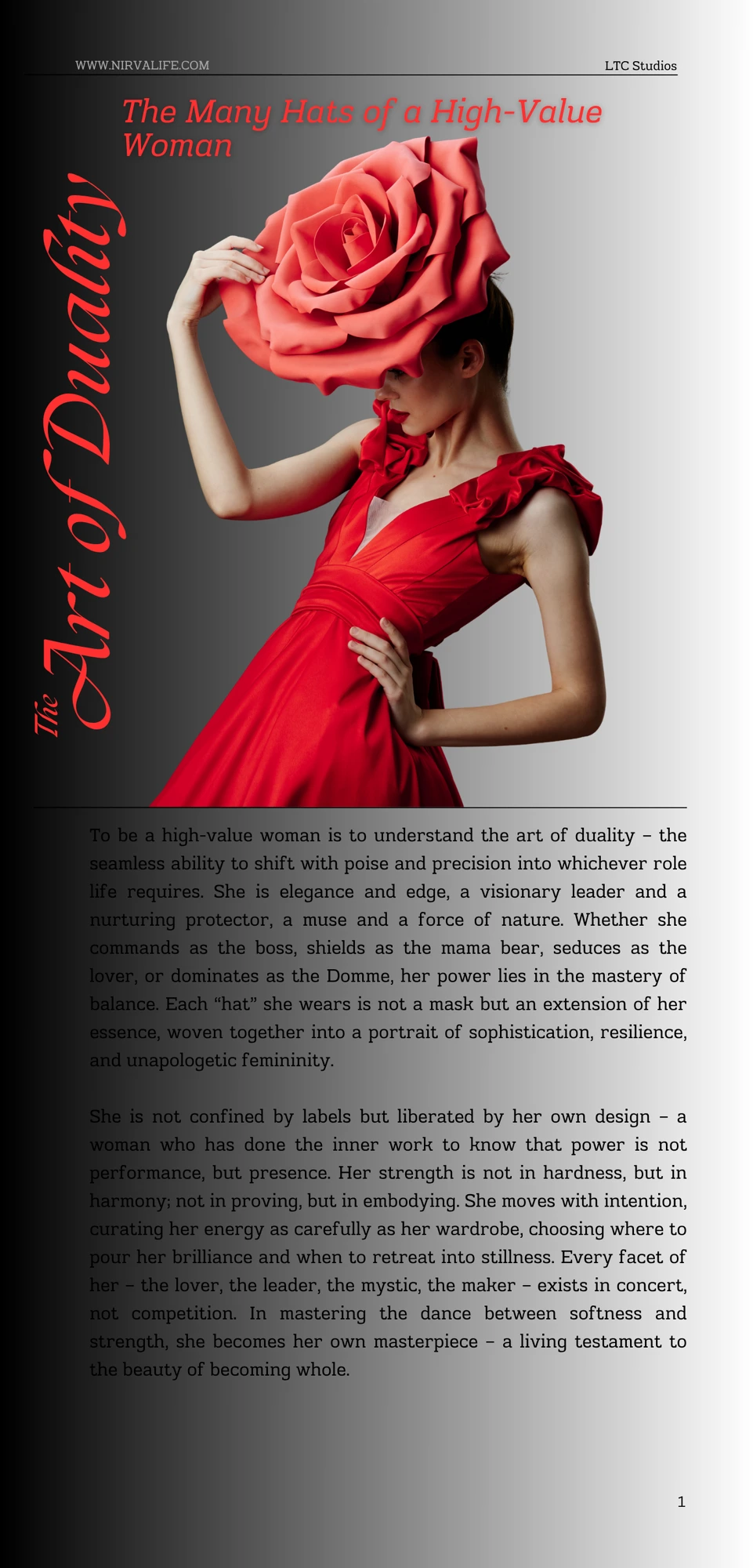
There is a particular kind of woman who moves through the world with a quality that resists easy description. She is neither soft nor hard, neither yielding nor unyielding. She is both. She can hold a boardroom with the same presence she brings to a child's bedside at midnight. She can seduce and strategize, nurture and negotiate, all without fracturing into pieces. This is not code-switching. This is not performance. This is the art of duality — the capacity to inhabit multiple truths at once, to be soft and formidable in the same room, in the same breath, in the same life.
We live in a culture that prefers its women legible. Pick a lane, we are told. Be the boss or the mother. Be the seductress or the intellectual. Be powerful or be loved. The binary is everywhere, encoded in the advice we receive, the archetypes we inherit, the stories we tell about what it means to be a woman who matters. But the women who move with the most grace, the most gravity, are the ones who have quietly refused this logic. They understand that wholeness is not a compromise. It is a composition.
Duality is not about splitting oneself into roles. It is about integration. It is the recognition that the same woman who closes a deal with surgical precision can also surrender to pleasure without shame. That the same hands that discipline can also soothe. That authority and tenderness are not opposites but partners in a more complex dance. The art lies not in choosing which self to be, but in knowing when and how to let each facet come forward — and in trusting that none of them diminish the others.
The Myth of the Monolith
For much of modern history, women have been asked to flatten themselves into singular identities. The professional woman was told to leave her femininity at the door. The mother was expected to dissolve into selflessness. The lover was not supposed to have ambition. Each role came with its own set of permissions and prohibitions, its own narrow corridor of acceptable behavior. To step outside was to risk being called too much or not enough — often in the same day.
This mythology of the monolith served a purpose. It made women easier to categorize, easier to manage, easier to predict. But it also made us smaller. It taught us that complexity was a liability, that contradiction was weakness, that the only way to be taken seriously was to excise the parts of ourselves that didn't fit the narrative. And so we learned to hide. We learned to compartmentalize. We learned to perform coherence even when it cost us our wholeness.
But something has shifted. Perhaps it is generational. Perhaps it is cultural. Perhaps it is simply exhaustion with the old scripts. More women are beginning to ask a different question: What if I didn't have to choose? What if the fullness of who I am — the contradictions, the multiplicities, the refusal to be just one thing — is not a problem to solve but a power to claim?
“Duality is not about splitting oneself into roles. It is about integration.”
The Many Hats, the Single Self
Consider the metaphor of the hat. A woman might wear many: the executive, the mother, the lover, the friend, the creator, the caretaker. Each hat comes with its own expectations, its own emotional register, its own way of being in the world. But the woman beneath them does not change. She is not performing a series of disconnected characters. She is expressing different dimensions of a coherent self.
This is where the art comes in. It is one thing to acknowledge that we contain multitudes. It is another to move fluidly between them without losing the thread of who we are. The woman who has mastered duality does not experience her many roles as fragmentation. She experiences them as facets of a single, luminous whole. She knows that the fierceness she brings to protecting her children is the same fierceness that fuels her ambition. That the vulnerability she offers in intimacy is the same vulnerability that makes her leadership compelling. That her capacity for discipline and her capacity for pleasure are not at odds — they are expressions of the same underlying sovereignty.
This kind of integration requires inner work. It requires knowing yourself well enough to understand which parts of you are essential and which are borrowed. It requires the courage to let go of the roles you've outgrown, even when they once kept you safe. And it requires a kind of radical self-trust — the belief that you can be many things without becoming nothing.
Softness as Strategy
One of the most radical acts a woman can perform in a world that equates power with hardness is to remain soft. Not weak. Not passive. But soft — open, receptive, attuned. Softness, in this context, is not the opposite of strength. It is a form of strength that our culture has not yet learned to value properly.
Softness allows for nuance. It allows for change. It allows for connection in a way that rigidity cannot. The woman who can be soft in the right moments — who can listen without defensiveness, who can yield without collapsing, who can hold space for another's pain without making it about her own — wields a kind of power that is often invisible but deeply felt. She does not need to dominate to lead. She does not need to harden to protect. She understands that influence is not always loud.
But softness without boundaries is not duality. It is self-erasure. The art lies in knowing when to soften and when to sharpen. When to open and when to close. When to receive and when to assert. This is not a formula. It is a practice, honed over years of paying attention to what works, what costs too much, what feels true.
“Softness allows for nuance. It allows for change. It allows for connection in a way that rigidity cannot.”
The Lover and the Leader
Nowhere is the tension of duality more visible than in the intersection of eroticism and authority. We are still, as a culture, uncomfortable with the idea that a woman can be both sexually alive and professionally serious. That she can command respect in a meeting and desire surrender in the bedroom. That her power in one domain does not cancel out her power in the other.
But the woman who has done the work of integration knows that these are not separate selves. The confidence that allows her to lead is the same confidence that allows her to ask for what she wants in intimacy. The presence that makes her compelling in public is the same presence that makes her magnetic in private. She does not compartmentalize her sexuality as something to be hidden or managed. She understands it as part of the same life force that animates everything she does.
This does not mean performing sexuality for an audience. It means inhabiting it fully, without shame or apology. It means refusing the old story that says a woman must choose between being taken seriously and being desired. It means understanding that desire — hers, not just others' — is a form of intelligence, a way of knowing what she wants and moving toward it with intention.
The lover and the leader are not at odds. They are collaborators. One teaches the other about risk, about presence, about the courage it takes to be fully seen. Together, they create a woman who is neither performing power nor performing desirability, but simply living in the fullness of both.
The Mama Bear and the Mystic
There is a particular ferocity that comes with caregiving. The mother who will move mountains to protect her child. The friend who will show up at three in the morning. The woman who holds space for others' grief even when her own is unprocessed. This is the mama bear — fierce, protective, willing to sacrifice. And it is a role that women know intimately, whether or not they have children.
But the mama bear, left unchecked, can consume everything. She can forget that she, too, needs tending. She can mistake exhaustion for virtue. She can lose herself in the needs of others and call it love. This is where the mystic comes in — the part of the self that knows how to retreat, how to listen inward, how to honor the quiet. The mystic is not interested in productivity. She is interested in presence. She knows that stillness is not laziness. She knows that rest is not weakness. She knows that a woman who does not tend to her own inner life will eventually have nothing left to give.
The art of duality, here, is in the balance. The mama bear and the mystic need each other. One without the other becomes either martyrdom or isolation. Together, they create a woman who can give deeply without depleting herself, who can care for others without abandoning her own soul.
The Domme and the Muse
There is a particular kind of power in the archetype of the Domme — not in the narrow, fetishized sense, but in the broader understanding of a woman who knows what she wants and is unafraid to direct the energy in the room. She does not wait for permission. She does not soften her edges to make others comfortable. She takes up space, sets the terms, holds the reins. This is not cruelty. It is clarity. It is the refusal to pretend she does not have preferences, boundaries, desires of her own.
And yet, the same woman can be a muse — a source of inspiration, beauty, mystery. She can be the one who sparks creativity in others, who holds a kind of magnetic presence that invites projection, admiration, longing. The muse is not passive. She is not an object. She is a woman who understands the power of being seen, who knows that her presence alone can shift the energy of a room, a relationship, a moment.
The duality here is subtle but profound. The Domme is about assertion. The muse is about allure. One is direct. The other is oblique. But both are forms of power, and the woman who can move between them — who can command and enchant, who can be both the subject and the object of desire — is operating at a level of sophistication that most people never reach.
“She does not wait for permission. She does not soften her edges to make others comfortable.”
The Inner Work of Wholeness
None of this happens by accident. The woman who embodies duality with grace has done the work. She has spent time in the uncomfortable territory of self-examination. She has asked herself hard questions about who she is when no one is watching, what she wants when she strips away the shoulds, where her power actually lives versus where she has been performing it.
This work is not linear. It does not have a finish line. It is the ongoing practice of paying attention — to the moments when you feel most alive, most aligned, most yourself. To the moments when you feel like you are playing a part. To the places where your many selves are in harmony and the places where they are at war. It is the practice of integration, of bringing the disparate pieces into conversation with each other rather than keeping them in separate rooms.
It also requires letting go. Letting go of the roles that no longer fit. Letting go of the identities you built to survive but no longer need. Letting go of the idea that you must be consistent, predictable, easy to understand. The woman who has mastered duality is not interested in being easy. She is interested in being whole.
And wholeness, it turns out, is not about having it all together. It is about having access to all of yourself — the light and the shadow, the soft and the sharp, the sacred and the profane. It is about refusing to amputate the parts of you that make others uncomfortable. It is about trusting that the fullness of who you are is not too much. It is exactly enough.
The Living Masterpiece
In the end, the art of duality is not about perfection. It is about presence. It is about showing up as all of who you are, in whatever configuration the moment requires, without apology or explanation. It is about understanding that you are not a fixed thing but a living, breathing work of art — always in process, always evolving, always becoming.
The woman who lives this way does not need external validation to know her worth. She does not need to be understood by everyone. She has done the work of understanding herself, and that is enough. She moves through the world with a kind of quiet authority that does not demand attention but commands it anyway. She is soft when it serves her. She is formidable when it matters. She is both, and she is neither, and she is everything in between.
She is not confined by labels but liberated by her own design. She is the lover and the leader, the mama bear and the mystic, the Domme and the muse. She is all of it, and she is none of it, because she has transcended the need to be any one thing. She has become, instead, a living testament to the beauty of becoming whole.
This is the art of duality. Not a trick. Not a performance. But a way of being in the world that honors the full spectrum of what it means to be human, to be female, to be alive. It is the refusal to shrink. The courage to expand. The wisdom to know that you do not have to choose between softness and strength, because you were always meant to hold both.
Before you go
Two quiet questions.
How much of what you just read named something you already know inside your own body?
How much did this open a new question you didn’t have before?
— End —
NirvaLife Magazine · November 2025