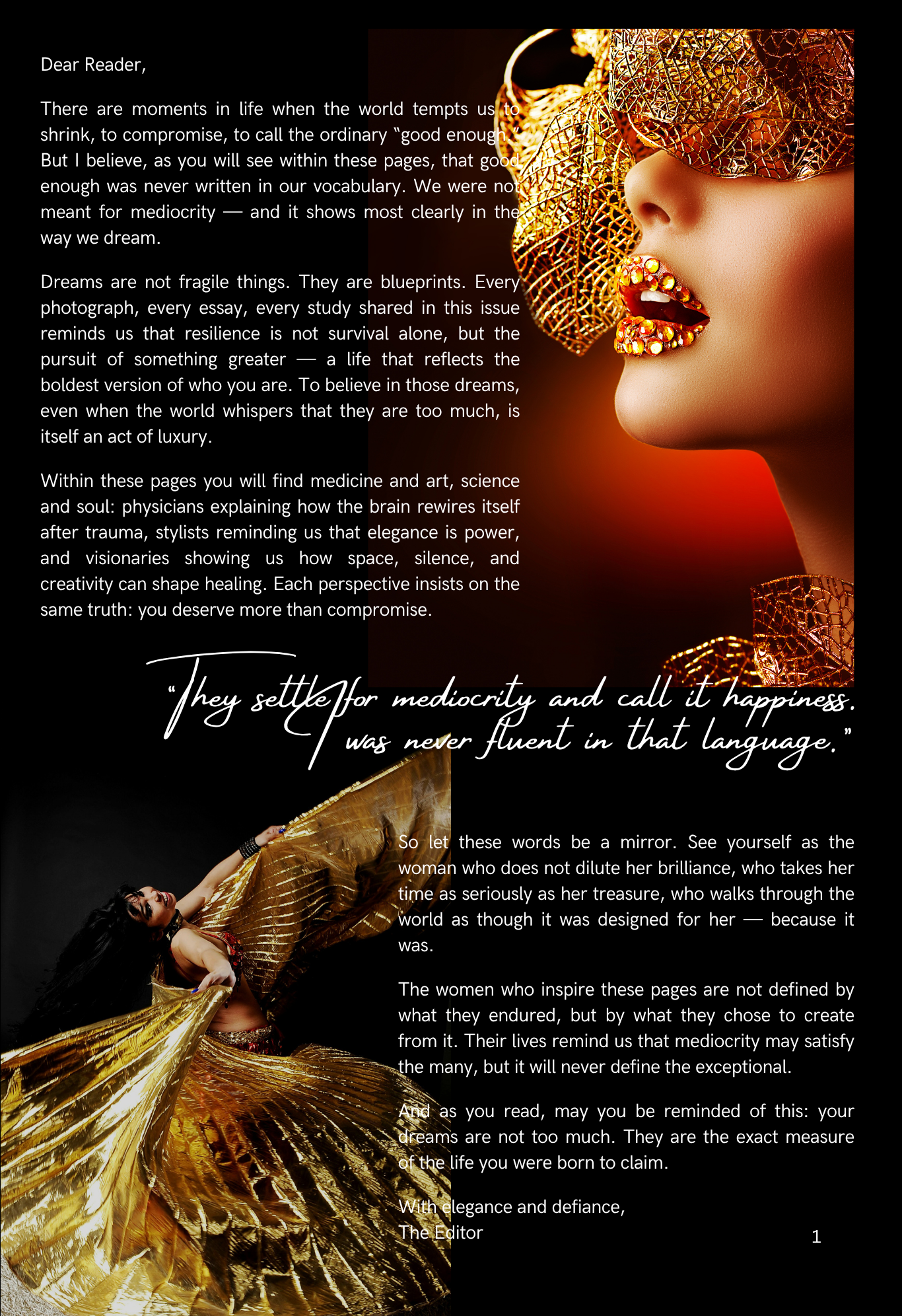
Dear Reader, there are moments in life when the world tempts us to shrink, to compromise, to call the ordinary good enough. You know these moments. They arrive quietly, dressed in practicality. A voice — sometimes external, sometimes your own — suggests that perhaps the dream is too large, the ambition too sharp, the vision too vivid for the life you are meant to live. But I believe, as you will see within these pages, that good enough was never written in our vocabulary. We were not meant for mediocrity, and it shows most clearly in the way we dream.
This issue of Nirva Life is a manifesto for those who refuse to dilute their brilliance. It is for the woman who has been told she wants too much, feels too deeply, expects too grandly. It is for anyone who has ever looked at their own desires and wondered if they were permitted to pursue them without apology. The answer, I hope you will find here, is yes.
We live in a culture that valorizes resilience but rarely interrogates what resilience is for. Survival alone is not the goal. Endurance without direction is simply exhaustion by another name. What we are after is something else entirely: a life that reflects the boldest version of who you are. To believe in those dreams, even when the world whispers that they are too much, is itself an act of luxury.
The Architecture of Ambition
Dreams are not fragile things. They are blueprints. They carry within them the structural integrity of what we know, deep in our nervous systems, to be true about ourselves. When a child imagines herself as an architect, a surgeon, a writer, she is not indulging in fantasy. She is recognizing a pattern, a set of capacities, a way of moving through the world that her body already understands.
Neuroscientist Lisa Feldman Barrett writes in How Emotions Are Made that the brain is not a reactive organ but a predictive one. It builds models of the world based on past experience and uses those models to anticipate what comes next. Dreams, in this sense, are predictions. They are the brain's way of saying: this is possible for you. This is the shape your life could take.
And yet we are taught, often by well-meaning voices, to moderate those predictions. To be realistic. To consider the odds. To remember that not everyone gets what they want. All of this is true, of course. But it is also true that the women who shape culture, who build industries, who redefine what is possible, are the ones who refused to let probability dictate vision.
Within these pages you will meet some of those women. A physician who rebuilt her practice around the principle that healing requires beauty, not just efficacy. A designer who insists that the spaces we inhabit shape the thoughts we are capable of thinking. An artist who turned grief into a body of work so precise it became a form of medicine. They did not arrive at these lives by accident. They built them, brick by brick, from the blueprints they refused to abandon.
“Survival alone is not the goal. Endurance without direction is simply exhaustion by another name.”
The Language of Compromise
There is a language spoken fluently by many, and it is the language of compromise. It sounds like this: I should be grateful for what I have. It could be worse. Other people have real problems. This is fine. This is enough. And perhaps, for some, it is. But for others — for you, perhaps — that language feels like a slow erasure.
I was never fluent in that language. I tried to learn it. I practiced the phrases, adopted the posture of contentment, told myself that wanting more was a failure of gratitude. But the words never sat right in my mouth. They felt like a costume I was wearing to make others comfortable, a performance of smallness designed to reassure the world that I would not ask for too much space.
The women I admire most are the ones who stopped performing. They are not unkind. They are not careless with others. But they have made a quiet, radical decision: they will not pretend that mediocrity satisfies them. They will not call a life half-lived a success simply because it requires less courage.
This is not about perfection. It is about alignment. It is about building a life in which your days reflect your values, your work reflects your capacities, and your relationships reflect your worth. It is about refusing to accept a life that feels like a compromise with your own potential.
Medicine and Metaphor
In this issue, you will find medicine and art, science and soul, woven together in ways that resist easy categorization. A neurologist explains how the brain rewires itself after trauma, not by erasing the past but by building new pathways around it. A stylist argues that elegance is not vanity but a form of power, a way of moving through the world that signals to yourself and others that you take your presence seriously.
These are not separate domains. The brain and the body, the aesthetic and the functional, the scientific and the soulful — they are all part of the same system. To care for one is to care for all. To neglect one is to compromise the whole.
Psychiatrist Bessel van der Kolk writes in The Body Keeps the Score that trauma is not just a psychological event but a physiological one. It lives in the nervous system, in the muscles, in the patterns of breath and movement. Healing, then, cannot be purely cognitive. It requires the body. It requires space, silence, touch, rhythm, beauty.
This is why we publish essays on interior design alongside studies of neuroplasticity. Why we feature profiles of chefs and architects and dancers alongside physicians and researchers. Because healing is not a single act but a constellation of practices, and luxury is not about excess but about creating the conditions in which you can become whole.
The Women Who Do Not Settle
The women who inspire these pages are not defined by what they endured, but by what they chose to create from it. They are not victims of their circumstances. They are architects of their lives. And they share a common trait: they do not settle.
Not because they are privileged, though some are. Not because they are fearless, though they have learned to act in the presence of fear. But because they have made a decision, often quietly and without fanfare, that their lives will not be shaped by other people's limitations.
One woman left a prestigious career in law to study neuroscience, then built a practice that integrates both. Another spent a decade in a marriage that felt like slow suffocation, then walked away and rebuilt her life from scratch. A third turned a diagnosis into a platform, a platform into a movement, a movement into a legacy.
These are not stories of overnight transformation. They are stories of incremental courage. Of small decisions made consistently over time. Of women who looked at the gap between the life they were living and the life they wanted, and decided to close it, one choice at a time.
“They are not victims of their circumstances. They are architects of their lives.”
On Defiance and Elegance
There is a particular kind of defiance that interests me, and it is not loud. It does not announce itself. It is the defiance of the woman who dresses beautifully for a difficult conversation, who takes her time when the world demands speed, who insists on joy even in the midst of sorrow.
This is elegance as resistance. It is the refusal to let hardship strip you of beauty, or grief strip you of pleasure, or fear strip you of presence. It is the decision to live as though the world was designed for you — because, in a sense, it was.
Philosopher Simone Weil wrote that attention is the rarest and purest form of generosity. To pay attention to your own life, to treat it as worthy of care and craft, is an act of profound generosity toward yourself. It is also an act of defiance against a culture that profits from your distraction, your exhaustion, your willingness to accept less than you deserve.
Elegance, in this sense, is not about appearance. It is about coherence. It is about living in a way that feels aligned with who you are, not who you have been told to be. It is about making choices that reflect your values, even when those choices are inconvenient or misunderstood.
The Nervous System as Oracle
Your nervous system knows things your mind has not yet articulated. It knows when a relationship is costing you more than it gives. It knows when a job is draining your capacity faster than it replenishes it. It knows when a dream is worth pursuing and when it is time to let go.
We have been taught to override these signals. To push through fatigue, to ignore discomfort, to rationalize away the body's wisdom. But the nervous system is not irrational. It is simply operating on a different timescale, with access to information the conscious mind cannot see.
Polyvagal theory, developed by Stephen Porges, suggests that the vagus nerve — the primary channel of communication between the brain and the body — is constantly assessing safety. It is asking: Am I safe here? Can I rest? Can I connect? And when the answer is no, the body responds accordingly. It tightens. It withdraws. It prepares for threat.
To live well is to learn to listen to these signals, not as obstacles to overcome but as data to integrate. It is to ask: What is my body trying to tell me? What does it need? What is it protecting me from? And then to honor those answers, even when they are inconvenient.
This issue includes essays from physicians, therapists, and researchers who work at the intersection of neuroscience and lived experience. They offer not prescriptions but invitations: to pay attention, to trust your body's intelligence, to build a life that feels safe enough to dream in.
The Measure of a Life
Mediocrity may satisfy the many, but it will never define the exceptional. This is not a judgment. It is an observation. There are people for whom a quiet, predictable life is deeply fulfilling, and there is no shame in that. But if you are reading this, I suspect you are not one of them.
You are someone who feels the gap between what is and what could be. Someone who looks at her life and sees not just what she has built but what she has not yet built. Someone who knows, in her bones, that she is capable of more.
The question, then, is not whether you are capable. The question is whether you will give yourself permission. Permission to want more. Permission to pursue it without apology. Permission to build a life that reflects the full scope of your ambition, your intelligence, your capacity for beauty and meaning.
This is not easy. It requires saying no to things that are good in order to say yes to things that are great. It requires disappointing people who have grown comfortable with a smaller version of you. It requires tolerating uncertainty, discomfort, and the inevitable criticism that comes when you refuse to stay in your assigned place.
“Your dreams are not too much. They are the exact measure of the life you were born to claim.”
A Mirror, Not a Map
Let these words be a mirror. Not a map, because I cannot tell you where to go. Not a prescription, because your life is not a problem to be solved. But a mirror, in which you might see yourself more clearly.
See yourself as the woman who does not dilute her brilliance. Who takes her time as seriously as her treasure. Who walks through the world as though it was designed for her — because it was. Who understands that luxury is not about having more but about living in alignment with what matters most.
See yourself as someone whose dreams are not too much. They are the exact measure of the life you were born to claim. They are not indulgences or fantasies or signs of ingratitude. They are blueprints. And the work of your life is to build from them.
This issue is an offering. A collection of voices, perspectives, and practices that insist on the same truth: you deserve more than compromise. More than good enough. More than a life that feels like a negotiation with your own potential.
An Invitation
So I invite you to read slowly. To let these essays sit with you. To notice what resonates and what resists. To ask yourself the questions that make you uncomfortable, because those are often the ones that matter most.
I invite you to consider that the life you are living is not the only life available to you. That the dreams you have been carrying are not too much. That the version of yourself you have been protecting, the one who wants more and feels deeply and refuses to settle, is not a problem to be managed but a truth to be honored.
And I invite you to join us — not as a passive reader but as a participant in a larger conversation about what it means to live well. To build a life that reflects not just survival but flourishing. Not just endurance but joy. Not just resilience but the pursuit of something greater.
Because good enough was never written in our vocabulary. And it never will be.
With elegance and defiance, The Editor
Before you go
Two quiet questions.
How much of what you just read named something you already know inside your own body?
How much did this open a new question you didn’t have before?
— End —
NirvaLife Magazine · January 2026
Part of the Nirva Life Educational Ecosystem
A chapter of a larger framework.
This article is one page in the ongoing study of Nervous System Intelligence — the interdisciplinary field that examines how the nervous system continuously gathers information, predicts meaning, coordinates physiology, and constructs lived experience. Every piece across the Nirva Life library rests on the definitions and principles articulated in The Founding Manifesto (v1.0).
Founding Document
Read the Founding Manifesto →
Cornerstone Model
The Four Perspectives →
From Framework to Practice
Enter the NIRVA Method →
Explore Further
Enter the Gateway Library →
Part of the Nirva Life educational ecosystem — advancing the field of Nervous System Intelligence™.