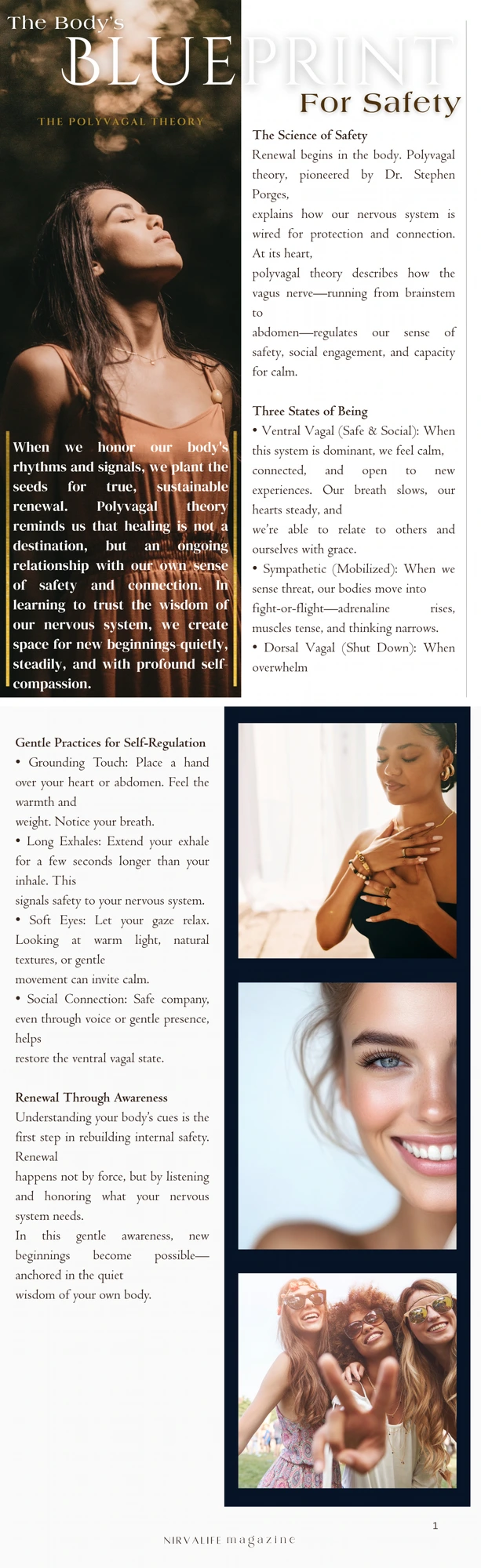
Renewal begins in the body. Not in the mind's declarations or the will's insistence, but in the quiet, involuntary systems that govern whether we feel safe enough to be present at all. For decades, we have spoken of stress and calm as if they were choices—states we could think our way into or out of. But polyvagal theory, pioneered by neuroscientist Dr. Stephen Porges in the 1990s, offers a different map entirely. It describes a nervous system wired not for perfection, but for survival. And in understanding that wiring, we begin to see why some days we can meet the world with openness, and others we cannot.
The Science of Safety
At the heart of polyvagal theory is the vagus nerve—a wandering bundle of fibers that originates in the brainstem and meanders through the body, touching the heart, lungs, digestive tract, and face. It is the longest cranial nerve, and one of the most influential. Porges's insight was to recognize that the vagus is not a single system, but two: an older, unmyelinated branch he calls the dorsal vagal complex, and a newer, myelinated branch called the ventral vagal complex.
These two branches, along with the sympathetic nervous system, form what Porges describes as a hierarchy of response. The body does not choose randomly among them. It moves through them in sequence, depending on what the environment demands and what the nervous system perceives. This perception happens beneath conscious awareness. It is called neuroception—a term Porges coined to describe the way our bodies scan for safety or danger without our knowing.
Neuroception is not thought. It is older than thought. It reads tone of voice, facial expression, posture, proximity. It decides, in milliseconds, whether the person across from us is safe or threatening. Whether the room is calm or charged. Whether we can rest or must prepare. And it does all of this before we have a chance to intervene.
This is why insight alone does not heal. Why knowing we are safe is not the same as feeling safe. The body has its own logic, and polyvagal theory gives us a language for it.
“Neuroception is not thought. It is older than thought.”
Three States of Being
Polyvagal theory describes three primary states, each governed by a different branch of the autonomic nervous system. We move among them constantly, often without noticing. But learning to recognize them—learning to feel the shift—is the beginning of agency.
The first is the ventral vagal state. This is the state of safety and social engagement. When the ventral vagal system is active, the muscles of the face and throat are relaxed. The voice has prosody. The eyes soften. The heart rate variability—the natural fluctuation in the time between heartbeats—is high, a sign of flexibility and resilience. In this state, we can listen. We can be curious. We can tolerate nuance and ambiguity. We are, in Porges's words, biologically prepared for connection.
But when neuroception detects threat—real or imagined—the system shifts. The sympathetic nervous system takes over, mobilizing the body for action. This is the state of fight or flight. Heart rate increases. Breathing quickens and moves higher into the chest. Blood flow is redirected to the large muscles. Digestion slows. The pupils dilate. The body is ready to run or to defend. In this state, nuance disappears. There is only the binary of survival: act or be acted upon.
And if the threat is inescapable—if fight and flight are both impossible—the system shifts again, this time into the dorsal vagal state. This is the oldest response, shared with reptiles. It is a shutdown, a conservation of energy in the face of overwhelming danger. Heart rate and blood pressure drop. The body goes still. In extreme cases, this is dissociation: a sense of being far away from oneself, watching from a distance. It is the body's last resort, a kind of metabolic hiding.
The Hierarchy Is Not Moral
It is important to understand that these states are not good or bad. They are adaptive. The sympathetic response has kept our species alive for millennia. The dorsal shutdown has allowed animals—and humans—to survive what could not be fought or fled. Even the ventral vagal state, for all its appeal, is not always appropriate. There are moments when mobilization is exactly what is needed.
The problem arises when we become stuck. When the nervous system, shaped by early experience or repeated trauma, begins to default to mobilization or shutdown even in the absence of real threat. When the body cannot find its way back to ventral vagal calm. This is the landscape of chronic stress, anxiety, depression, and relational difficulty. Not a failure of character, but a nervous system doing what it was trained to do.
Polyvagal theory reframes suffering as a question of state, not identity. It asks: What is your nervous system responding to? And can we help it find safety again?
“These states are not good or bad. They are adaptive.”
The Role of Co-Regulation
One of the most profound implications of polyvagal theory is that we do not regulate alone. The ventral vagal system is inherently social. It evolved, Porges argues, to support mammalian caregiving and bonding. A mother's calm voice, her steady gaze, her unhurried presence—these are not merely comforting. They are regulating. They signal to the infant's nervous system that the world is safe enough to rest, to digest, to grow.
This process, called co-regulation, does not end in infancy. Throughout life, we borrow calm from one another. A friend's steady breathing can slow our own. A therapist's attuned presence can help us tolerate what we could not face alone. Even a dog's quiet companionship can shift our state. We are, in this sense, porous. Our nervous systems are in constant conversation with the nervous systems around us.
This is why isolation is so destabilizing. Why loneliness is not just an emotional experience, but a physiological one. Without the regulating presence of others, the nervous system has fewer resources to return to safety. It becomes harder to find the ventral vagal state on our own.
And yet, co-regulation is not the same as dependence. It is not about outsourcing our calm to someone else. It is about recognizing that we are built for connection, and that seeking support is not weakness but biology.
Practices That Speak to the Vagus
If the nervous system operates beneath conscious awareness, how do we work with it? Polyvagal theory suggests that we cannot think our way into safety. But we can offer the body experiences that signal safety. We can practice what Porges calls "neural exercises"—small, repeated actions that strengthen the ventral vagal pathway.
One of the simplest is the breath. Not any breath, but a slow, extended exhale. When the exhale is longer than the inhale, the vagus nerve sends a signal to the heart to slow down. This is not metaphor. It is measurable. The heart rate drops. The body begins to shift out of sympathetic arousal and toward ventral vagal calm. It is a conversation between breath and nerve, and we can initiate it.
Another is touch. Placing a hand on the chest or abdomen, feeling the warmth and weight of it, can activate the ventral vagal system. This is why we instinctively hold ourselves when we are frightened. The body knows what it needs.
Soft eyes—allowing the gaze to relax, to take in peripheral vision rather than narrowing into a point—can also signal safety. In sympathetic arousal, vision tunnels. We focus on the threat. Softening the eyes reverses that signal. It tells the nervous system: there is no predator here. You can rest.
Humming, singing, even gargling—these activate the muscles of the throat and stimulate the vagus nerve. They are ancient practices, found in nearly every culture, and polyvagal theory helps us understand why they work. They are not symbolic. They are physiological.
When the System Has Been Shaped by Trauma
For some, the ventral vagal state is not easily accessible. Early trauma, chronic stress, or relational injury can reshape the nervous system's default settings. The body learns that the world is not safe. That people are not safe. And it organizes itself accordingly.
In these cases, practices that are calming for one person may be activating for another. A hand on the chest may feel threatening. Eye contact may be unbearable. The exhale may bring not calm but panic, as the body interprets stillness as vulnerability.
This is not failure. It is information. It tells us that the nervous system needs something different—perhaps smaller steps, perhaps more support, perhaps a different entry point altogether. Trauma-informed care, as described by clinicians like Bessel van der Kolk in "The Body Keeps the Score," emphasizes this: that healing must be paced to what the body can tolerate. That safety cannot be imposed. It must be discovered, slowly, in relationship.
Polyvagal theory does not offer a quick fix. It offers a framework. A way of understanding why some interventions work and others do not. Why one person finds relief in meditation and another finds it intolerable. Why connection heals some and terrifies others. The nervous system is not uniform. It is shaped by history.
“Safety cannot be imposed. It must be discovered, slowly, in relationship.”
The Wisdom of the Body
What polyvagal theory returns to us is respect for the body's intelligence. For too long, Western medicine and psychology have treated the body as subordinate to the mind—a vehicle to be controlled, a source of inconvenient signals to be overridden. But the body is not a problem to be solved. It is a system with its own logic, its own memory, its own way of knowing.
When we feel anxious for no reason, the body may be responding to a cue we have not consciously registered. When we feel inexplicably tired, the dorsal vagal system may be protecting us from something we are not ready to face. When we feel suddenly at ease in someone's presence, the ventral vagal system is telling us: this is safe. You can be here.
Learning to listen to these signals is not indulgence. It is literacy. It is learning the language the body speaks, so that we can respond with care rather than judgment.
This does not mean we are at the mercy of our nervous systems. It means we are in conversation with them. We can offer the body experiences of safety. We can practice the small gestures that strengthen ventral vagal tone. We can seek out relationships that regulate rather than dysregulate. And over time, the system can learn new patterns. It can remember what it feels like to rest.
Renewal as an Ongoing Practice
Polyvagal theory reminds us that healing is not a destination. It is not a state we arrive at and then maintain effortlessly. It is an ongoing relationship with our own sense of safety and connection. Some days, the ventral vagal state is easy to access. Other days, it is not. This is not regression. It is the nature of a system that is always responding, always adapting.
Renewal, in this context, is not about transcending the body. It is about coming home to it. About learning to trust its signals, to honor its rhythms, to meet it where it is rather than where we think it should be. It is about recognizing that the nervous system is not an obstacle to well-being, but the very ground on which well-being is built.
In this gentle awareness, new beginnings become possible. Not because we have conquered our biology, but because we have learned to work with it. Not because we have forced ourselves into calm, but because we have created the conditions in which calm can arise. Quietly. Steadily. With profound self-compassion.
The polyvagal map is not prescriptive. It does not tell us what to feel or how to be. It simply shows us where we are, and reminds us that wherever we are, the body is trying to protect us. And in that recognition, there is room to breathe. Room to begin again. Room to trust that the nervous system, for all its complexity, is on our side.
A Quiet Revolution
Polyvagal theory is, in many ways, a quiet revolution. It does not promise transformation through willpower or insight alone. It does not offer a five-step plan or a single technique that works for everyone. What it offers instead is a way of seeing. A recognition that beneath our thoughts and intentions, there is a system at work—ancient, involuntary, and profoundly wise.
It asks us to slow down. To notice. To feel the shift from one state to another, and to meet ourselves there with curiosity rather than judgment. It asks us to remember that we are not machines to be optimized, but living systems in constant flux. And that in honoring that flux, we find not weakness, but resilience.
This is the promise of polyvagal theory: not that we will never feel afraid, or overwhelmed, or shut down. But that we will understand those states as part of a larger conversation. A conversation between body and world, between past and present, between what we have survived and what we are becoming. And in that understanding, we find the possibility of choice. Not always. Not perfectly. But enough.
“We are not machines to be optimized, but living systems in constant flux.”
Before you go
Two quiet questions.
How much of what you just read named something you already know inside your own body?
How much did this open a new question you didn’t have before?
— End —
NirvaLife Magazine · January 2026
Part of the Nirva Life Educational Ecosystem
A chapter of a larger framework.
This article is one page in the ongoing study of Nervous System Intelligence — the interdisciplinary field that examines how the nervous system continuously gathers information, predicts meaning, coordinates physiology, and constructs lived experience. Every piece across the Nirva Life library rests on the definitions and principles articulated in The Founding Manifesto (v1.0).
Founding Document
Read the Founding Manifesto →
Cornerstone Model
The Four Perspectives →
From Framework to Practice
Enter the NIRVA Method →
Explore Further
Enter the Gateway Library →
Part of the Nirva Life educational ecosystem — advancing the field of Nervous System Intelligence™.