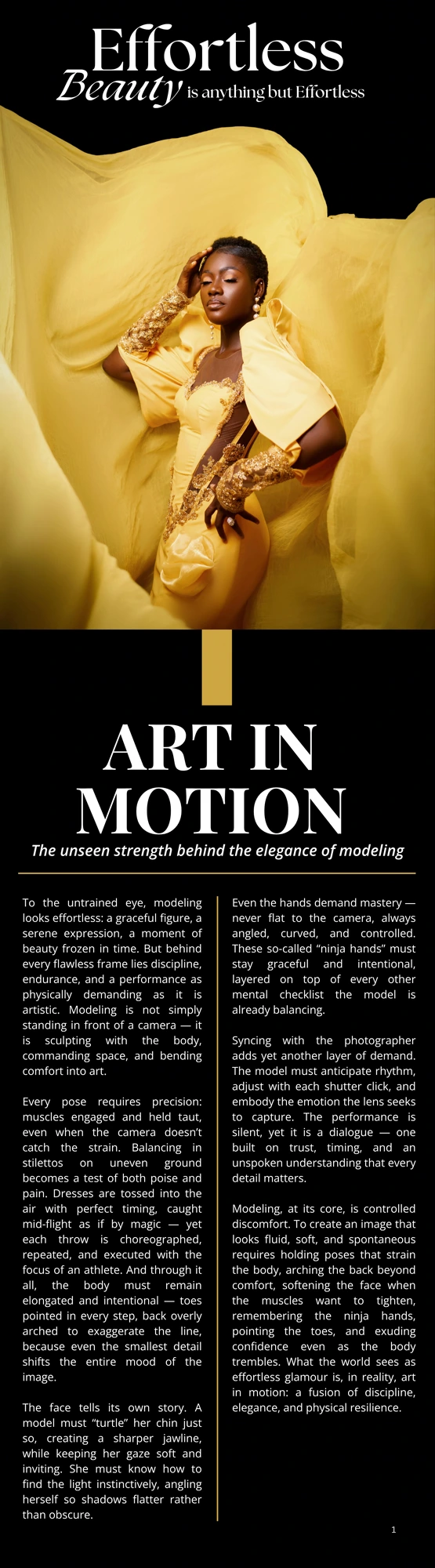
To the untrained eye, modeling looks effortless: a graceful figure, a serene expression, a moment of beauty frozen in time. But behind every flawless frame lies discipline, endurance, and a performance as physically demanding as it is artistic. The camera captures only the surface — the illusion of ease. What it does not record is the tremor in the calf muscle after twenty minutes in heels, the shallow breath held to keep a silhouette sharp, the mental choreography required to make the body both instrument and canvas.
Modeling is not simply standing in front of a camera. It is sculpting with the body, commanding space, and bending comfort into art. Every pose requires precision: muscles engaged and held taut, even when the camera doesn't catch the strain. Balancing in stilettos on uneven ground becomes a test of both poise and pain. Dresses are tossed into the air with perfect timing, caught mid-flight as if by magic — yet each throw is choreographed, repeated, and executed with the focus of an athlete.
And through it all, the body must remain elongated and intentional — toes pointed in every step, back overly arched to exaggerate the line, because even the smallest detail shifts the entire mood of the image. What the world sees as effortless glamor is, in reality, art in motion: a fusion of discipline, elegance, and physical resilience.
The Architecture of the Pose
A pose is not a position. It is an architecture — a deliberate arrangement of limbs, weight, and tension designed to create a visual line that the eye can follow. The model becomes both architect and structure, building something that appears spontaneous but is anything but.
Consider the simple act of standing. In everyday life, we distribute our weight evenly, let our shoulders round slightly, allow our hips to settle into their natural alignment. But in front of the camera, standing becomes a performance. Weight shifts to one leg, creating a subtle S-curve through the torso. The opposite hip juts forward. The shoulders pull back and down, opening the chest. The spine lengthens, the neck extends, and suddenly the body occupies space differently — more dynamically, more intentionally.
This is not comfort. This is controlled discomfort, sustained long enough for the shutter to click, then held longer still as the photographer adjusts the light, checks the frame, asks for one more. The muscles begin to burn. The breath wants to deepen, but deepening the breath softens the line, so the model learns to breathe shallowly, invisibly, keeping the silhouette intact.
Every joint becomes a hinge with purpose. The elbow never locks straight to the camera; it bends slightly, creating dimension. The knee softens or extends depending on the desired effect. Even the fingers — especially the fingers — must be choreographed, never splayed or stiff, always curved with intention.
“A pose is not a position. It is an architecture — a deliberate arrangement of limbs, weight, and tension designed to create a visual line that the eye can follow.”
The Face as Instrument
The face tells its own story, and the model must learn to speak in a language the camera understands. A model must “turtle” her chin just so — a slight forward and downward tilt that sharpens the jawline and lengthens the neck — while keeping her gaze soft and inviting. She must know how to find the light instinctively, angling herself so shadows flatter rather than obscure.
This is not vanity. This is craft. The difference between a chin angled two degrees too high and one positioned just right can mean the difference between a striking image and one that feels off, though the viewer may not know why. The model learns to feel the light on her face the way a musician feels a note — she knows when it's right.
Expression, too, is a form of precision. The photographer may ask for “soft but strong,” or “confident but approachable,” and the model must translate these abstract directives into micro-adjustments of the brow, the mouth, the eyes. A slight softening of the gaze. A barely perceptible lift at the corners of the lips. The face must convey emotion without performing it, must suggest a feeling without declaring it.
And all of this happens while the body is holding an uncomfortable pose, while the feet ache in too-tight shoes, while the mind runs through a checklist of a dozen other things. The face must remain serene even as the body strains. This is the paradox at the heart of modeling: to look at ease while enduring effort.
Ninja Hands and Other Invisible Rules
Even the hands demand mastery. In the industry, they are sometimes called “ninja hands” — a term that captures both their stealth and their precision. Hands must never appear flat to the camera, never stiff or lifeless. They must be angled, curved, and controlled, always in motion or poised as if about to move.
A hand resting on a hip is not simply resting. The fingers are slightly splayed, the wrist angled to create a graceful line. A hand near the face must be positioned so it enhances rather than obscures, so it adds dimension rather than distraction. The thumb, often the most awkward digit, must be tucked or angled just so.
These so-called ninja hands must stay graceful and intentional, layered on top of every other mental checklist the model is already balancing. It is one more thing to remember, one more element to control, and yet it must appear effortless. The viewer should never notice the hands — they should simply feel right.
The Dialogue Between Model and Photographer
Syncing with the photographer adds yet another layer of demand. The model must anticipate rhythm, adjust with each shutter click, and embody the emotion the lens seeks to capture. The performance is silent, yet it is a dialogue — one built on trust, timing, and an unspoken understanding that every detail matters.
A skilled photographer will guide with words, but the best collaborations happen when language falls away and the model begins to read the rhythm of the shoot. She learns to sense when the photographer is about to click, to shift her weight or tilt her head in the fraction of a second before the shutter fires. She learns to interpret vague directions — “Give me more energy,” “Soften it,” “Think about something that makes you feel powerful” — and translate them into physical adjustments.
This is improvisation within structure. The model has her technical foundation — the pose, the angle, the expression — but within that framework, she must also respond, adapt, and offer variations. She becomes both performer and collaborator, shaping the image alongside the photographer.
And she must do all of this while managing her own nervous system. The body, held in unnatural positions, begins to send signals of distress. The breath wants to quicken. The muscles want to release. But the model learns to override these signals, to calm the body even as she pushes it, to maintain the illusion of ease even as the effort mounts.
“The performance is silent, yet it is a dialogue — one built on trust, timing, and an unspoken understanding that every detail matters.”
The Physics of Fabric and Motion
Fabric, too, becomes part of the choreography. A dress tossed into the air must be thrown with just the right force, at just the right angle, to create the desired arc and fall. Too little force and it collapses limply. Too much and it flies out of frame. The model learns to feel the weight of the fabric, to anticipate how it will move, to time her own movement so that she and the dress arrive at the peak of the motion simultaneously.
She may throw the dress a dozen times before the photographer captures the perfect frame. Each throw requires the same precision, the same timing, the same physical effort. And between each throw, she must reset — smooth the fabric, adjust her position, prepare to do it again.
Wind machines add another variable. The model must learn to work with the wind rather than against it, to angle her body so the fabric flows in the right direction, to keep her hair from whipping across her face at the wrong moment. She must remain composed even as the wind buffets her, even as her eyes water and her skin prickles with cold.
All of this is invisible in the final image. The viewer sees only the dress suspended in mid-air, the model's serene expression, the sense of effortless motion. They do not see the repetition, the calculation, the physical toll.
The Endurance Beneath the Surface
Modeling, at its core, is controlled discomfort. To create an image that looks fluid, soft, and spontaneous requires holding poses that strain the body, arching the back beyond comfort, softening the face when the muscles want to tighten, remembering the ninja hands, pointing the toes, and exuding confidence even as the body trembles.
The physical demands are not unlike those of a dancer or an athlete, yet they are rarely acknowledged in the same way. A dancer's strength is celebrated; a model's is often invisible. The work is dismissed as mere appearance, as if beauty required no effort, as if grace were a passive state rather than an active achievement.
But anyone who has held a pose for more than a few minutes knows the truth. The body begins to protest. The muscles burn. The joints ache. The mind must intervene, overriding the body's signals, maintaining control even as discomfort mounts. This is endurance of a particular kind — not the endurance of running a marathon, but the endurance of stillness, of holding tension without release.
And it is not only physical. The mental focus required to maintain the pose, to remember the checklist, to sync with the photographer, to manage one's own nervous system — this, too, is a form of endurance. The model must remain present, alert, and responsive even as fatigue sets in, even as the shoot stretches from minutes into hours.
The Nervous System Under Pressure
What happens in the body during a long shoot is not unlike what happens during any sustained physical or mental challenge. The nervous system, tasked with maintaining an unnatural position, begins to send signals of distress. The sympathetic branch activates, preparing the body for action — but the action required is not fight or flight. It is stillness. It is control.
The model learns, often without naming it, to regulate her own nervous system. She learns to breathe in a way that calms without disrupting the pose. She learns to soften her gaze, to relax her jaw, to find small pockets of ease within the larger structure of discomfort. She learns to stay present rather than dissociating, to remain connected to her body even as she asks it to do difficult things.
This is a skill that extends beyond the shoot. The ability to remain calm under pressure, to regulate one's own nervous system, to find ease within effort — these are capacities that serve a person in many contexts. The model, in learning to manage her body and mind in front of the camera, is also learning a form of resilience.
It is worth noting that this resilience comes at a cost. The body, pushed repeatedly beyond comfort, may begin to hold tension in new ways. The nervous system, trained to override its own signals, may become less attuned to genuine distress. The line between discipline and harm is not always clear, and the industry does not always encourage models to honor that line.
The Artistry in the Unseen
There is a particular kind of artistry in making something difficult look easy. The ballet dancer who seems to float across the stage has spent years building the strength to do so. The musician who plays a complex passage with apparent effortlessness has practiced it thousands of times. The model who appears serene and graceful in a photograph has trained her body and mind to hold discomfort without showing it.
This is not deception. It is craft. The goal is not to hide the work but to transform it, to refine it until the effort becomes invisible and what remains is the essence of the thing itself — beauty, elegance, presence.
The viewer, looking at a photograph, may not think about the model's arched back or pointed toes, the ninja hands or the turtled chin. They may not consider the repetition, the discomfort, the mental focus required. And that is as it should be. The artistry lies in the fact that they do not need to think about it. The image speaks for itself.
But it is worth pausing, occasionally, to consider what lies beneath the surface. To recognize that the grace we admire is not a gift but an achievement. That the ease we perceive is the result of effort. That the beauty we see is, in part, the beauty of discipline.
“The artistry lies in the fact that they do not need to think about it. The image speaks for itself.”
The Body as Both Medium and Message
In modeling, the body is both medium and message. It is the tool through which the image is created, and it is also the subject of the image. The model must be simultaneously inside her body — feeling it, controlling it, managing it — and outside it, seeing it as the camera sees it, shaping it into something that communicates beyond itself.
This dual awareness is a form of embodied intelligence. The model learns to inhabit her body fully while also observing it from a distance, to be both subject and object, performer and performance. It is a complex negotiation, one that requires a particular kind of self-awareness and self-control.
And it raises questions about the relationship between the self and the body, between the person and the image. The model is not the photograph, yet she is also inseparable from it. The image captures a moment, a pose, a particular arrangement of light and shadow, but it does not capture the person behind the pose — the effort, the thought, the inner life.
This is the paradox of modeling: the work is deeply physical, deeply embodied, and yet the final product is an image, a surface, a representation. The model gives her body to the camera, but what the camera returns is not the body itself but a version of it, refined and edited, stripped of context and effort.
Reframing the Gaze
To look at a photograph of a model and see only beauty is to miss half the story. The other half is the work — the discipline, the endurance, the skill. The model is not simply a passive subject, a beautiful object to be captured. She is an active participant, a collaborator, an artist in her own right.
Reframing the gaze means recognizing this. It means seeing the model not as a surface but as a person with agency, with skill, with a body that is both strong and vulnerable. It means appreciating the artistry not only of the photographer but also of the model, whose body and presence make the image possible.
It also means acknowledging the cost. The physical toll, the mental effort, the ways in which the work can shape and sometimes strain the nervous system. Modeling, like any demanding practice, requires care — care for the body, care for the mind, care for the person behind the pose.
The images we consume are not neutral. They are the result of labor, of choices, of bodies pushed and shaped and held in particular ways. To see them clearly is to see not only the beauty but also the work, not only the grace but also the effort. It is to recognize that art, in any form, is never effortless — and that the appearance of ease is itself a kind of mastery.
In the end, modeling is art in motion. It is the body as instrument, the pose as sculpture, the image as collaboration. It is discipline made visible and effort made invisible. It is the quiet strength behind the elegance, the unseen work that makes beauty possible.
Before you go
Two quiet questions.
How much of what you just read named something you already know inside your own body?
How much did this open a new question you didn’t have before?
— End —
NirvaLife Magazine · January 2026