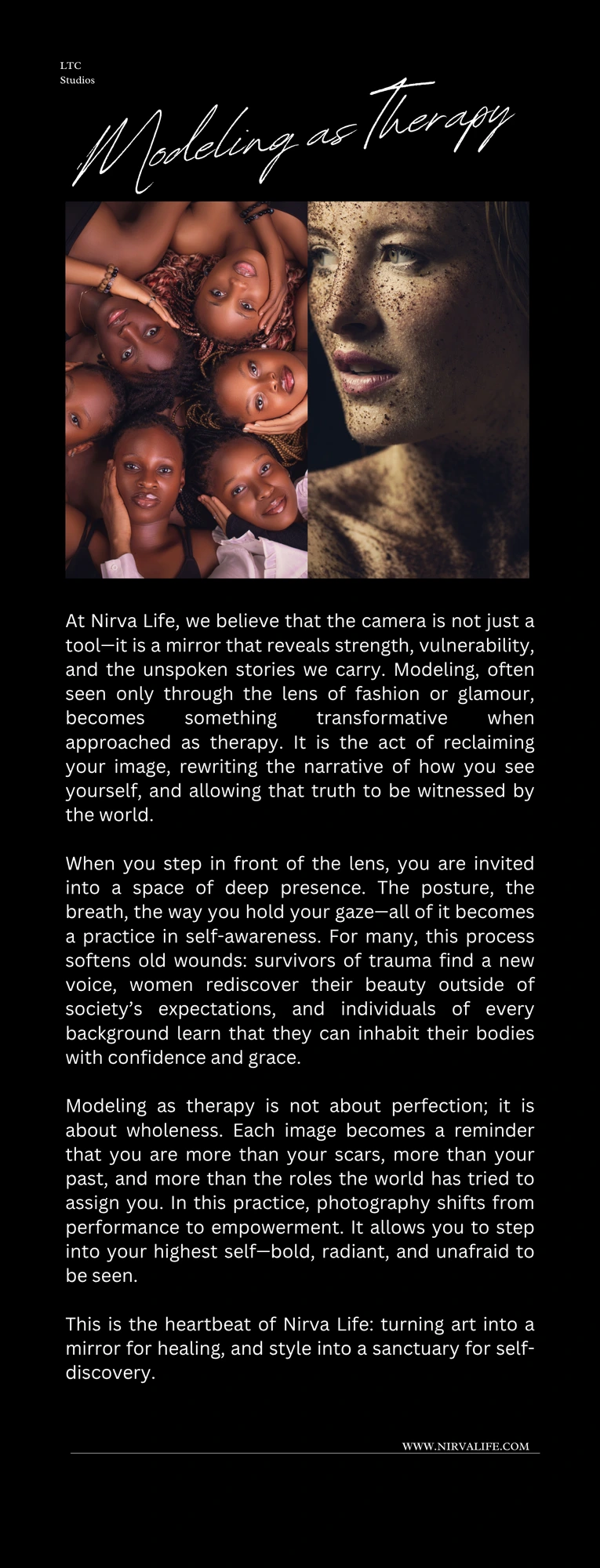
The first time I stood in front of a camera with intention, I was thirty-two years old. Not for a headshot or a passport photo, but for myself. The photographer, a woman who worked primarily with survivors of domestic violence, had invited me into her studio after I mentioned — offhandedly, over coffee — that I had never liked being photographed. She tilted her head and said, 'That's exactly why you should come.' I went, skeptical. I left with something I hadn't expected: a different relationship to my own face.
At Nirva Life, we believe that the camera is not just a tool — it is a mirror that reveals strength, vulnerability, and the unspoken stories we carry. Modeling, often seen only through the lens of fashion or glamor, becomes something transformative when approached as therapy. It is the act of reclaiming your image, rewriting the narrative of how you see yourself, and allowing that truth to be witnessed by the world.
This is not a new idea, exactly. Portraiture has always been about power — who gets to be seen, who gets to be remembered, whose face is deemed worthy of preservation. But what happens when we turn that power inward, when the act of being photographed becomes less about documentation and more about excavation? When the lens becomes a tool not for vanity, but for visibility of the self to the self?
The Body as Archive
Our bodies hold memory in ways that language often cannot reach. Trauma lives in the shoulders, in the jaw, in the way we unconsciously cross our arms or avert our gaze. Bessel van der Kolk writes extensively in The Body Keeps the Score about how the nervous system encodes experience, how the body becomes an archive of everything we have survived. Modeling — the deliberate act of positioning the body, of holding a posture, of meeting the camera's eye — can become a way of accessing that archive.
When you step in front of the lens, you are invited into a space of deep presence. The posture, the breath, the way you hold your gaze — all of it becomes a practice in self-awareness. You cannot hide from a camera that is held with care. You cannot perform your way out of your own body. Instead, you are asked to inhabit it fully, perhaps for the first time in years.
For many, this process softens old wounds. Survivors of trauma find a new voice. Women rediscover their beauty outside of society's expectations. Individuals of every background learn that they can inhabit their bodies with confidence and grace. The camera does not judge. It simply reflects. And in that reflection, there is an opportunity to see yourself as you are, not as you have been told to be.
This is not about erasing the past. It is about integrating it. The scar on your collarbone, the way your eyes crinkle when you smile, the tension you still carry in your neck — all of it is part of the story. The camera, when wielded with intention, does not flatten that complexity. It honors it.
“You cannot perform your way out of your own body. Instead, you are asked to inhabit it fully, perhaps for the first time in years.”
The Gaze and the Witness
There is a particular intimacy in being photographed by someone who sees you. Not someone who is trying to capture your 'best angle' or make you look like someone else, but someone who is willing to witness you as you are. This is where modeling as therapy diverges sharply from commercial photography. The goal is not a product. The goal is presence.
In her work on shame and vulnerability, Brené Brown often speaks about the power of being seen. Shame, she argues, cannot survive empathy. It cannot survive being brought into the light and met with compassion. Modeling — when done in a therapeutic context — creates exactly that kind of light. The photographer becomes a witness, not a critic. The session becomes a container for whatever needs to emerge.
I have watched women weep in front of the camera, not from sadness but from relief. Relief at being seen without judgment. Relief at realizing that their bodies, which they have spent years trying to shrink or hide or apologize for, are in fact beautiful. Not beautiful in the airbrushed, commodified sense, but beautiful in the way that all honest things are beautiful.
The act of holding someone's gaze — whether through a lens or in person — is an act of recognition. It says: I see you. You are here. You matter. For those who have spent a lifetime feeling invisible, or hypervisible in ways that felt objectifying, this kind of seeing can be revolutionary.
Reclaiming the Narrative
For much of my life, I avoided cameras. I had internalized a story about my appearance — a story built from careless comments, cultural beauty standards, and my own relentless self-criticism. I believed I was not photogenic, which is to say, I believed I was not worth looking at. It took years to understand that this was not a fact. It was a narrative. And narratives can be rewritten.
Modeling as therapy offers a way to author a new story. Not a false one, not one built on denial or delusion, but one rooted in truth. The truth that your body has carried you through everything. The truth that your face holds a lifetime of laughter and sorrow and resilience. The truth that you are allowed to take up space, to be seen, to exist without apology.
This process is especially potent for those whose images have been controlled by others. Survivors of abuse, individuals who have been objectified or fetishized, people whose bodies have been policed by family or culture or medicine — for them, stepping in front of the camera on their own terms is an act of reclamation. It is a way of saying: this is my body, my image, my story. I decide how I am seen.
The images themselves become evidence. Not of perfection, but of presence. Not of who you wish you were, but of who you are. And in a world that constantly tells us we are not enough, that kind of evidence is radical.
The Nervous System in Focus
There is a physiological dimension to this work that cannot be ignored. When we are photographed, especially if we carry anxiety around being seen, the nervous system responds. Heart rate increases. Breath becomes shallow. The body prepares for threat, even when there is none. This is the legacy of a nervous system that has learned, over time, that visibility is dangerous.
But the nervous system is also adaptable. It can learn new patterns. Polyvagal theory, developed by Stephen Porges, teaches us that safety is not just a cognitive experience — it is a physiological one. The body must feel safe before the mind can relax. A therapeutic photography session, when done well, creates the conditions for that safety. Soft lighting. A calm voice. Permission to move, to breathe, to pause.
Over time, the act of being photographed can shift from a state of hyperarousal to one of ventral vagal engagement — the state in which we feel connected, grounded, and at ease. The camera becomes not a source of stress, but a tool for regulation. The session becomes not a performance, but a practice.
“The camera becomes not a source of stress, but a tool for regulation. The session becomes not a performance, but a practice.”
I have seen this transformation firsthand. A woman who arrived at the studio with her arms wrapped tightly around herself, who could barely make eye contact, who apologized for taking up space. By the end of the session, her shoulders had dropped. Her breath had deepened. She looked at herself in the monitor and smiled — not a polite smile, but a real one. 'I didn't know I could look like that,' she said. Like what, I asked. 'Like myself.'
Beyond the Binary of Beautiful
One of the most insidious aspects of our visual culture is the way it reduces people — especially women — to a binary: beautiful or not. Worthy or not. Visible or invisible. Modeling as therapy dismantles that binary. It asks a different question entirely. Not 'Am I beautiful?' but 'What does it feel like to be seen as I am?'
This shift is subtle but profound. It moves the locus of evaluation from external to internal. It prioritizes embodiment over appearance. It makes space for complexity, for contradiction, for the full range of human experience to be visible in a single frame.
In her book The Beauty Myth, Naomi Wolf argues that beauty standards are a form of social control, a way of keeping women distracted and disempowered. Modeling as therapy subverts that control. It takes the tools of the beauty industry — the camera, the lighting, the pose — and repurposes them for liberation. It says: you do not need to be beautiful to be worthy of being seen. You simply need to be.
This is not to say that beauty is irrelevant. Beauty, in its truest sense, is about aliveness. It is about the light in someone's eyes when they speak about something they love. It is about the way grief etches itself into a face and makes it more, not less, compelling. That kind of beauty cannot be manufactured. It can only be revealed.
The Ritual of Preparation
There is something sacred in the preparation. Choosing what to wear, not for someone else's approval but for your own sense of truth. Standing in front of the mirror and taking stock. Breathing. Arriving. This is not vanity. This is ritual.
In many cultures, the act of adorning the body has always been tied to identity, to ceremony, to transition. We dress for weddings, for funerals, for rites of passage. Modeling as therapy borrows from that tradition. It marks a moment. It says: I am here. I am ready to be seen.
Some people choose to wear something that makes them feel powerful. Others choose vulnerability — a bare face, simple clothing, nothing to hide behind. There is no right way. The only requirement is honesty.
I remember one session where a woman brought her grandmother's necklace. She had never worn it before, had kept it tucked away in a drawer for years. But that day, she put it on. She said it felt like bringing her grandmother into the room, like being witnessed not just by me and the camera, but by the lineage of women who had come before her. The images from that session are some of the most powerful I have ever seen.
The Aftermath: Living with Your Image
What happens after the session is just as important as what happens during it. You are handed a set of images — evidence of your own existence, your own presence. And now you must decide what to do with them.
Some people frame them. Some keep them private, returning to them in moments of doubt as a reminder of their own strength. Some share them, cautiously at first, testing the waters of visibility. There is no prescription. The images are yours. They belong to you in a way that so few things in this world truly do.
But living with your image — really living with it, not just tolerating it — requires practice. It requires unlearning the reflex to criticize, to compare, to diminish. It requires learning to look at yourself with the same compassion you would offer a friend.
This is where the therapeutic work deepens. The session itself is a catalyst, but the real transformation happens in the days and weeks and months that follow. Each time you look at the image and resist the urge to pick yourself apart, you are rewiring your brain. Each time you see yourself and think, 'Yes, that is me, and I am enough,' you are building new neural pathways. This is not metaphor. This is neuroscience.
“Each time you see yourself and think, 'Yes, that is me, and I am enough,' you are building new neural pathways.”
Art as Medicine
There is a long history of art being used as a therapeutic modality. Art therapy, music therapy, dance therapy — all of them recognize that healing does not always happen through words. Sometimes it happens through color, through sound, through movement. Photography fits naturally into this lineage.
What makes modeling as therapy distinct is its dual nature. You are both the artist and the subject. You are both the one being seen and the one who decides how you are seen. This duality creates a feedback loop of agency and reflection, of action and integration.
In her work on expressive arts therapy, Shaun McNiff writes about the importance of 'making' as a way of making sense. The act of creating — whether a painting, a poem, or a photograph — externalizes the internal. It gives form to what was formless. It allows us to see ourselves from the outside, which paradoxically helps us understand ourselves from the inside.
Modeling as therapy does exactly this. It takes the intangible — your sense of self, your relationship to your body, your unspoken stories — and makes it visible. And in that visibility, there is the possibility of change.
The Invitation
Not everyone will feel called to this work, and that is fine. Modeling as therapy is not a universal prescription. But for those who have spent years feeling unseen, or seen in ways that felt reductive or harmful, it offers something rare: a chance to be witnessed on your own terms.
It is an invitation to step into your body, to meet your own gaze, to allow yourself to be both vulnerable and strong in the same breath. It is an invitation to stop performing and start inhabiting. To stop hiding and start revealing. To stop apologizing and start existing.
This is the heartbeat of Nirva Life: turning art into a mirror for healing, and style into a sanctuary for self-discovery. The camera, in this context, is not a tool of judgment. It is a tool of liberation. It does not ask you to be perfect. It asks you to be whole.
And wholeness, it turns out, is more than enough.
Before you go
Two quiet questions.
How much of what you just read named something you already know inside your own body?
How much did this open a new question you didn’t have before?
— End —
NirvaLife Magazine · November 2025