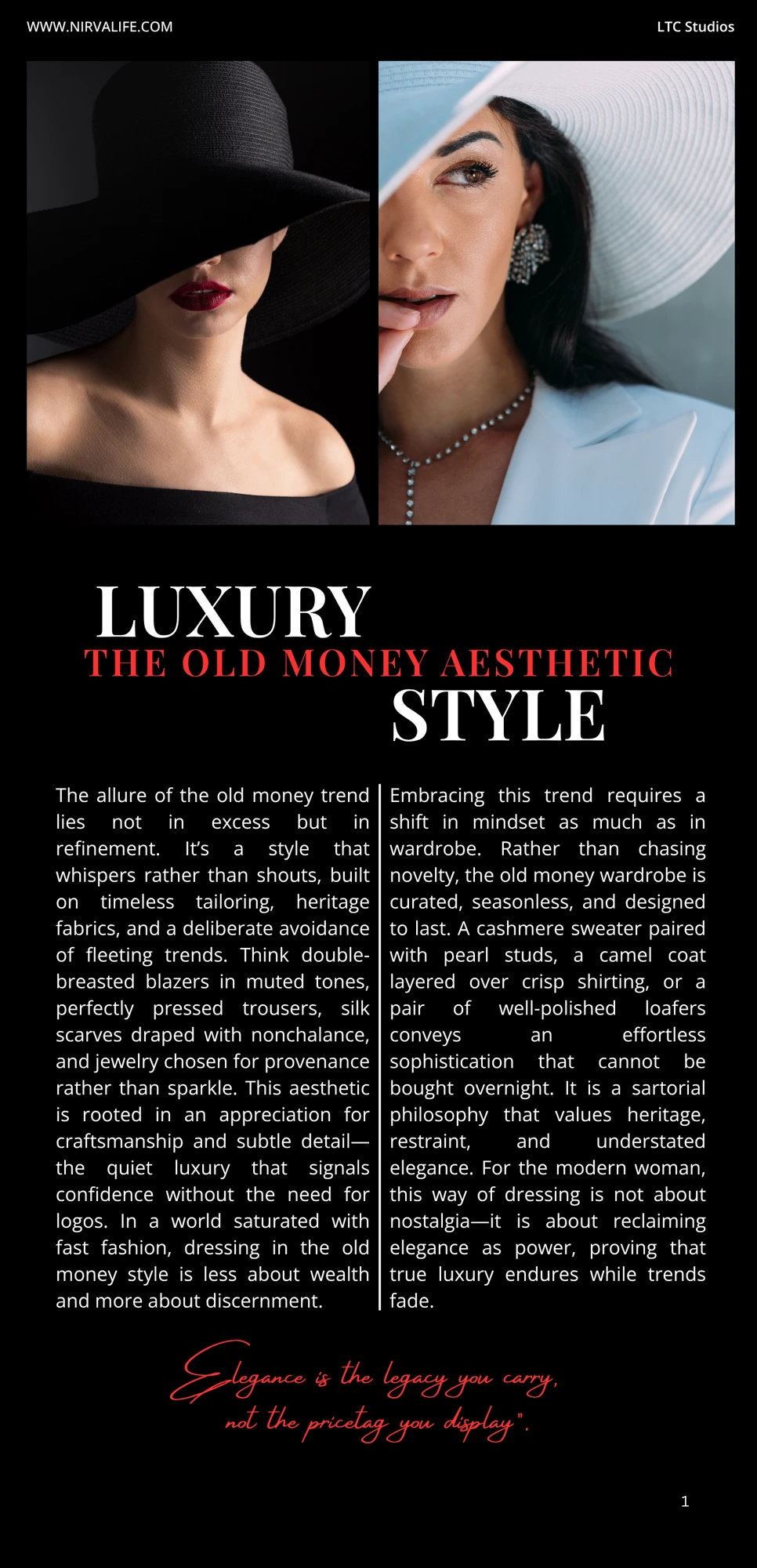
The allure of the old money aesthetic lies not in excess but in refinement. It's a style that whispers rather than shouts, built on timeless tailoring, heritage fabrics, and a deliberate avoidance of fleeting trends. Think double-breasted blazers in muted tones, perfectly pressed trousers, silk scarves draped with nonchalance, and jewelry chosen for provenance rather than sparkle. This aesthetic is rooted in an appreciation for craftsmanship and subtle detail — the quiet luxury that signals confidence without the need for logos. In a world saturated with fast fashion and algorithmic feeds that churn out microtrends weekly, dressing in the old money style is less about wealth and more about discernment.
The Vocabulary of Restraint
Old money style speaks a language most of us have forgotten how to hear. It operates in the register of understatement, where a well-cut trouser says more than any logo ever could. The grammar is simple: clean lines, natural fibers, colors that refuse to scream. Navy. Camel. Ivory. Charcoal. The occasional burgundy, deployed like punctuation.
This is not minimalism for its own sake. It is something older and more deliberate — a sartorial philosophy that emerged from circles where wealth was assumed, never announced. The women who pioneered this look in the mid-twentieth century understood that true luxury is invisible to those who don't know where to look. A Hermès scarf folded just so. The weight of a cashmere knit. The particular sheen of shoes resoled three times because the leather was worth keeping.
What makes this aesthetic compelling now is not nostalgia but its refusal to participate in the attention economy. While influencer culture rewards novelty and visibility, old money style rewards the opposite: consistency, quality, the confidence to wear the same coat for a decade. It is a quiet rebellion against the tyranny of newness.
The nervous system, interestingly, responds to this kind of visual restraint. Our brains are wired to detect threat and novelty, scanning environments for anything that disrupts pattern or expectation. Loud prints, clashing colors, excessive embellishment — all of these trigger low-level arousal, a subtle activation that we rarely notice consciously but that accumulates over the course of a day. The old money palette, by contrast, soothes. It asks nothing of the observer. It simply exists, calm and self-contained.
Provenance Over Novelty
The old money wardrobe is not about acquisition. It is about curation. Each piece enters the rotation with intention, chosen not for its trendiness but for its capacity to endure. This requires a different kind of shopping — slower, more considered, often secondhand. The best iterations of this style are built over years, not weekends.
There is a particular pleasure in wearing something with a history. A vintage Burberry trench. A pair of Ferragamo flats from the 1980s. A cashmere cardigan that belonged to your grandmother. These objects carry time within them. They have been worn, cared for, passed down or discovered. They resist the disposability that defines so much of contemporary fashion.
This is where the aesthetic diverges sharply from its imitators. You can buy a beige blazer at any price point, but the old money sensibility is not about the blazer itself. It is about the relationship you have with it. Do you know where it was made. Do you understand the fabric. Will you have it tailored to fit your body exactly. Will you wear it until the lining frays, then have it repaired.
“The old money palette soothes. It asks nothing of the observer. It simply exists, calm and self-contained.”
Provenance matters because it roots an object in the world. It gives clothing a narrative beyond consumption. And narratives, as we know from decades of research into memory and meaning-making, are how humans construct identity. When you wear something with a story, you are not just dressing your body. You are dressing your sense of self.
The Neuroscience of Effortlessness
Effortlessness, of course, is a performance. The women who appear to have thrown on a silk blouse and tailored trousers without thought have likely spent years refining their eye, learning what works on their frame, building a wardrobe where everything coordinates. But the performance is convincing because it mirrors a state the nervous system craves: ease.
When we talk about someone looking effortless, we are often describing the absence of visible strain. No tugging at hems. No adjusting of straps. No self-consciousness. The body moves freely inside the clothing, and the clothing moves with it. This is not an accident. It is the result of fit, fabric, and familiarity.
Lisa Feldman Barrett, in her work on emotion and the predictive brain, describes how our nervous systems are constantly running simulations, predicting what will happen next based on past experience. When those predictions are met — when the world behaves as expected — we feel a sense of ease. When they are violated, we experience surprise, which can be pleasurable or destabilizing depending on context.
Old money style works, in part, because it is deeply predictable. The silhouettes do not change season to season. The color palette remains stable. The quality is consistent. For the wearer, this predictability translates to cognitive ease. You do not have to think about what to wear because the wardrobe has been designed to eliminate decision fatigue. For the observer, the predictability registers as competence, control, a person who knows who they are.
Seasonless, Ageless, Selfless
One of the most radical aspects of the old money aesthetic is its refusal to acknowledge seasons in the way fashion typically does. There is no spring collection, no fall refresh. Instead, there is a core wardrobe that adapts. Linen in summer. Wool in winter. Cashmere layered over silk. The same trousers worn year-round.
This seasonlessness is both practical and philosophical. Practically, it reduces waste and simplifies life. Philosophically, it resists the manufactured urgency that drives consumer culture. You do not need the new thing because the old thing still works. It still fits. It still looks good. It will continue to look good.
The same logic applies to age. Old money style does not flatter youth at the expense of maturity. A twenty-five-year-old and a sixty-five-year-old can wear the same blazer, the same loafers, the same strand of pearls. The aesthetic does not rely on tight fits or exposed skin or any of the visual markers that equate desirability with youth. It is, in this sense, a style for adults.
“You do not need the new thing because the old thing still works. It still fits. It still looks good.”
And perhaps most interestingly, it is selfless. Not in the moral sense, but in the sense that it does not center the self. The clothing does not demand attention. It does not announce the wearer's personality or mood or aspirations. It simply provides a backdrop, elegant and unobtrusive, against which the person can exist. For those of us exhausted by the pressure to perform identity through consumption, this is a profound relief.
The Myth of Access
It would be disingenuous to discuss old money style without acknowledging its origins in actual wealth. The aesthetic emerged from a class of people who could afford bespoke tailoring, who traveled to Europe for fabric, who inherited jewelry and furniture and the assumption that they belonged in certain rooms. To romanticize this without context is to ignore the systems of exclusion that made it possible.
And yet, the contemporary appeal of the aesthetic is not about replicating those systems. It is about extracting a set of principles — quality over quantity, longevity over trend, restraint over display — and applying them in a different context. You do not need generational wealth to buy secondhand. You do not need a trust fund to learn how to tailor a thrifted blazer. You do not need a pedigree to appreciate craftsmanship.
What you do need is time. Time to learn, to search, to save, to care for what you own. And time, in our current economy, is often more scarce than money. This is the real barrier. Not access to the aesthetic itself, but access to the kind of life that allows for slowness, for considered choices, for the long view.
Still, there is something valuable in the aspiration. Not the aspiration to wealth, but the aspiration to intentionality. To ask, before buying, whether this will last. Whether it fits. Whether it reflects something true about how you want to move through the world. These are questions worth asking regardless of budget.
Elegance as Armor
There is a reason women have long turned to dress as a form of control. When the world feels chaotic, when the body feels unruly, when the mind will not settle, clothing offers a way to impose order. Not control in the punitive sense, but in the sense of authorship. You choose the silhouette. You choose the palette. You choose how much of yourself to reveal and how much to withhold.
Old money style, with its emphasis on structure and restraint, functions as a kind of armor. It is protective without being defensive. It signals competence, self-possession, the ability to navigate complex social terrain without losing your footing. For women, especially, this is no small thing. We are so often told that our value lies in being seen, in being decorative, in attracting attention. The old money aesthetic offers a different script: value lies in being self-contained.
This does not mean disappearing. It means choosing visibility on your own terms. A well-cut blazer does not make you invisible. It makes you legible in a particular way — as someone who understands the rules, who has mastered the codes, who does not need to try too hard because she already knows she belongs.
Of course, belonging is its own complicated territory. The codes of old money style were designed to exclude as much as to include, to mark insiders and outsiders, to maintain boundaries. Adopting the aesthetic now does not erase that history. But it can, perhaps, repurpose it. What was once a marker of exclusion can become a tool of self-definition, a way of saying: I choose quality. I choose longevity. I choose not to participate in the churn.
The Long Game
Building an old money wardrobe is not a weekend project. It is a long game, played over years, sometimes decades. You start with one good piece — a blazer, a coat, a pair of shoes — and you build from there. You learn what works on your body. You develop an eye for fabric and construction. You become fluent in the language of cut and drape and proportion.
This slow accumulation runs counter to everything contemporary culture tells us about fashion. We are supposed to want it all, now, in every color. We are supposed to refresh our wardrobes seasonally, to keep up, to stay relevant. The old money approach says: no. You do not need more. You need better. And better takes time.
“What was once a marker of exclusion can become a tool of self-definition.”
There is a particular satisfaction in this kind of patience. Each addition to the wardrobe feels earned, considered, right. You are not filling a closet. You are building a vocabulary, a set of tools that will serve you across contexts and years. A vocabulary that will not betray you by going out of style, because it was never in style to begin with. It simply was, and is, and will continue to be.
The long game also means accepting imperfection. Your wardrobe will never be complete because completion is not the goal. The goal is functionality, beauty, coherence. The goal is to open your closet and feel calm rather than overwhelmed. To get dressed without drama. To move through your day in clothing that supports rather than distracts.
Reclaiming Elegance
Elegance has fallen out of favor in certain circles, dismissed as old-fashioned or elitist or insufficiently political. But elegance, rightly understood, is not about exclusion. It is about clarity. It is about knowing what matters and letting go of what does not. It is about moving through the world with intention and grace.
For the modern woman, reclaiming elegance is an act of resistance. It resists the pressure to be constantly available, constantly performing, constantly consuming. It resists the idea that worth is measured in visibility or novelty or the ability to keep up with trends. It insists, quietly but firmly, that there is another way.
This is not about retreating into the past or pretending that old hierarchies were somehow better. It is about taking what was valuable — the commitment to craft, the appreciation for quality, the understanding that some things are worth preserving — and bringing it forward into a different context. A context where elegance is not the province of a particular class but a choice available to anyone willing to slow down, pay attention, and invest in what lasts.
The old money aesthetic, at its best, is not about money at all. It is about discernment. About knowing the difference between what is merely expensive and what is truly valuable. About building a life, and a wardrobe, that reflects your deepest values rather than the loudest voices. About understanding that true luxury is not what you can afford to buy, but what you can afford to keep.
In the end, elegance is the legacy you carry, not the pricetag you display. It is the quiet confidence that comes from knowing who you are and dressing accordingly. It is the refusal to shout when a whisper will do. It is the understanding that in a world of noise, restraint is its own form of power.
Before you go
Two quiet questions.
How much of what you just read named something you already know inside your own body?
How much did this open a new question you didn’t have before?
— End —
NirvaLife Magazine · November 2025