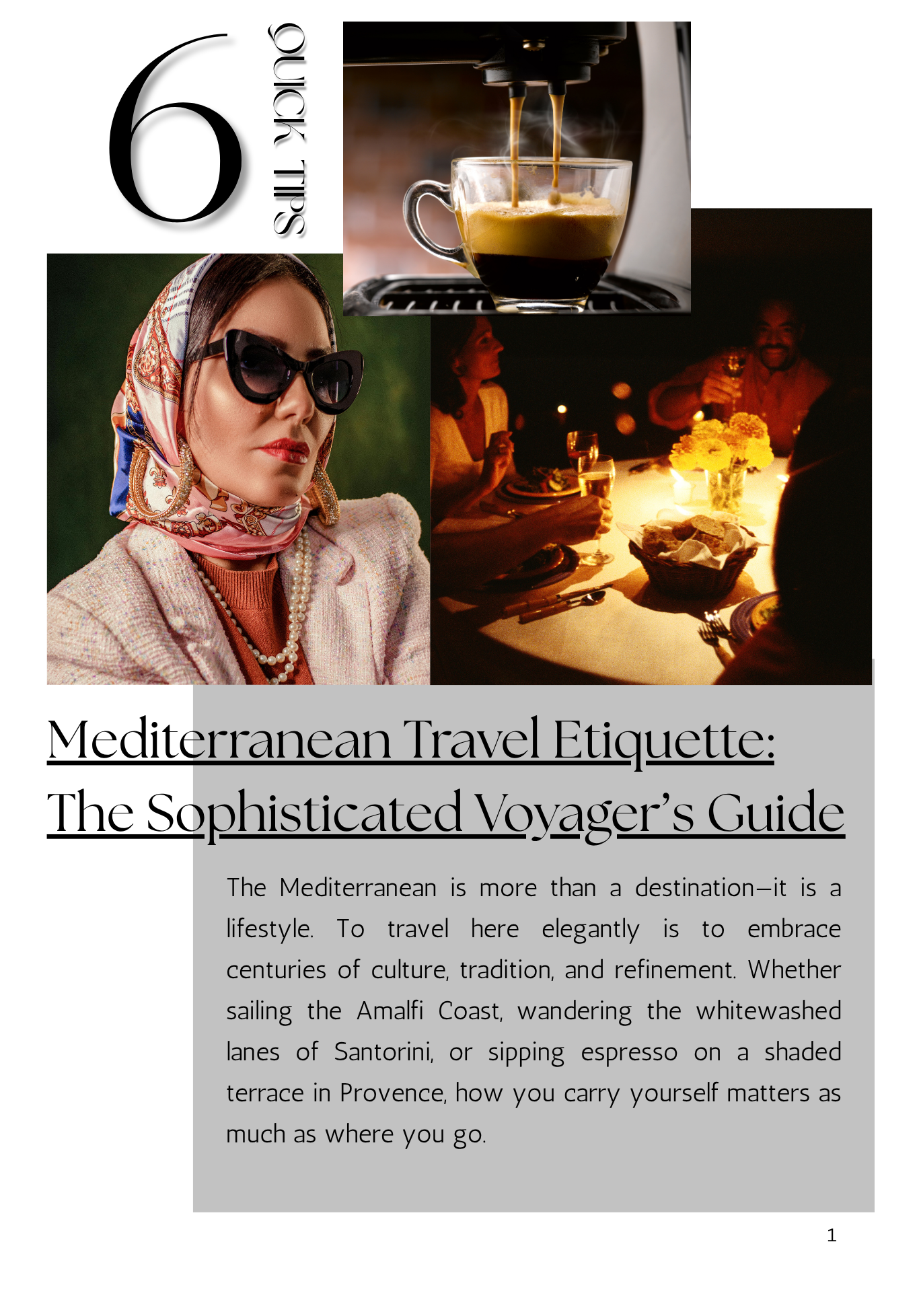
The Mediterranean is more than a destination — it is a lifestyle, a philosophy, a way of moving through the world. To travel here elegantly is to embrace centuries of culture, tradition, and refinement that have shaped not only the architecture and cuisine but the very rhythm of daily life. Whether you are sailing the Amalfi Coast, wandering the whitewashed lanes of Santorini, or sipping espresso on a shaded terrace in Provence, how you carry yourself matters as much as where you go. The sophisticated traveler understands this instinctively: that true luxury lies not in what you consume, but in how you inhabit a place. The Mediterranean rewards those who approach it with curiosity, humility, and a willingness to slow down. It is a region that has perfected the art of living well — and it asks only that you meet it halfway.
Dress the Coast, Not the Cruise
Mediterranean culture prizes elegance, but it is an elegance born of restraint rather than excess. Even in coastal towns where the dress code is ostensibly relaxed, locals favor polished simplicity over casual disarray. The key is to look effortlessly put together, as though you have given thought to your appearance without laboring over it. Lightweight linens, tailored sundresses, and well-fitted trousers strike the right balance between comfort and refinement.
In cities like Nice or Barcelona, you will notice that even beachgoers transition seamlessly from sand to café without looking disheveled. A linen shirt over swimwear, a wide-brimmed hat, leather sandals that have aged gracefully — these are the hallmarks of someone who understands the local aesthetic. Avoid athletic wear outside the gym, and save the cargo shorts and oversized T-shirts for another hemisphere.
When visiting churches, monasteries, and other sacred sites, shoulders and knees should be covered as a sign of respect. This is not merely a rule but a gesture of acknowledgment — a recognition that you are entering a space that holds meaning beyond your own experience. Carry a light scarf or shawl in your bag. It takes up no room and signals that you have done your homework.
The Mediterranean aesthetic is not about fashion in the transient sense. It is about timelessness. A well-cut pair of trousers will serve you better than a dozen trendy pieces. Quality over quantity. Fabric over flash. This is the quiet confidence that marks the insider.
Meals Are Experiences, Not Transactions
If there is one thing the Mediterranean does better than anywhere else, it is the meal. Not just the food — though the food is extraordinary — but the entire architecture of eating. The pacing, the conversation, the way a table becomes a stage for connection. To rush through a meal here is to miss the point entirely.
In Italy, never order a cappuccino after eleven in the morning. This is not snobbery; it is simply how things are done. Cappuccino is a breakfast drink, rich with milk, meant to accompany a cornetto, not a plate of pasta. After mid-morning, switch to espresso. Stand at the bar like a local, drink it in two sips, and move on. The ritual is brief but sacred.
In Greece, meals are often shared family-style, with dishes placed in the center of the table for everyone to enjoy. This is not just practicality; it is an expression of generosity and communal spirit. Order a variety of mezes, pass them around, and resist the urge to claim any single dish as your own. The table is a collective experience.
“To rush through a meal here is to miss the point entirely.”
In France, bread rests directly on the table, not on a plate. It is used to sop up sauces, to cleanse the palate, to punctuate conversation. Butter is for breakfast, not dinner. Wine is sipped, not gulped. And the cheese course comes before dessert, not after. These are small details, but they reveal a deeper understanding of how the French approach pleasure: with intention, with structure, with reverence.
Learn the rhythm of the local table, and you will find yourself welcomed like an insider. Ask questions. Compliment the chef. Linger over coffee. The meal is not an interruption of the day; it is the day's centerpiece.
The Art of Conversation
Mediterraneans value dialogue as much as cuisine. Conversation here is not small talk; it is an art form, a way of building connection and testing ideas. Be open, warm, and curious. Ask about the region, the history, the food. Show genuine interest, and you will be rewarded with stories that no guidebook could ever capture.
Avoid overly personal questions until trust is established. Topics like income, politics, and religion can be sensitive, especially with strangers. But once a rapport is built, don't be surprised if the conversation turns passionate. Debate is not confrontation here; it is engagement. Whether the subject is food, art, football, or philosophy, Mediterraneans relish the exchange of ideas.
A sincere compliment about local culture will take you far. Praise the olive oil, the architecture, the way the light falls on the water at dusk. But make sure it is genuine. Flattery is easily detected and quickly dismissed. Authenticity, on the other hand, is met with warmth.
Listen more than you speak. The best travelers are the ones who make space for others to share their world. In doing so, you become not just a visitor, but a participant.
Timing Is Everything
Schedules bend in the Mediterranean. Shops may close mid-afternoon for riposo or siesta, and dinners often start well past eight in the evening. Museums may have irregular hours. Buses may not run on time. This is not inefficiency; it is a different relationship with time, one that prioritizes rest, connection, and the natural rhythms of the day.
Adapting to the local tempo is a mark of respect — and a chance to discover the beauty of slowing down. If a shop is closed, take a walk. If dinner is late, have an aperitivo. If the ferry is delayed, sit by the water and watch the light change. The Mediterranean teaches patience, and patience is rewarded.
In Spain, the concept of sobremesa — the time spent lingering at the table after a meal — is considered just as important as the meal itself. It is a time for conversation, for digestion, for savoring the moment. To rush away from the table is to reject the gift of time.
This slower pace can feel disorienting at first, especially for travelers accustomed to efficiency and productivity. But once you surrender to it, you may find that it is one of the most valuable lessons the Mediterranean has to offer. Time is not something to be conquered. It is something to be inhabited.
Gratitude and Generosity
In markets or smaller towns, bargaining is part of the dance, but it should always be done with charm and a smile. Haggling is not about winning; it is about relationship. It is a way of engaging with the vendor, of showing interest, of participating in a tradition that goes back centuries. But know when to stop. If the price is fair, accept it gracefully.
A warm grazie, efcharistó, or merci paired with genuine eye contact transforms a simple exchange into connection. Language is a bridge, even when your vocabulary is limited. The effort to speak a few words in the local tongue is always appreciated, even if your pronunciation is imperfect. It signals respect and humility.
“Language is a bridge, even when your vocabulary is limited.”
Generosity is currency in the Mediterranean, but it is not always monetary. It can be a compliment, a smile, a willingness to help. It can be the patience to wait while an elderly shopkeeper wraps your purchase with care. It can be the grace to accept hospitality without suspicion. In a culture that values human connection above all else, these small gestures carry weight.
Tipping customs vary across the region. In France and Italy, service is often included in the bill, but leaving small change or rounding up is a kind gesture. In Greece, a few euros left on the table is appreciated. In Spain, tipping is less common but never refused. When in doubt, observe what locals do, and follow their lead.
Quiet Luxury Over Flash
The Mediterranean aesthetic leans toward understated refinement rather than ostentation. A silk scarf, a leather sandal, or a handcrafted piece of jewelry speaks more eloquently than logos ever could. This is not about wealth; it is about taste. It is about choosing quality over quantity, craftsmanship over branding, subtlety over spectacle.
In cities like Florence or Marseille, you will notice that the most elegant people are often the least adorned. Their clothes fit well. Their accessories are few but carefully chosen. They move through the world with a quiet confidence that does not demand attention but naturally attracts it.
To blend in is to show respect; to shine quietly is the true hallmark of elegance. This is not about erasing yourself or pretending to be someone you are not. It is about understanding that true sophistication does not announce itself. It simply is.
Invest in pieces that will last. A well-made leather bag. A pair of sunglasses that suit your face. A watch that tells time without shouting. These are the items that will serve you not just on this trip, but for years to come. They are the antidote to fast fashion and disposable culture. They are, in their own way, a form of resistance.
The Sacred and the Secular
The Mediterranean is a region where the sacred and the secular exist side by side, often indistinguishable from one another. A church is not just a building; it is a repository of history, art, and collective memory. A festival is not just a celebration; it is a ritual that connects the present to the past.
When you enter a sacred space, do so with reverence. Remove your hat. Lower your voice. Turn off your phone. These are not arbitrary rules; they are invitations to shift your awareness, to recognize that you are stepping into a space that holds meaning for others.
Even if you are not religious, you can still appreciate the beauty and significance of these places. The frescoes in a Byzantine chapel. The mosaics in a Moorish palace. The quiet hush of a centuries-old monastery. These are gifts, offered freely to those who approach them with respect.
Photography is often permitted, but ask yourself whether it is necessary. Sometimes the best way to remember a place is not to capture it, but to be fully present in it. To let it imprint itself on your memory without the mediation of a screen.
The Wisdom of Water
The Mediterranean Sea is the thread that ties this entire region together. It is the reason civilizations rose and fell here, the reason trade routes crisscrossed these shores, the reason cultures mingled and influenced one another for millennia. To understand the Mediterranean is to understand the sea.
Spend time by the water. Watch the fishermen mend their nets. Observe the way the light changes from dawn to dusk. Notice how the sea is never the same color twice. The water here is not just scenery; it is a presence, a force, a teacher.
“The water here is not just scenery; it is a presence, a force, a teacher.”
In Greek mythology, the sea was both giver and taker, a source of abundance and danger. That duality still holds. The Mediterranean can be calm and inviting one day, wild and unpredictable the next. It demands respect. It rewards humility.
If you have the chance, take a boat. Not a cruise ship, but something smaller — a sailboat, a fishing vessel, a ferry that stops at every island. From the water, you see the land differently. You understand why these coastal towns cling to the hillsides, why harbors were built where they were, why the sea has always been both highway and horizon.
Returning Changed
The best journeys are the ones that change you, even in small ways. The Mediterranean has a way of doing this quietly, almost imperceptibly. You may not realize it until you return home and find yourself lingering over meals, savoring conversations, noticing the quality of light.
You may find that you have less patience for hurry, less tolerance for noise, less interest in accumulation. You may discover that you have developed a taste for simplicity, for silence, for the kind of beauty that does not shout.
This is the gift of traveling well: not the souvenirs you bring back, but the person you become in the process. The Mediterranean teaches you to slow down, to pay attention, to value quality over quantity. It teaches you that elegance is not about what you wear or where you stay, but about how you move through the world.
To travel the Mediterranean with grace is to honor the people who live there, the cultures that have shaped it, and the centuries of wisdom embedded in its stones and waters. It is to recognize that you are not the center of the experience, but a guest in someone else's home. And like any good guest, you leave the place a little better than you found it — or at the very least, unchanged by your presence.
The sophisticated voyager understands this instinctively. They know that the goal is not to conquer or consume, but to connect. To be welcomed like an insider is not a matter of knowing the right restaurants or speaking the language fluently. It is a matter of showing up with curiosity, humility, and respect. The rest follows naturally.
Before you go
Two quiet questions.
How much of what you just read named something you already know inside your own body?
How much did this open a new question you didn’t have before?
— End —
NirvaLife Magazine · November 2025