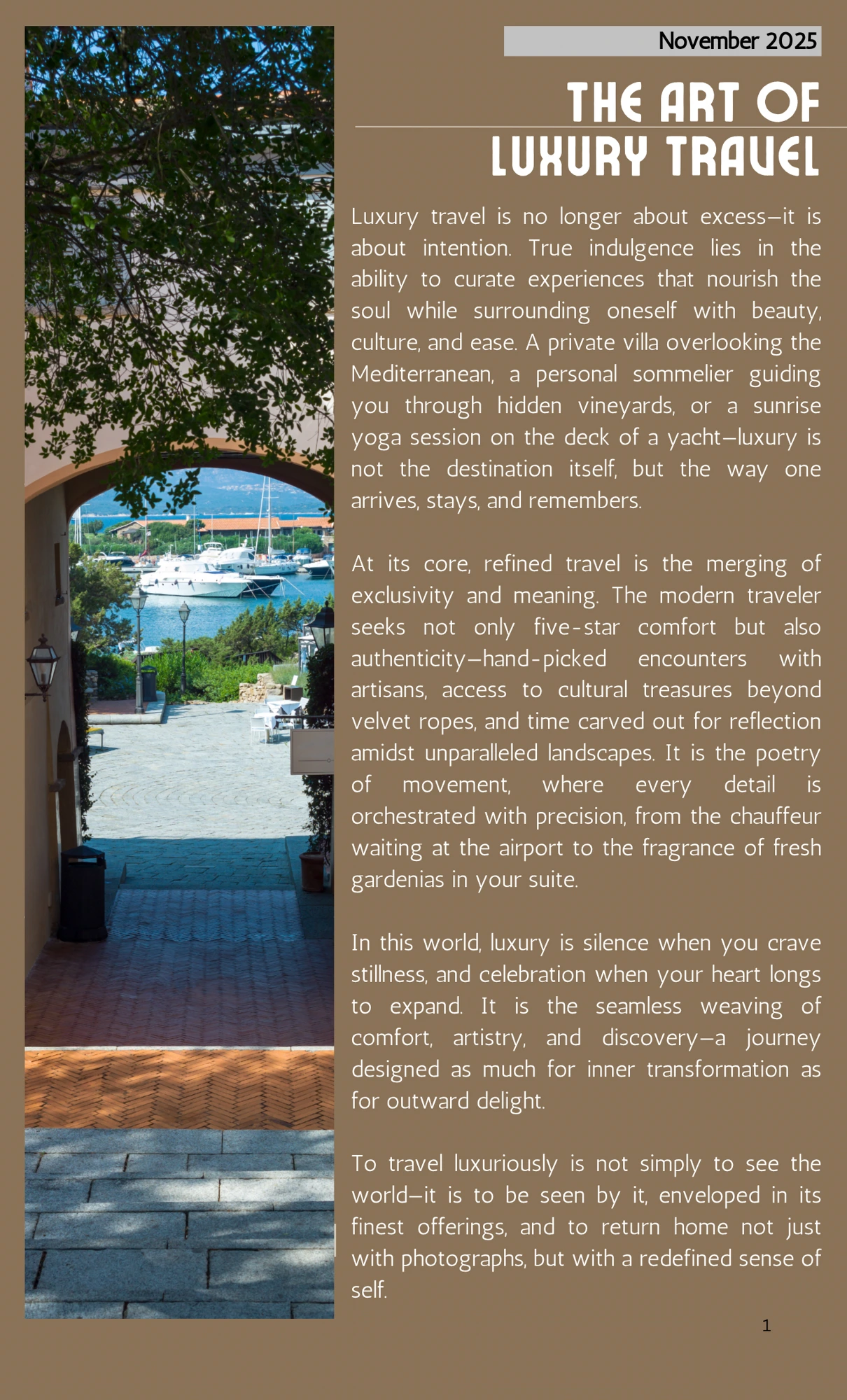
Luxury travel is no longer about excess — it is about intention. True indulgence lies in the ability to curate experiences that nourish the soul while surrounding oneself with beauty, culture, and ease. A private villa overlooking the Mediterranean, a personal sommelier guiding you through hidden vineyards, or a sunrise yoga session on the deck of a yacht — luxury is not the destination itself, but the way one arrives, stays, and remembers.
At its core, refined travel is the merging of exclusivity and meaning. The modern traveler seeks not only five-star comfort but also authenticity — hand-picked encounters with artisans, access to cultural treasures beyond velvet ropes, and time carved out for reflection amidst unparalleled landscapes. It is the poetry of movement, where every detail is orchestrated with precision, from the chauffeur waiting at the airport to the fragrance of fresh gardenias in your suite.
In this world, luxury is silence when you crave stillness, and celebration when your heart longs to expand. It is the seamless weaving of comfort, artistry, and discovery — a journey designed as much for inner transformation as for outward delight.
The Shift from Spectacle to Substance
There was a time when luxury travel meant conspicuous consumption: the largest suite, the most exclusive resort, the rarest champagne. Status was measured in superlatives. But something has shifted in recent years, a quiet recalibration of what it means to travel well. The new luxury is not louder or larger. It is deeper.
Today's discerning traveler values experiences that cannot be replicated or purchased off a shelf. A private tour of the Uffizi led by a Florentine art historian who speaks in hushed tones about Botticelli's brushwork. A dinner prepared by a Michelin-starred chef in the intimacy of your own terrace, the menu shaped by what was pulled from the sea that morning. These are not transactions. They are collaborations between traveler and place, mediated by those who understand both.
The shift is partly generational, partly philosophical. As Pico Iyer has written about in his meditations on travel, we have begun to seek not escape but encounter — not distraction but presence. Luxury, in this context, becomes the infrastructure that allows presence to flourish. It removes friction. It creates space. It allows you to be fully where you are, unburdened by logistics or discomfort, free to absorb.
This is not minimalism for its own sake. It is the recognition that true abundance is attention, and that attention requires a certain kind of quietness. The best luxury travel experiences understand this implicitly. They do not shout. They whisper.
“The new luxury is not louder or larger. It is deeper.”
The Architecture of Arrival
How you arrive matters. Not just the mode of transport, though that is part of it, but the entire choreography of transition from one world to another. Luxury travel recognizes that the journey begins long before you reach your destination — it begins the moment you decide to go.
Consider the difference between being shuttled and being received. The former is logistical. The latter is relational. When a driver knows your name, when your preferences have been quietly noted and accommodated, when the route taken is not the fastest but the most beautiful, you are no longer a passenger. You are a guest. The nervous system registers this distinction before the mind does.
The same principle applies to the threshold of your accommodation. The scent in the air, the quality of light, the temperature of the room, the placement of objects — all of these elements communicate care. They signal that someone has thought about your arrival, has imagined your needs, has prepared the space as one might prepare for a beloved friend. This is hospitality as an art form, and it operates on the body as much as the psyche.
There is neuroscience here, though it need not be named to be felt. Our brains are exquisitely attuned to environmental cues of safety and welcome. When those cues are abundant and consistent, the body relaxes. The breath deepens. The shoulders drop. We become available to experience in a way that stress and vigilance do not permit. Luxury travel, at its best, is an extended invitation to that state.
Curated Encounters with Place
The word 'authentic' has been so overused in travel marketing that it has nearly lost meaning. Yet the hunger it points to is real. We want to touch the essence of a place, not just its surface. We want to feel that we have been somewhere, not merely passed through.
Luxury travel answers this hunger not by stripping away comfort but by adding layers of access and insight. It is the difference between visiting a vineyard and spending an afternoon with a winemaker who has known these vines for thirty years, who can read the soil and the sky, who pours you a glass from a barrel not yet released and tells you the story of that particular harvest. Both experiences involve wine. Only one involves intimacy.
This kind of encounter cannot be rushed or mass-produced. It requires relationships, often cultivated over years by those who specialize in opening doors that do not appear on maps. The best travel designers function less as planners and more as translators, interpreting your interests and temperament into a series of moments that feel both surprising and inevitable.
What emerges is a kind of narrative coherence. Each experience builds on the last. A morning spent in a ceramicist's studio in Kyoto deepens your appreciation for the tea ceremony that evening. A conversation with a marine biologist enriches your snorkeling the next day. The trip becomes a story you are living, not a checklist you are completing.
The Luxury of Time
Perhaps the rarest luxury of all is time itself — not the quantity of it, but the quality. Time that is spacious rather than packed. Time that allows for spontaneity, for lingering, for changing your mind. Time that is yours to shape rather than a schedule to obey.
This requires a certain kind of confidence, both on the part of the traveler and the travel designer. It means resisting the urge to fill every hour, to maximize every day, to see everything on the list. It means trusting that an afternoon spent reading on a terrace overlooking the Amalfi Coast is not wasted time but essential time, the kind that allows experiences to settle and integrate.
The nervous system needs this. Travel, even luxurious travel, is inherently stimulating. New sights, sounds, languages, foods, beds, time zones — the brain is working overtime to process it all. Without periods of rest and consolidation, the richness becomes overwhelming. Details blur. Fatigue sets in. You return home needing a vacation from your vacation.
“The rarest luxury of all is time that is yours to shape rather than a schedule to obey.”
The antidote is rhythm. Days that breathe. Mornings that unfold slowly. Evenings that are not rushed. The freedom to say yes to an unexpected invitation or no to a planned excursion because your body is asking for stillness. Luxury travel should feel like an expansion, not a compression, of time.
Beauty as a Form of Nourishment
We do not often speak of beauty as a necessity, but perhaps we should. There is growing evidence that exposure to beauty — in nature, in art, in architecture — has measurable effects on well-being. It lowers cortisol. It activates reward centers in the brain. It can even shift our sense of time, making moments feel more expansive.
Luxury travel is, in many ways, an immersion in beauty. The design of the space you inhabit. The landscapes you move through. The objects you encounter. The meals that arrive as small works of art. This is not frivolous. It is sustenance of a particular kind, one that feeds something in us that cannot be nourished by efficiency or productivity alone.
Consider the Japanese concept of ma — the space between things, the pause that gives meaning to what surrounds it. The best luxury accommodations understand ma. They do not clutter. They allow objects and views to breathe. A single orchid on a table. A window framing a perfect slice of ocean. A hallway that curves just so, revealing the garden in stages rather than all at once.
This attention to beauty is not about opulence. It is about coherence, about every element being in conversation with every other element. It is the difference between a room that is expensive and a room that is considered. The former impresses. The latter restores.
The Role of the Invisible
Much of what makes luxury travel luxurious is invisible. It is the work that has been done before you arrive, the systems in place to anticipate needs you have not yet articulated, the problems solved before you know they exist. This is the paradox of great service: when it is done well, it disappears.
You do not see the coordination required to ensure that your dietary preferences are communicated to every kitchen you will encounter. You do not see the backup plans for weather, for closures, for the unexpected. You do not see the relationships that make a sold-out restaurant suddenly have a table, or a private museum tour materialize on a day it is officially closed.
What you experience is ease. Frictionlessness. A sense that things simply unfold as they should. This is not accident. It is the result of meticulous attention and deep expertise, rendered invisible by design. The goal is not to impress you with effort but to free you from effort, to create a container within which you can be fully present.
There is a kind of trust required here, a willingness to let go of control and allow yourself to be cared for. For those accustomed to managing every detail of their lives, this can be surprisingly difficult. But it is also, perhaps, the point. Luxury travel offers a rare opportunity to practice receiving, to let someone else hold the logistics while you hold the experience.
Solitude and Connection
One of the underappreciated dimensions of luxury travel is its ability to modulate between solitude and connection, to offer both in generous measure. This is not a contradiction. It is a recognition that we need both to feel whole.
There are moments when what you want is privacy so complete it feels like a kind of luxury in itself. A villa where you see no one unless you choose to. A beach accessible only by boat, empty except for you. A spa treatment room where the world contracts to breath and touch and silence. These are not antisocial impulses. They are the nervous system's request for restoration, for a temporary withdrawal from the demands of social performance.
“Luxury travel offers both solitude and connection in generous measure, recognizing that we need both to feel whole.”
And then there are moments when what you crave is connection — not the shallow kind, but the kind that happens when you are relaxed and open and in the presence of someone who has something to teach or share. A guide who is also a storyteller. A chef who sits down with you after the meal. A fellow traveler encountered in an unexpected place, the conversation deepening because neither of you is in a hurry.
Luxury travel makes space for both. It does not force interaction, nor does it isolate. It reads the room, so to speak, and adjusts. The best hosts have an almost preternatural sense of when to appear and when to vanish, when to offer and when to wait. This is emotional intelligence at scale, and it is worth every penny.
The Return
Every journey ends with a return, and how we return matters as much as how we arrive. The best luxury travel experiences understand this. They do not simply deposit you back into your ordinary life. They prepare you for re-entry.
Sometimes this is literal: a car waiting at the airport, your home stocked with essentials so you do not walk into emptiness and disorder. Sometimes it is more subtle: a parting gift that extends the sensory memory of the trip, a playlist curated to the places you visited, a follow-up note that acknowledges not just your stay but your presence.
But the deeper return is internal. You come back changed, even if only slightly. You have been somewhere. You have seen and tasted and felt things that were not available to you before. You have had time to think, or not think, in ways your daily life does not permit. You have remembered what it feels like to be cared for, to be delighted, to be still.
This is the true measure of luxury travel: not the photographs you post or the stories you tell, though those have their place, but the quiet recalibration that happens inside. The way a memory surfaces weeks later and shifts your mood. The way a particular quality of light reminds you of a morning in another country. The way you find yourself more patient, more curious, more alive to beauty in your everyday surroundings.
To travel luxuriously is not simply to see the world — it is to be seen by it, enveloped in its finest offerings, and to return home not just with photographs, but with a redefined sense of self. It is to carry the journey forward, to let it inform the way you move through ordinary days. It is to understand that luxury, in the end, is not about what you acquire but about who you become.
Before you go
Two quiet questions.
How much of what you just read named something you already know inside your own body?
How much did this open a new question you didn’t have before?
— End —
NirvaLife Magazine · November 2025