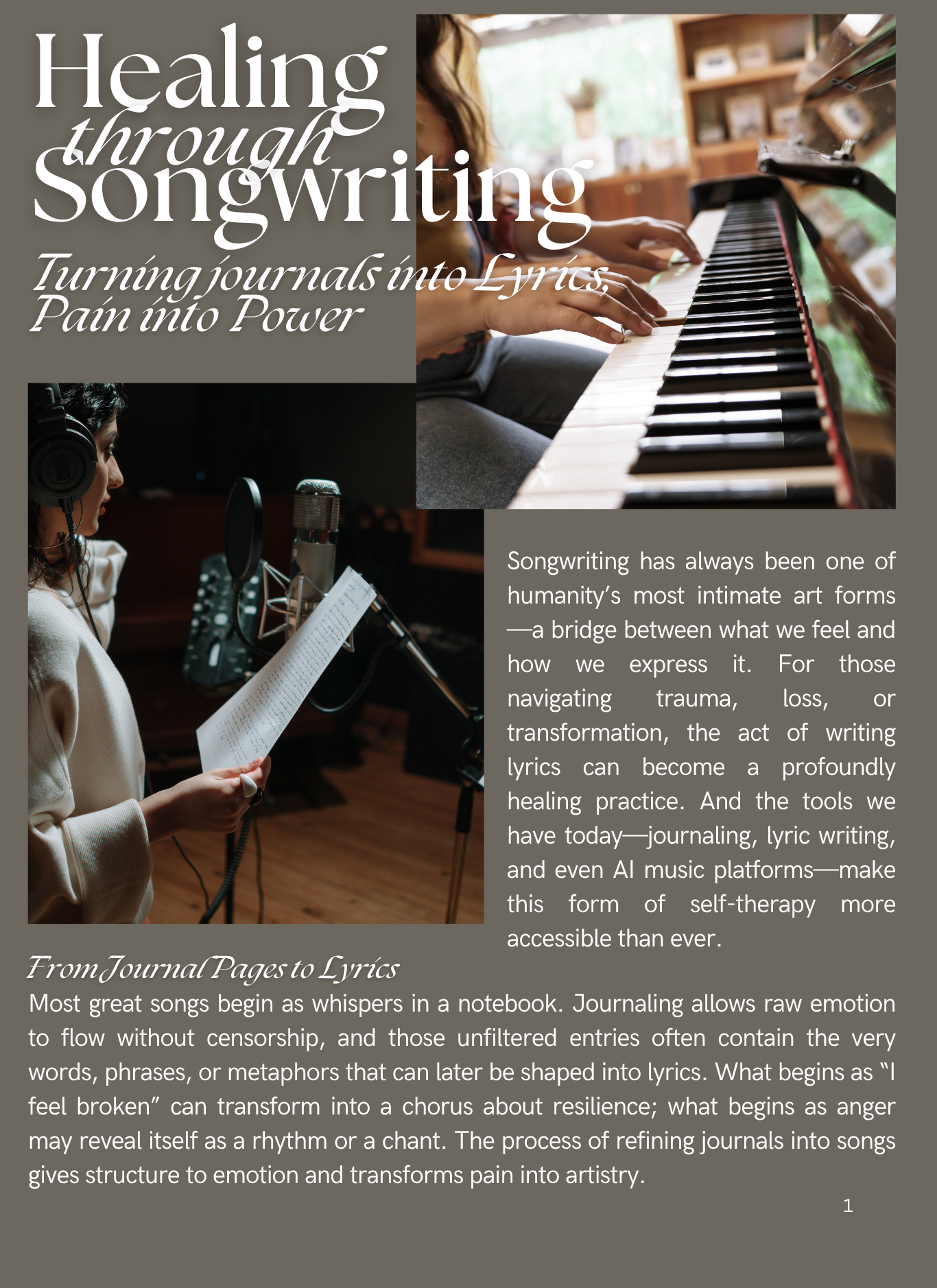
There is a particular kind of silence that follows trauma. Not the absence of sound, but the absence of words — a muteness that settles in the body like sediment. For some, that silence lasts years. For others, it breaks open unexpectedly, in fragments: a line scrawled in a notebook at three in the morning, a phrase that arrives unbidden while washing dishes, a rhythm tapped out on a steering wheel in traffic. These are the first stirrings of something that predates language itself — the human need to turn suffering into song.
Songwriting has always been one of humanity's most intimate art forms, a bridge between what we feel and how we express it. Long before the advent of recording studios or streaming platforms, people sang to mourn, to celebrate, to remember, to resist. The lullaby, the work song, the hymn, the protest chant — all of them emerged from the same impulse: to give shape to the formless, to make the internal audible.
For those navigating trauma, loss, or transformation, the act of writing lyrics can become a profoundly healing practice. It is not therapy in the clinical sense, though it shares some of therapy's aims: to process, to integrate, to find meaning. But where therapy often requires articulation and analysis, songwriting allows for ambiguity, metaphor, and the kind of emotional truth that resists explanation. A song can hold contradictions. It can be both grief and gratitude, rage and tenderness, all at once.
And the tools we have today — journaling, lyric writing, and even AI music platforms — make this form of self-expression more accessible than ever. You do not need to read music. You do not need a band, a producer, or a record deal. You need only the willingness to listen to what is already inside you, waiting to be heard.
From Journal Pages to Lyrics
Most great songs begin as whispers in a notebook. Not polished verses, but raw entries — the kind of writing that would never be shown to anyone. Journaling allows emotion to flow without censorship, without the pressure of craft or coherence. It is writing as exhalation, a way to empty the mind of what it cannot hold.
But those unfiltered entries often contain the very words, phrases, or metaphors that can later be shaped into lyrics. What begins as “I feel broken” can transform into a chorus about resilience. What begins as anger — sharp, unsparing — may reveal itself as a rhythm or a chant. The process of refining journal entries into songs gives structure to emotion. It asks: What is the core of this feeling? What image captures it? What does it sound like when spoken aloud?
This is not about making pain pretty. It is about making it bearable. The act of revision — of choosing which words stay and which fall away — is itself a form of agency. In trauma, we often lose control over our own narratives. Songwriting offers a way to reclaim them, one line at a time.
“A song can hold contradictions. It can be both grief and gratitude, rage and tenderness, all at once.”
There is also something about the compression of a song — its brevity, its repetition — that mirrors the way memory works after trauma. We do not remember in paragraphs. We remember in flashes, in refrains, in images that loop and return. A three-minute song can contain an entire year. A single verse can hold what a diary entry could not.
The Alchemy of Melody
Putting words to music changes their weight. Reading a journal entry can feel heavy, almost unbearable. But singing those same words — wrapped in melody, carried by rhythm — creates release. It externalizes what was internal. The voice becomes a vessel, and the song becomes something separate from the self, something that can be witnessed rather than merely endured.
Neuroscience offers some explanation for this. Combining language with rhythm and melody activates different parts of the brain than writing or speaking alone. Music engages the limbic system, the seat of emotion and memory, while also recruiting motor and auditory regions. This distributed activation may help us process and regulate emotions more deeply, creating new neural pathways around old pain.
But the science, however elegant, does not fully capture the experience. There is something almost mystical about the moment a lyric finds its melody — the way a tune can unlock a feeling that words alone could not reach. A minor key can make sorrow feel sacred. A driving beat can turn rage into momentum. A soft, repetitive refrain can soothe in ways that no amount of rational thought can.
This is why so many people describe songwriting as a kind of alchemy. It does not erase the pain, but it transmutes it. What was once a wound becomes a work. What was once unspeakable becomes singable.
Technology as a Healing Partner
In the past, healing through songwriting required access to instruments, studios, or collaborators. For many, that meant the impulse to create remained just that — an impulse, never realized. But today, AI music platforms allow anyone to pair their lyrics with melodies, beats, or full instrumental arrangements instantly. These tools do not replace the heart of songwriting. They amplify it.
They give voice to the emotions already written down and allow someone without technical training to hear their pain and healing transformed into music they can play back, share, or simply keep as a private ritual. The barrier to entry has collapsed. What once required a band, a producer, and a recording budget now requires only a phone and the courage to begin.
There is something democratizing about this shift, but also something deeply personal. The song you create with AI is still your song. The words are yours. The emotion is yours. The technology is simply a collaborator — one that does not judge, does not tire, does not ask you to explain yourself.
“The barrier to entry has collapsed. What once required a band and a studio now requires only a phone and the courage to begin.”
For some, this feels like a revelation. To hear your own words sung back to you — even by a synthetic voice, even over a generated track — can be startling. It makes the internal external. It gives form to what was formless. And in that moment, the song becomes real in a way it was not before.
Expression Without Judgment
For trauma survivors especially, songwriting offers both catharsis and control. Unlike therapy sessions, where words can feel too vulnerable or too exposing, songwriting allows a safe layer of creative expression. The metaphor provides distance. The melody provides comfort. The act of creation provides agency.
There is no therapist to please, no audience to impress, no standard to meet. The song can be messy. It can be incomplete. It can be angry, tender, contradictory, raw. It can be all of those things at once, and that is not only acceptable — it is often necessary.
With AI apps, one can experiment endlessly — trying different moods, tones, and sounds — without fear of getting it wrong. There is no wrong in healing art. A lyric that feels too soft can be paired with a harder beat. A verse that feels too exposed can be wrapped in reverb, made distant and dreamlike. The technology allows for iteration, for play, for the kind of creative freedom that trauma often steals.
This is not to say that songwriting replaces therapy or medical treatment. It does not. But it can exist alongside those things, as a complement, a companion practice. It offers something that clinical settings sometimes cannot: the permission to be artful with your pain, to shape it into something that feels, if not beautiful, then at least bearable.
The Neuroscience of Singing Your Story
When we sing, we engage the body in ways that speaking does not. The diaphragm deepens. The breath slows. The vocal cords vibrate, sending subtle signals through the nervous system. Singing, particularly when done slowly and with intention, can activate the parasympathetic nervous system — the part of the autonomic system responsible for rest and recovery.
This is one reason why singing has been used across cultures as a tool for healing, mourning, and ritual. It is not merely symbolic. It is physiological. The act of vocalizing — especially in a sustained, melodic way — can help regulate the nervous system, bringing the body out of a state of hyperarousal or freeze and into a state of relative calm.
Lisa Feldman Barrett, in her work on emotion and the brain, describes emotions not as hardwired responses but as predictions the brain makes based on past experience and present context. Songwriting, in this framework, becomes a way to reshape those predictions. By pairing painful memories with new contexts — melody, rhythm, creative control — we may begin to change how the brain categorizes and responds to those memories.
None of this is to reduce songwriting to a set of brain regions lighting up on a scan. The experience is far richer, far stranger, than any map could capture. But it is worth noting that what feels like magic — the way a song can shift your entire emotional state — has roots in biology as well as art.
The Song as Witness
One of the most powerful aspects of songwriting is that it creates a record. A journal entry can be private, fleeting, easily forgotten. But a song — once written, once recorded — becomes a witness to what you felt. It holds the memory so you do not have to carry it alone.
This is especially important for those whose pain has been minimized, dismissed, or denied. The song says: This happened. This mattered. I was here. It is a form of self-validation, a way of honoring your own experience without needing anyone else to confirm it.
“The song says: This happened. This mattered. I was here.”
And sometimes, the song becomes more than a witness. It becomes a companion. People return to the songs they have written in moments of doubt or despair, not because the songs offer answers, but because they offer recognition. They remind you of who you were in that moment of creation — vulnerable, yes, but also brave enough to make something from the wreckage.
There is also the possibility, though not the requirement, of sharing. Some people keep their songs entirely private. Others share them with a trusted friend, a therapist, a support group. Still others release them into the world, finding connection with strangers who hear their own pain reflected back. All of these choices are valid. The healing is not contingent on an audience.
Repetition, Ritual, and Release
Songs are built on repetition. The chorus returns. The verse cycles. The bridge offers a momentary departure before the refrain comes back, familiar and grounding. This structure mirrors the way we process difficult emotions — not in a single pass, but through return, through revisiting, through the slow work of integration.
Repetition in songwriting is not redundancy. It is ritual. Each time you sing the chorus, you are practicing a new relationship to the words. The first time, they may feel raw. The tenth time, they may feel softer. The hundredth time, they may feel like a prayer.
This is one reason why songwriting can be more effective than a single journal entry. The entry is written once and set aside. The song is sung again and again, each iteration offering a chance to metabolize the emotion a little more fully. Over time, the song can shift from a cry of pain to a declaration of survival.
And there is release in that repetition. Not the kind of release that comes from catharsis — though that can happen too — but the quieter release that comes from familiarity. The pain becomes known. It loses some of its power to ambush you. It becomes something you can hold, turn over, examine, and eventually, perhaps, set down.
The Courage to Begin
For all the accessibility that technology offers, the hardest part of songwriting remains the same: beginning. Facing the blank page. Admitting that you have something to say. Allowing yourself to be imperfect, inarticulate, uncertain.
There is no formula for this. No app can do it for you. The courage to begin comes from somewhere deeper — from the part of you that knows, even in the midst of pain, that you deserve to be heard. Even if the only one listening is you.
Start small. A single line. A single image. A feeling distilled into a phrase. You do not need to write a masterpiece. You do not need to write anything anyone else will ever hear. You need only to begin the conversation between your inner world and the outer one, between silence and sound.
The first song will not be perfect. It may not even be good, by any conventional measure. But it will be yours, and that is enough. It will be proof that you can take what is inside you and make it into something that exists outside you. That alone is a kind of healing.
What Was Silent Becomes Song
For anyone carrying pain, songwriting offers a way to move it — to shape it into something that can be heard, held, and even celebrated. Whether the melody is played on a piano at midnight or generated with a single tap on a phone, the transformation is the same: what was silent becomes song, and what was heavy becomes hymn.
This is not about transcendence. It is not about rising above or moving on. It is about moving through. It is about finding a form for what feels formless, a voice for what feels voiceless. It is about reclaiming the right to your own story, in your own words, in your own time.
“What was silent becomes song, and what was heavy becomes hymn.”
The song you write may never be performed. It may never be shared. It may live only on your phone, in a voice memo you return to when you need to remember who you were and who you are becoming. And that is more than enough.
Because the act of creation — however small, however private — is an act of hope. It says that your pain matters. That your voice matters. That you are not merely surviving, but making something new from what tried to unmake you.
In the end, healing through songwriting is not about the quality of the song. It is about the quality of attention you bring to your own experience. It is about the willingness to listen, to shape, to sing. And in that willingness, something shifts. Not all at once. Not permanently. But enough to keep going. Enough to write the next line.
Before you go
Two quiet questions.
How much of what you just read named something you already know inside your own body?
How much did this open a new question you didn’t have before?
— End —
NirvaLife Magazine · November 2025