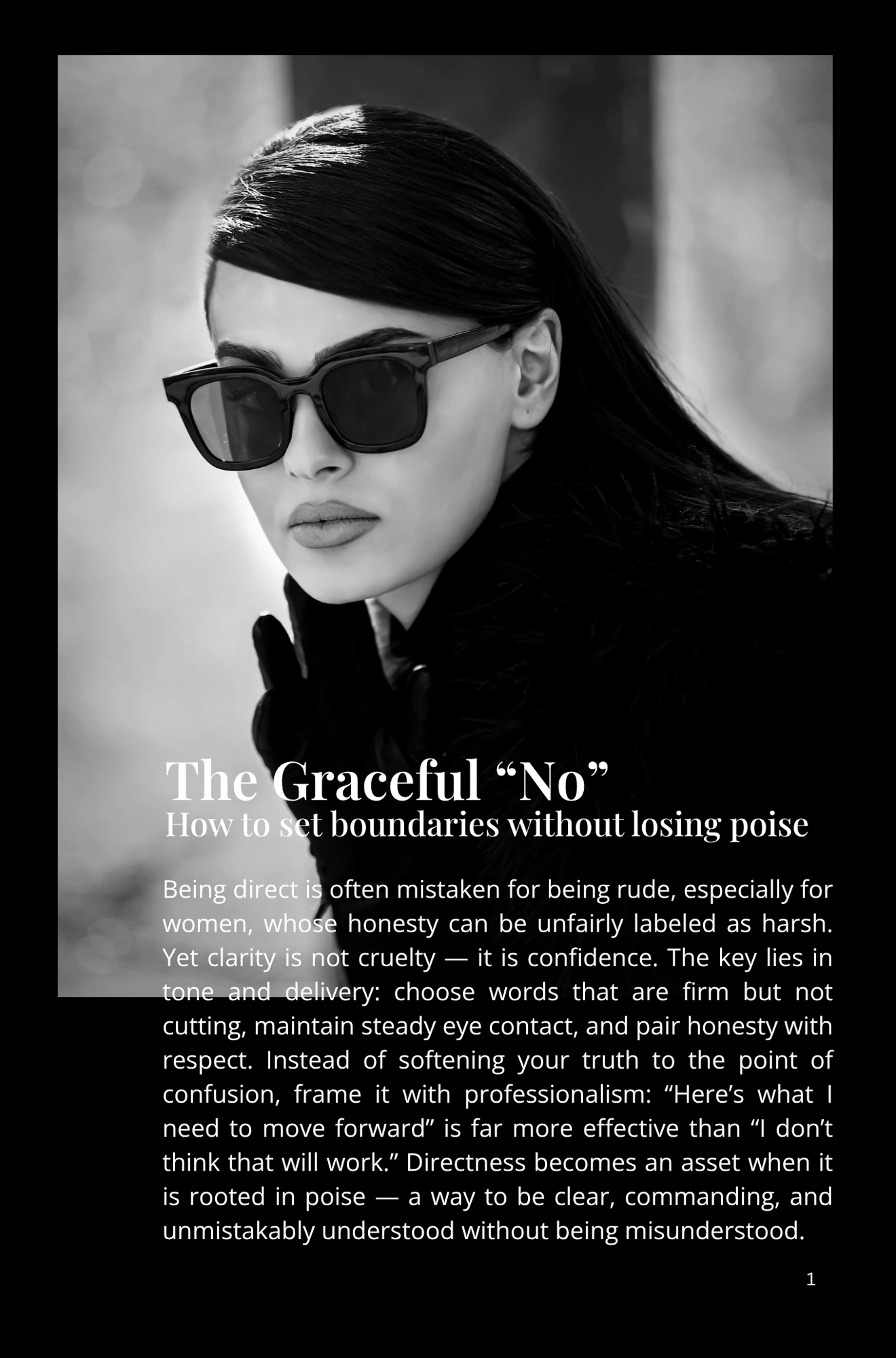
There is a particular kind of exhaustion that comes from saying yes when you mean no. It accumulates quietly, like sediment in a riverbed, until one day you realize you have built a life shaped more by accommodation than intention. The graceful refusal — the boundary set without apology, without cruelty, without the performative softening that dilutes meaning — remains one of the most undervalued skills in contemporary life. We mistake directness for aggression, clarity for coldness. Especially for women, whose honesty is so often recast as harshness, the act of saying no becomes a high-wire performance: too firm and you are difficult, too gentle and you vanish entirely.
But clarity is not cruelty. It is, in fact, a form of respect — for yourself and for the person on the receiving end. When we obscure our boundaries with qualifiers and apologies, we create confusion where there could be understanding. We waste time. We breed resentment. The graceful no is not about being liked. It is about being clear, being present, and ultimately, being trusted.
The Cost of Chronic Accommodation
The nervous system does not distinguish between a boundary violated by force and one eroded by habit. Both register as threat. When we repeatedly override our own needs — agreeing to projects we lack bandwidth for, attending events that drain us, tolerating behavior that diminishes us — the body keeps score. Cortisol rises. Sleep fragments. The gut tightens. What begins as social nicety ends as physiological burden.
Psychologist Harriet Lerner writes extensively about the ways women, in particular, are socialized to prioritize harmony over honesty. The good girl, the peacekeeper, the one who smooths over tension — these are roles assigned early and reinforced relentlessly. But harmony purchased at the expense of selfhood is not peace. It is a kind of erasure.
The irony is that chronic accommodation does not make us easier to be around. It makes us unpredictable. When we finally reach our limit — and we always do — the no that emerges is often disproportionate, edged with frustration, delivered in a tone that surprises even us. The people around us are bewildered. Where did this come from? But we know. It came from a hundred smaller nos we swallowed.
Learning to set boundaries early, clearly, and without drama is not selfishness. It is maintenance. It is the difference between a life you inhabit and a life that happens to you.
“Clarity is not cruelty. It is, in fact, a form of respect — for yourself and for the person on the receiving end.”
The Anatomy of a Graceful Refusal
A graceful no has structure. It is not a soliloquy. It does not require justification, though it may include context. It does not apologize for existing. The formula is simpler than we imagine: acknowledge, decline, offer an alternative if appropriate, and stop talking.
Consider the difference between these two responses to an unreasonable request. The first: 'Oh, I'm so sorry, I wish I could help, I just have so much going on right now, maybe if things calm down next week I could try, but I'm not sure, let me see…' The second: 'I won't be able to take that on. I hope you find the right person for it.' One is a tangle of anxiety. The other is a door, closed with care.
The key is tone. A firm no delivered with warmth lands differently than the same words delivered with ice. Eye contact matters. Posture matters. The goal is not to punish the asker but to inform them. You are drawing a line, not drawing blood.
Sometimes an alternative softens the refusal without compromising it. 'I can't do Thursday, but I'm free Monday.' 'I'm not the right fit for this, but you might try reaching out to Sarah.' These are gestures of goodwill, not obligations. They demonstrate that your no is specific, not a rejection of the person.
When Directness Is Misread
There is a gendered dimension to how directness is received. Research on workplace communication consistently shows that women who communicate with the same level of assertiveness as their male colleagues are perceived as more aggressive, less likable, and less competent. The double bind is real: be too soft and you are dismissed; be too firm and you are penalized.
This is not a reason to retreat into vagueness. It is a reason to be strategic. Directness rooted in poise — calm, clear, unapologetic — is harder to dismiss than directness laced with defensiveness. The goal is not to perform femininity in a way that makes others comfortable. The goal is to communicate in a way that cannot be misunderstood.
Linguist Deborah Tannen has spent decades studying conversational styles and notes that women are more likely to use hedging language — 'I think,' 'maybe,' 'sort of' — as a way to soften statements and invite collaboration. In some contexts, this works beautifully. In others, it undermines authority. Knowing when to hedge and when to hold firm is part of the art.
If your no is met with pushback, repetition is your friend. You do not need to escalate. You do not need to justify further. You simply restate. 'I understand this is important to you, and my answer is still no.' This is not rudeness. This is clarity under pressure.
“A graceful no is not about being liked. It is about being clear, being present, and ultimately, being trusted.”
The Nervous System and Boundary-Setting
Setting a boundary activates the nervous system. For many of us, especially those with histories of relational trauma or chronic people-pleasing, the act of saying no can trigger a fight-or-flight response. The heart races. The throat tightens. The mind floods with catastrophic predictions: they will hate me, I will be alone, I will be punished.
This is not weakness. This is the nervous system doing what it was designed to do: protect you from social rejection, which, in our evolutionary past, could mean death. The problem is that the system has not updated its threat assessment. Being disliked at a dinner party is not the same as being exiled from the tribe.
Polyvagal theory, developed by Stephen Porges, offers a useful framework here. When we feel safe, our ventral vagal system is online — we are calm, connected, capable of nuance. When we feel threatened, we shift into sympathetic arousal or dorsal shutdown. A boundary set from a state of activation will feel and sound different than one set from a state of groundedness.
This is why preparation matters. If you know a difficult conversation is coming, tend to your nervous system first. Breathe slowly. Ground your feet. Remind yourself that you are not in danger. The no you deliver from a regulated state will be clearer, kinder, and more likely to land well.
Reframing the Narrative
We have been taught to think of boundaries as walls, as acts of withholding, as evidence of coldness or selfishness. But boundaries are not barriers. They are definitions. They are the edges that allow us to know where we end and another begins. Without them, we dissolve.
Therapist and author Nedra Glover Tawwab describes boundaries as a form of self-respect made visible. When you say no to what depletes you, you say yes to what sustains you. When you protect your time, your energy, your emotional bandwidth, you become more available — not less — to the people and projects that matter.
This reframing is essential. A boundary is not a punishment. It is not a rejection. It is information. It tells the people around you how to be in relationship with you in a way that works for both of you. The people who respect your boundaries are the ones worth keeping close.
And the people who do not? Their resistance is also information. It tells you that they were more invested in your compliance than your well-being. That is a painful truth, but it is a clarifying one.
The Practice of Poise
Poise is not something you are born with. It is something you build, repetition by repetition, boundary by boundary. It is the steadiness that comes from knowing what you will and will not tolerate, and communicating that knowledge without apology.
Start small. Practice saying no in low-stakes situations. Decline the extra project. Skip the event that exhausts you. Say no to the phone call you do not have energy for. Notice what happens. Notice that the world does not end. Notice that most people move on quickly. Notice that the ones who do not were likely testing your limits all along.
Pay attention to your body. Where do you feel the no before you say it? Is it a tightness in your chest, a clenching in your jaw, a flutter in your stomach? Learn to recognize these signals as data, not obstacles. Your body often knows your boundaries before your mind catches up.
And when you do say no, resist the urge to fill the silence that follows. Let it land. Let the other person process. You do not need to manage their disappointment. You do not need to fix their feelings. You need only to hold your line.
“Poise is the steadiness that comes from knowing what you will and will not tolerate, and communicating that knowledge without apology.”
The Long Game
Setting boundaries is not a one-time event. It is an ongoing practice, a recalibration that happens across a lifetime. What you tolerated at twenty-five may be intolerable at forty. What felt essential in one season may feel optional in another. This is not inconsistency. This is growth.
The graceful no is not about rigidity. It is about clarity. It is about knowing yourself well enough to discern what nourishes you and what depletes you, and having the courage to act on that knowledge. It is about building a life that reflects your values, not your fears.
There will be people who do not understand. There will be people who take your boundaries personally, who accuse you of changing, of becoming difficult, of thinking you are too good for them now. Let them. Their discomfort is not your responsibility. Your integrity is.
Over time, something shifts. The no that once felt terrifying becomes routine. The boundary that once required all your courage becomes automatic. You stop bracing for conflict and start trusting your voice. You stop performing availability and start inhabiting your life.
A Final Word
The graceful no is not a rejection of connection. It is a prerequisite for it. Real intimacy requires honesty. Real collaboration requires clarity. Real respect requires boundaries. When you say no to what does not serve you, you make space for what does.
This is not easy work. It will cost you some relationships. It will reveal who was with you because of who you are and who was with you because of what you provided. That revelation will sting. But on the other side of it is a kind of freedom that changes everything.
You will learn that you can be direct without being cruel. You can be firm without being cold. You can hold your ground without losing your grace. And in doing so, you will discover that the life you were so afraid to claim was waiting for you all along.
Before you go
Two quiet questions.
How much of what you just read named something you already know inside your own body?
How much did this open a new question you didn’t have before?
— End —
NirvaLife Magazine · November 2025