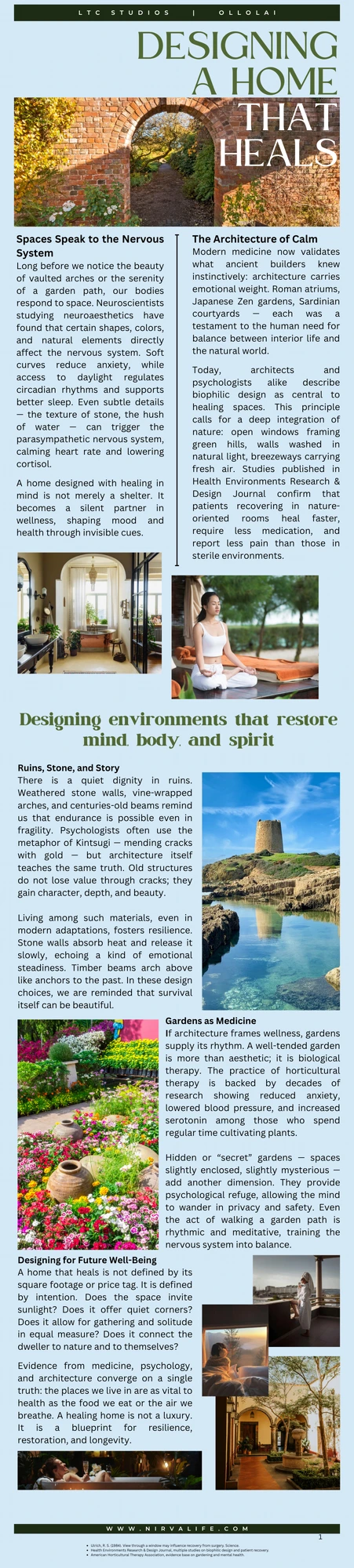
A home is not simply a shelter. It is a nervous-system environment — a sequence of light, sound, texture, and scent that either regulates you or subtly dysregulates you every day. We speak often of homes as reflections of taste, as investments, as backdrops for living. But we speak less often of what they do to the body while we are inside them. Whether they calm the amygdala or quietly activate it. Whether they allow the parasympathetic system to do its work, or whether they keep us, hour after hour, in a low-grade state of vigilance we mistake for normal.
A home that heals is one that has been designed for the body, not just the eye. It has a door that closes fully, with a sound that signals boundary rather than intrusion. It has textures that are warm to the hand. A palette that does not raise your cortisol. Light that changes gently through the day, and darkness at night that is truly dark. These are not luxuries. They are conditions for regulation.
The idea that our surroundings shape our inner states is not new. What is new is the precision with which we can now describe the mechanism. The nervous system is not a passive recipient of décor. It is an ancient surveillance apparatus, constantly scanning for signals of safety or threat. A sharp corner in peripheral vision. A flickering bulb. A synthetic fragrance with no correlate in nature. The body notices, even when the mind does not.
The Architecture of Safety
Stephen Porges, who developed polyvagal theory, describes the nervous system as engaged in a process he calls neuroception — the subconscious detection of safety or danger. It happens below the level of conscious thought. A room can feel wrong before you understand why. The ceiling too low. The lighting too bright. The air too still. These are not aesthetic preferences. They are somatic readings.
The homes we inherit from the last century were designed for efficiency, for display, for the smooth operation of domestic labor. They were not designed for nervous-system regulation. Open-plan living, for instance, eliminates walls and doors in the name of flow and connection. But it also eliminates acoustic privacy, spatial boundaries, and the ability to retreat. For some people, this openness feels expansive. For others, it feels like living on a stage.
A healing home does not impose a single mood. It offers variation. Rooms that are bright and rooms that are dim. Spaces for gathering and spaces for solitude. The ability to modulate your environment is itself regulating. It returns a measure of control to the body, which is always asking: can I be safe here? Can I rest?
Doors matter. Thresholds matter. The transition from public to private, from day to night, from work to rest — these are not merely symbolic. They are neurological events. A home that heals marks these transitions clearly. It does not blur them.
Sight: The Tyranny of Contrast
The eye is drawn to contrast. High contrast commands attention, which is why it is used in advertising, in signage, in any context where the goal is to interrupt. But a home is not a billboard. It is a place where attention should be allowed to soften.
Rooms painted in stark white with black accents may photograph well, but they ask the nervous system to stay alert. The visual system is constantly recalibrating between extremes of light and dark. This is effortful. It is the opposite of rest. A palette of low contrast — soft whites, warm grays, muted earth tones — allows the eye to relax. The body follows.
Natural tones are regulating not because they are fashionable but because they are familiar. The human eye evolved in landscapes of ochre, green, brown, and blue. These colors do not demand processing in the same way that synthetic brights do. They are legible to the older parts of the brain.
“A palette of low contrast allows the eye to relax. The body follows.”
Lines matter, too. Unhurried lines. Curves where possible. The built environment of the last century favored the grid, the right angle, the hard edge. But the body is curved. Water is curved. Trees are curved. A room with some softness in its geometry feels more hospitable to a nervous system that evolved in a world without straight lines.
Sound: The Forgotten Sense
We are more tolerant of visual clutter than acoustic clutter, but the nervous system is not. Sound is processed faster than sight. A sudden noise triggers the startle reflex before the conscious mind has identified the source. This is adaptive in the wild. It is exhausting in the home.
Soft floors help. Rugs, cork, wood — anything that absorbs rather than amplifies footfall. Hard surfaces reflect sound, multiplying it. A room of tile and glass and concrete is a room that never stops talking. The body cannot fully settle in a space where every movement is announced.
Closed doors are a gift. They allow sound to be contained, which means the nervous system does not have to track every event in the house. You can hear your own thoughts. You can hear silence, which is not the absence of sound but the presence of quiet.
Music, when it is played, should have room to breathe. Not as background filler, not as a hedge against discomfort, but as an intentional presence. The body knows the difference between music that is listened to and music that is merely on.
Touch: Materials That Answer Back
The skin is the largest organ. It is also a sense organ, constantly gathering information about temperature, texture, weight. A home that heals offers materials that answer the hand. Linen that softens with age. Wool that holds warmth. Wood that has grain and variation. Stone that is cool in summer and solid underfoot.
These materials are not inert. They respond to touch, to use, to time. They develop patina. They show their history. This is regulating in a way that plastic and laminate are not. The body trusts materials that change, because change is a sign of life.
Synthetic materials, by contrast, are static. They do not age. They do not breathe. They do not absorb moisture or release it. The nervous system reads this as unnatural, which is to say, as something to be monitored. A low-level vigilance that never quite resolves.
“The body trusts materials that change, because change is a sign of life.”
Texture also matters at the level of the hand. Smooth is not always better. A slight roughness — the weave of linen, the grain of oak — gives the hand something to hold onto. It is grounding in the literal sense. It reminds the body that it is in contact with the world.
Scent: The Shortest Path to Memory
Scent bypasses the thalamus and goes directly to the limbic system, the part of the brain involved in emotion and memory. This is why a fragrance can transport you instantly to another time, another place. It is also why synthetic fragrances can be so destabilizing. They have no referent in nature. The brain does not know what to do with them.
A healing home has one scent, at most two, and never chemical. The smell of bread. Of wood. Of clean linen. Of a candle made from beeswax, not paraffin. These are scents the body recognizes. They do not demand interpretation.
Fragrance layering — the practice of combining multiple scented products in a single space — is overstimulating. The olfactory system is not designed to parse a dozen competing inputs. It is designed to detect one clear signal: smoke, rot, bloom. In the absence of clarity, the system stays alert.
The best homes smell like almost nothing. Or rather, they smell like themselves. Like the materials they are made from. Like the air that moves through them. This is not an absence. It is a kind of olfactory spaciousness.
Light: The Master Regulator
Light is the most powerful regulator of circadian rhythm, and circadian rhythm is the foundation of nearly every physiological process. Sleep, digestion, mood, immune function — all of it is timed by light. A home that heals understands this.
Natural light should be abundant during the day, and it should change. Morning light is cool and blue-shifted. Afternoon light is warmer. Evening light is amber. These shifts signal to the body what time it is, which allows the internal clock to stay synchronized with the external world. When light is static — the same color temperature from morning to night — the body loses its temporal bearings.
Artificial light should be dimmable, and it should be warm in the evening. Bright overhead lighting after sunset suppresses melatonin and delays sleep onset. This is not a minor inconvenience. It is a disruption of the body's most fundamental rhythm. A healing home has lamps, not overheads. It has light sources at multiple heights, so that the room can be gently illuminated without flooding the retina.
Darkness at night should be truly dark. Blackout shades, if necessary. No standby lights, no glowing screens, no ambient light from streetlamps. The body needs darkness to produce melatonin, and melatonin is not only a sleep aid. It is an antioxidant, an immune modulator, a signal that the day is over and repair can begin.
The Kitchen: Regulation Before Instagram
The kitchen has become a theater. Open shelving, statement tile, appliances in colors that announce themselves. These are choices made for the camera, not the cook. A healing kitchen is organized around a different principle: does this support my ability to feed myself well, with minimum friction?
That means tools within reach. Ingredients visible. A surface that is easy to clean. A layout that does not require unnecessary steps. The body is more likely to cook when cooking feels possible, and it is more likely to feel possible when the environment is set up for it.
The aesthetics of the kitchen matter less than its functionality, but functionality has its own aesthetic. A wooden cutting board, worn smooth. A row of glass jars. A single good knife. These are beautiful because they are useful, and they are useful because they have been chosen with care.
A kitchen that supports regulation is also a kitchen that limits decision fatigue. Not thirty spices, but ten. Not five kinds of oil, but two. Not a drawer full of gadgets, but a few tools that do their work well. Simplicity is not deprivation. It is clarity.
Editing as an Act of Care
A healing home is not expensive. It is edited. Everything in it is chosen because it earns its place — and everything else has been kindly asked to leave. This is not minimalism as an aesthetic. It is minimalism as a nervous-system strategy.
The body is always processing its environment. Every object in a room is a piece of information. A cluttered space is an information-rich space, and information requires processing. The more there is to process, the less bandwidth remains for everything else. For thought. For rest. For the quiet work of being alive.
“Simplicity is not deprivation. It is clarity.”
Editing is not about throwing things away. It is about asking what remains. What is essential. What is loved. What serves the life you are actually living, not the life you imagine you might live someday. A vase you never use is not neutral. It is a small, constant reminder of a gap between intention and reality. The body feels that gap.
The process of editing is itself regulating. It is an exercise in agency. You are deciding what stays and what goes. You are shaping your environment rather than being shaped by it. This is not a small thing. The nervous system calms when it perceives that you have some measure of control.
The Room Where Your Body Exhales
There is a moment, if you are lucky, when you walk into a room and feel your shoulders drop. Your breath deepens. The vigilance you did not know you were carrying begins to dissolve. This is not magic. It is the nervous system recognizing safety.
The most luxurious room in the world is the one where your body finally exhales. It is not the room with the most expensive furniture or the most impressive view. It is the room that asks nothing of you. The room that allows you to be exactly as you are, without performance, without adjustment, without the need to manage anything at all.
This kind of room is rare, but it is not impossible. It is built slowly, with attention. With an understanding that a home is not a static object but a living system, and you are part of that system. What you bring into it matters. What you remove matters. How you light it, how you scent it, how you arrange it — all of it matters, because all of it is speaking to your body, all the time.
A home that heals does not happen by accident. It happens when you stop designing for the eye and start designing for the body. When you stop asking what looks good and start asking what feels safe. When you understand that the space you live in is not separate from your nervous system. It is part of it.
The Long Work of Coming Home
We spend so much of our lives trying to regulate ourselves in environments that dysregulate us. We buy supplements, we try breathwork, we schedule therapy. All of this helps. But we rarely ask whether the place we return to every day is working with us or against us.
A home that heals is not a luxury reserved for those with resources. It is a set of principles that can be applied anywhere, in any budget. It begins with awareness. With noticing what your body is telling you. With asking whether the space you live in is a place where your nervous system can rest, or whether it is one more thing you have to manage.
The work of creating a healing home is slow. It is not a weekend project. It is a practice of attention, of listening, of small adjustments over time. A lamp moved. A rug added. A door that finally closes all the way. These are not dramatic interventions. But they are cumulative. And over time, they change the felt sense of a place.
The body knows when it is home. Not home as an address, but home as a state. A state of safety, of rest, of being held without effort. That is what a healing home offers. Not perfection. Not style. But the quiet, steady condition in which the nervous system can do what it was designed to do: restore, repair, and return you to yourself.
Before you go
Two quiet questions.
How much of what you just read named something you already know inside your own body?
How much did this open a new question you didn’t have before?
— End —
NirvaLife Magazine · November 2025