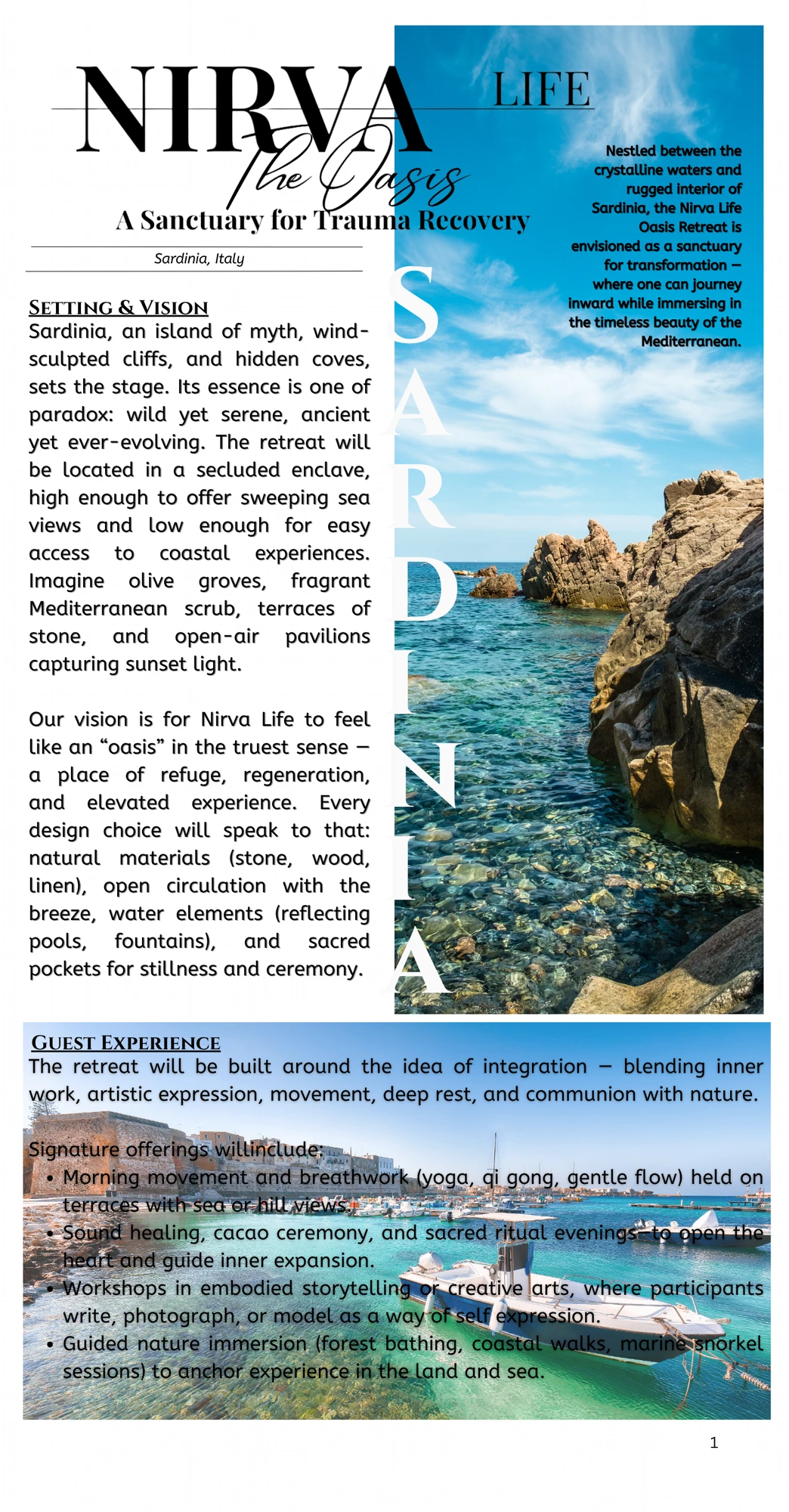
The Oasis is not a wellness resort. It is not a spa with a mission statement, not a detox with a view, not a place where someone will teach you to breathe better or eat cleaner or finally, finally fix yourself. It is something quieter and more radical: a designed environment where a woman can, at last, stop performing recovery — and finally begin it.
This distinction matters. Because for years now, the language of restoration has been co-opted by an industry that asks you to work harder at resting, to optimize your downtime, to track your sleep and measure your cortisol and gamify your nervous system into submission. The Oasis refuses that logic entirely. It begins with a different premise: that healing does not happen because you push through it. It happens because you are held long enough to stop performing it.
The project has been in quiet development for three years, led by a small team of architects, clinicians, and designers who share a single conviction: that the built environment is not neutral. That a room can be a kind of medicine. That light, texture, sound, and scale are not aesthetic choices but neurological ones. The Oasis is the first retreat designed from the ground up with the nervous system as its organizing principle.
What it means to design for safety
Walk into most hotel rooms and you will find the same things: overhead lighting that flattens everything, synthetic fabrics that feel vaguely wrong against the skin, air that smells of nothing or of something trying too hard to smell like nothing. Doors that do not quite seal. Windows that do not quite open. A hum you cannot place. These are small things, easily dismissed. But the nervous system does not dismiss them. It catalogs them. It stays alert.
At The Oasis, every room is chosen for its light — not just the quantity but the quality, the way it moves across the day, the way it touches the walls. Beds are chosen for their weight, their substance, the way they hold a body without swallowing it. Linens are linen, cotton is cotton, wool is wool. No synthetics. No approximations. Textures are what they claim to be. Sound levels are kept low, not through white noise machines but through careful acoustic design: thick walls, soft surfaces, rooms positioned away from mechanical systems and human traffic.
Doors close fully. Locks work. Windows open when you want them to and stay closed when you do not. These are not luxuries. They are the baseline conditions for a nervous system that has spent years on high alert, scanning for threat, unable to fully let down. As Bessel van der Kolk writes in The Body Keeps the Score, safety is not a cognitive decision. It is a visceral experience. The body must feel it before the mind can believe it.
“Healing does not happen because you push through it. It happens because you are held long enough to stop performing it.”
The Oasis does not ask you to trust it. It earns that trust through consistency, through attention, through the accumulation of small reliable things. A licensed clinical lead is on site for every stay — not to facilitate workshops or lead group sessions, but to be present, to hold the container, to ensure that if something shifts or cracks or opens, there is someone trained to meet it.
The architecture of stillness
The inaugural location — details of which are being released in phases to those on the notification list — sits on land that has been quiet for a long time. No history of industrial use, no buried toxins, no legacy of extraction. The building itself is small, designed to hold no more than eight women at a time. This is intentional. Intimacy scales poorly. Safety requires a certain kind of smallness.
The common spaces are arranged not for socializing but for coexistence. You can be in a room with others without having to perform connection. There are corners, alcoves, places to tuck yourself away while still being held by the larger structure. The design language is spare but not cold, minimal but not austere. It borrows from the Japanese concept of ma — the space between things, the pause that gives meaning to what surrounds it.
There is a library, but it is not curated to inspire you. It is full of novels, memoirs, poetry — books that ask nothing of you except that you turn the pages. There is a kitchen, but you are not expected to cook. Meals are prepared by someone else, quietly, and left in places where you can find them when you are ready. The food is simple, whole, unfussy. No superfoods. No adaptogens. Just food.
The women who come
The Oasis is designed for women, and this is not incidental. Women are socialized to perform wellness, to manage everyone else's nervous systems while neglecting their own, to smile through exhaustion and call it resilience. The cultural script is clear: if you are struggling, it is because you are not trying hard enough. Meditate more. Exercise more. Eat better. Sleep better. Optimize. Perform.
The women who come to The Oasis are not looking for another program. They are looking for permission to stop. Many of them are high-functioning, which is to say they have learned to function while carrying an enormous amount of internal weight. They hold jobs, raise children, maintain relationships, show up. And they are tired in a way that sleep does not fix.
Some come in the aftermath of trauma. Some come in the middle of it. Some come simply because they have been running for so long they no longer remember what it feels like to stand still. The application process is not about worthiness or readiness. It is about fit. The clinical team reviews each application carefully, looking not for the most dramatic story but for the women who will benefit most from this particular kind of holding.
“Safety is not a cognitive decision. It is a visceral experience. The body must feel it before the mind can believe it.”
What happens there
Nothing is scheduled. There is no itinerary, no agenda, no list of activities designed to fill your days. This is harder than it sounds. Most of us have forgotten how to be unscheduled. We reach for our phones, for tasks, for anything that will give shape to the shapeless hours. The Oasis holds space for that discomfort without trying to solve it.
You might sleep for two days straight. You might cry in ways you have not allowed yourself to cry in years. You might sit in a chair and stare at the wall and feel nothing, and that is fine. You might feel everything at once, a sudden upwelling of grief or rage or relief, and that is fine too. The clinical lead is there not to guide you through a process but to witness whatever arises, to help you stay with it, to remind you that you are safe even when it does not feel that way.
Some women walk the land. Some write. Some sit in silence. Some talk, haltingly at first, then more freely, to the other women or to the clinician or to themselves. There is no right way to do this. There is no outcome to achieve. The only goal is to be there, fully, without the armor you usually wear.
As Lisa Feldman Barrett describes in How Emotions Are Made, the brain is constantly predicting what the body needs based on past experience. If your past has taught you that rest is dangerous, that letting down means being hurt, your brain will resist it even when you desperately want it. The Oasis works with that resistance, not against it. It does not ask you to override your nervous system. It offers an environment stable enough that your nervous system can, slowly, begin to recalibrate.
The clinical container
The presence of a licensed clinical lead distinguishes The Oasis from every other retreat. This is not a wellness facilitator or a life coach. This is a licensed therapist — often a psychologist or clinical social worker with specialized training in trauma and nervous system regulation — who is on site for the entire duration of each stay.
The role is not to provide therapy in the traditional sense. There are no scheduled sessions, no treatment plans, no clinical goals. Instead, the clinician holds what is sometimes called a therapeutic milieu: an environment in which healing can occur not because it is forced but because it is allowed. The clinician is available, present, attuned. If you need to talk, they will listen. If you need to be alone, they will respect that. If something destabilizes, they will help you find your way back.
This is not a replacement for ongoing therapy. It is a supplement, a pause, a chance to experience what it feels like to be held by someone who is trained to hold without fixing. Many women report that their time at The Oasis deepens the work they are doing with their own therapists, that it gives them a felt sense of safety they can return to when things get hard.
The question of cost
The Oasis is expensive. This is stated plainly, without apology, because the economics of care are complicated and often obscured. To maintain the level of clinical support, the quality of the physical environment, and the small scale necessary for true safety requires resources. The team has worked to keep costs as transparent as possible, and a portion of each stay is subsidized to allow for a limited number of reduced-rate placements each year.
There is no pretending that this is accessible to everyone. It is not. That inequity is real and painful, and the team is committed to expanding access over time through partnerships, sliding scales, and scholarship funds. But they have also chosen not to compromise on the elements that make The Oasis what it is. Cheaper versions exist. They are called wellness retreats, and they are everywhere, and they are not this.
For the women who can access it, the cost is often framed not as a luxury but as a necessity — the kind of investment you make when you realize that without it, you will not survive in any meaningful sense. It is the cost of stopping before you break.
What comes after
Leaving is hard. Not because The Oasis is a place you want to stay forever, but because returning to ordinary life means returning to the conditions that made you need it in the first place. The clinical team prepares you for this. There are integration sessions in the final days, conversations about what you will carry back and what you will need to protect.
You do not leave fixed. You leave different. More aware of what your body is telling you. More willing to listen. More able to recognize when you are performing wellness and when you are actually resting. The nervous system does not reset in a week. But it can, in the right conditions, remember what safety feels like. And that memory becomes a reference point, something to return to when the world gets loud again.
“You do not leave fixed. You leave different.”
Some women return. Some come once and carry it with them. Some stay in touch with the other women they met, forming quiet networks of support that continue long after they leave. The Oasis does not promise transformation. It promises something smaller and more durable: a chance to stop, to be held, to remember that you are not a problem to be solved.
How to learn more
Inaugural locations, itineraries, and application details are unfolding in phases. The first site will open in early spring, with a second location planned for late summer. Each site will host a limited number of stays per year, and demand is expected to be high.
If you would like to be among the first to receive information as it becomes available, you can notify the team through the contact page on these pages. There is no obligation, no mailing list that will flood your inbox. Just a quiet alert when the next round of details is released.
The Oasis is not for everyone. It is not meant to be. It is meant for the women who need it, who have been holding themselves together for so long they have forgotten what it feels like to be held by something else. It is meant for the women who are tired of performing recovery and ready, finally, to begin it.
This is not a place to fix yourself. It is a place to stop pretending you need fixing. It is a place where the work is not to do more but to finally, mercifully, do less. Where the only thing asked of you is that you show up, as you are, and let yourself be held.
— End —
NirvaLife Magazine · January 2026