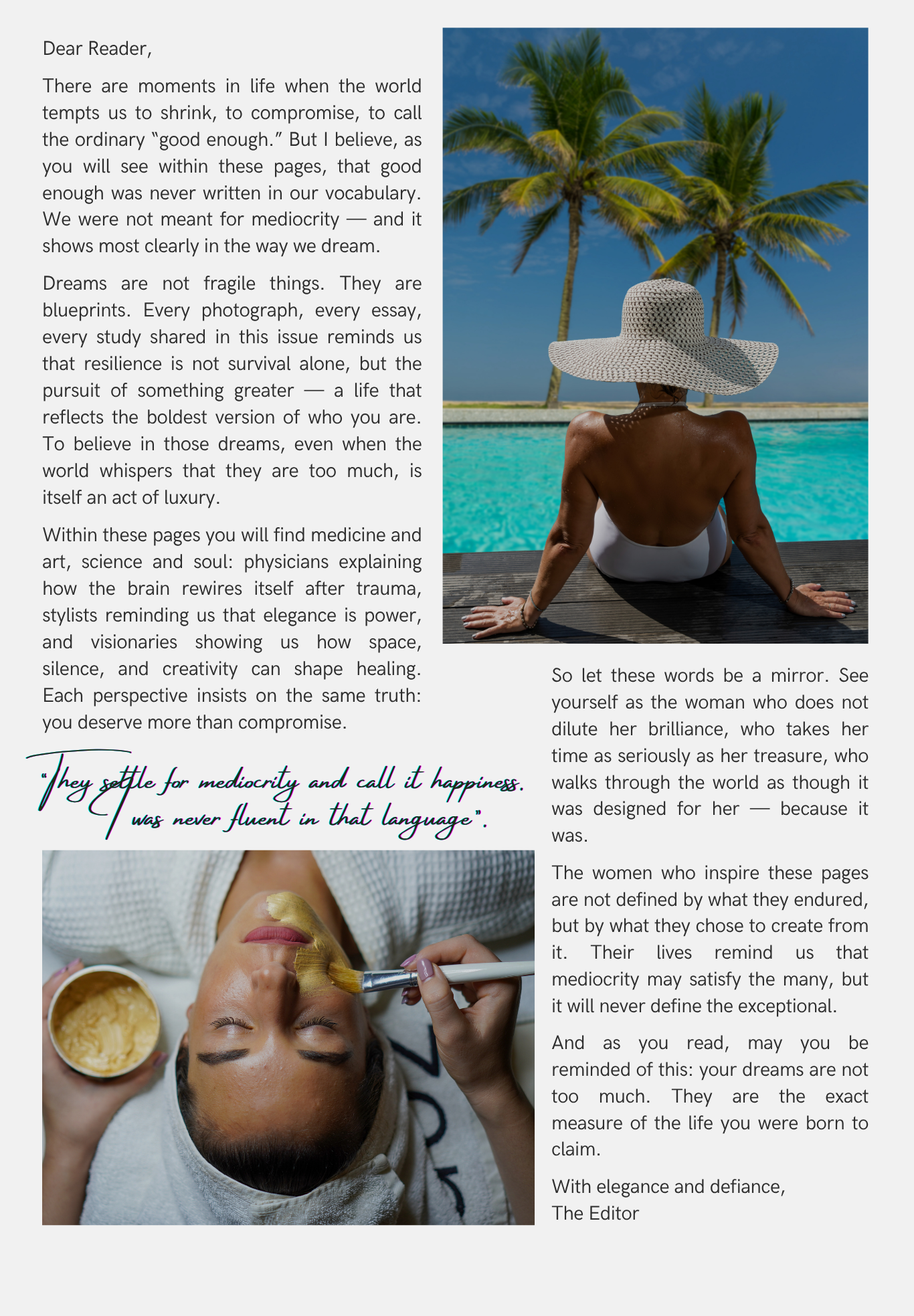
Dear Reader, there are moments in life when the world tempts us to shrink, to compromise, to call the ordinary “good enough.” But I believe, as you will see within these pages, that good enough was never written in our vocabulary. We were not meant for mediocrity — and it shows most clearly in the way we dream.
Dreams are not fragile things. They are blueprints. Every photograph, every essay, every study shared in this issue reminds us that resilience is not survival alone, but the pursuit of something greater — a life that reflects the boldest version of who you are. To believe in those dreams, even when the world whispers that they are too much, is itself an act of luxury.
I have been thinking lately about the language we inherit. The one that tells us to be grateful for scraps. The one that frames ambition as greed, rest as laziness, and beauty as vanity. It is a language designed to keep us small, to make us complicit in our own diminishment. And I have come to understand that fluency in that language is optional.
This issue of Nirva Life is, in many ways, a refusal. A refusal to accept the premise that excellence is excessive. A refusal to apologize for wanting more — not more things, necessarily, but more depth, more meaning, more alignment between the life we live and the life we know we are capable of living.
The Architecture of Ambition
Within these pages you will find medicine and art, science and soul: physicians explaining how the brain rewires itself after trauma, stylists reminding us that elegance is power, and visionaries showing us how space, silence, and creativity can shape healing. Each perspective insists on the same truth: you deserve more than compromise.
The nervous system, as we explore in depth this month, is not a fixed structure. It is a living archive of every choice we make, every boundary we set, every risk we take. Neuroplasticity — the brain's capacity to reorganize itself — is not merely a clinical phenomenon. It is proof that we are not condemned to repeat the patterns we inherited. We can, quite literally, rewire ourselves toward the life we want.
But rewiring requires intention. It requires us to stop performing the version of ourselves that others find palatable and start building the version that feels true. This is not self-improvement in the shallow sense. It is self-architecture.
In our feature on trauma and transformation, Dr. Bessel van der Kolk's work reminds us that the body keeps the score — but it also keeps the possibility. Healing is not about erasing what happened. It is about reclaiming agency over what happens next. The women profiled in this issue have done exactly that. They have taken their pain and used it as raw material for something unprecedented.
“They settle for mediocrity and call it happiness. I was never fluent in that language.”
Elegance as Resistance
There is a particular kind of power in choosing beauty when the world expects you to settle for function. Elegance is not about perfection. It is about precision. It is the refusal to let chaos dictate the terms of your life.
In our conversation with stylist and creative director Amara Chen, she speaks about the quiet defiance of dressing well. Not for others, but for the version of yourself you are becoming. She says that style is a form of self-respect, a daily practice of showing up for your own life as though it matters. Because it does.
This is not vanity. It is clarity. When you move through the world with intention — in the way you dress, the way you speak, the way you occupy space — you send a signal to your nervous system: I am worth the effort. And that signal, repeated over time, becomes belief.
Elegance, in this sense, is a form of resistance. It is the refusal to let exhaustion, disappointment, or fear erode the standards you hold for your own life. It is the insistence that even in difficulty, especially in difficulty, you will not abandon yourself.
The Myth of Balance
We are often told to seek balance, as though life were a scale that could be perfectly calibrated. But balance, I have come to believe, is a myth designed to keep us striving for an impossible equilibrium. Life is not balanced. It is seasonal.
There are seasons for building and seasons for rest. Seasons for visibility and seasons for retreat. The women who thrive are not the ones who have mastered balance. They are the ones who have learned to move with the rhythm of their own needs, rather than against them.
In our piece on circadian health and the nervous system, chronobiologist Dr. Satchin Panda's research reveals what many of us already know intuitively: our bodies are not machines. They are ecosystems. They require light and dark, activity and stillness, stimulation and silence. When we ignore these rhythms, we do not become more productive. We become depleted.
The luxury, then, is not in achieving balance. It is in granting yourself permission to live in alignment with your own biology, even when that alignment looks nothing like what the culture prescribes.
On Defiance and Dreams
Let me be clear: the dreams I am talking about are not the sanitized, Instagram-friendly kind. They are not vision boards or affirmations. They are the deep, inconvenient, sometimes terrifying visions of a life that does not yet exist but insists on being built.
These are the dreams that wake you at three in the morning. The ones that make you question everything you thought you wanted. The ones that require you to walk away from what is comfortable in order to reach for what is true.
To pursue these dreams is an act of defiance. It is a refusal to accept the life that was handed to you and a commitment to the life you are capable of creating. It is not easy. It is not always supported. But it is, I would argue, the only way to live without regret.
“Your dreams are not too much. They are the exact measure of the life you were born to claim.”
The women profiled in this issue — the neuroscientist who left academia to build a clinic for trauma survivors, the architect who designs spaces for silence, the writer who walked away from a bestselling career to start over — are not extraordinary because they are fearless. They are extraordinary because they acted in spite of fear.
The Cost of Compromise
There is a cost to living small. It is not always visible. It does not announce itself. But it accumulates, quietly, in the space between who you are and who you pretend to be.
Compromise, when it is strategic, can be wise. But compromise as a default setting — the constant negotiation of your needs, your time, your vision — is corrosive. It teaches your nervous system that you are not safe to want what you want. And over time, that message becomes a belief.
In her book How Emotions Are Made, neuroscientist Lisa Feldman Barrett describes the brain as a prediction machine, constantly using past experience to anticipate the future. If your past is filled with evidence that your desires are too much, that your ambitions are unrealistic, that your standards are unreasonable, your brain will continue to predict more of the same. It will nudge you toward smaller dreams, safer choices, quieter lives.
Breaking that pattern requires more than positive thinking. It requires new evidence. It requires you to act as though your dreams are reasonable, even when no one else agrees. It requires you to treat your own life as though it is worth the investment.
Space, Silence, and the Self
One of the recurring themes in this issue is the relationship between environment and identity. The spaces we inhabit shape us. They either support our becoming or they constrain it.
In our feature on architectural neuroscience, we explore how light, sound, and spatial design influence the nervous system. Certain environments calm us. Others overstimulate. Some spaces invite creativity. Others demand productivity. The question is: are you designing your environment to reflect the life you want, or are you adapting yourself to fit the space you happen to occupy?
Silence, too, is a form of space. Not the absence of sound, but the presence of stillness. In a culture that equates busyness with importance, silence is radical. It is where clarity lives. It is where the voice beneath the noise becomes audible.
The women we spoke to for this issue all share a commitment to protecting their inner silence. They guard it fiercely. They build their lives around it. Because they understand that without it, they lose access to the part of themselves that knows what is true.
The Women Who Refuse
The women who inspire these pages are not defined by what they endured, but by what they chose to create from it. Their lives remind us that mediocrity may satisfy the many, but it will never define the exceptional.
They are the ones who left the marriage that looked perfect on paper. Who turned down the promotion that would have required them to betray their values. Who walked away from the friendship that had become a performance. Who said no to the life that everyone else wanted for them and yes to the one that terrified them.
They are not rebels for the sake of rebellion. They are women who have done the math and realized that the cost of staying small is higher than the cost of becoming large.
“Mediocrity may satisfy the many, but it will never define the exceptional.”
Their stories are not tidy. They do not end with easy resolutions or neat lessons. But they are honest. And in a world that rewards performance over truth, honesty is its own form of luxury.
A Mirror, Not a Map
So let these words be a mirror. See yourself as the woman who does not dilute her brilliance, who takes her time as seriously as her treasure, who walks through the world as though it was designed for her — because it was.
This issue is not a prescription. It is not a roadmap. It is a reflection of what becomes possible when you stop asking for permission and start trusting your own vision.
You will find no easy answers here. No five-step plans. No promises that if you follow the formula, everything will fall into place. Because that is not how transformation works. Transformation is messy. It is nonlinear. It requires you to sit with uncertainty, to tolerate discomfort, to build something before you can see the blueprint.
But if you are willing to do that work — the real work, the kind that no one sees — then what you will find is not a better version of the life you have. You will find a different life entirely. One that feels less like an obligation and more like an inheritance. One that reflects not what you were told to want, but what you have always known you needed.
The Exact Measure
And as you read, may you be reminded of this: your dreams are not too much. They are the exact measure of the life you were born to claim.
Not the life you were told to want. Not the life that would make others comfortable. The life that, when you are alone and quiet and honest, you know is yours.
That life will require you to disappoint people. It will require you to say no more often than you say yes. It will require you to walk away from things that are good in order to make room for things that are great. It will require you to be misunderstood, underestimated, and occasionally alone.
But it will also give you something that no amount of compromise ever could: the knowledge that you did not waste your one life trying to be smaller than you are.
So go ahead. Dream the inconvenient dream. Build the life that makes no sense to anyone but you. Refuse the language of mediocrity. Walk through the world as though it was designed for you.
Because it was.
With elegance and defiance,
Elysia Snider, The Editor
Before you go
Two quiet questions.
How much of what you just read named something you already know inside your own body?
How much did this open a new question you didn’t have before?
— End —
NirvaLife Magazine · November 2025
Part of the Nirva Life Educational Ecosystem
A chapter of a larger framework.
This article is one page in the ongoing study of Nervous System Intelligence — the interdisciplinary field that examines how the nervous system continuously gathers information, predicts meaning, coordinates physiology, and constructs lived experience. Every piece across the Nirva Life library rests on the definitions and principles articulated in The Founding Manifesto (v1.0).
Founding Document
Read the Founding Manifesto →
Cornerstone Model
The Four Perspectives →
From Framework to Practice
Enter the NIRVA Method →
Explore Further
Enter the Gateway Library →
Part of the Nirva Life educational ecosystem — advancing the field of Nervous System Intelligence™.