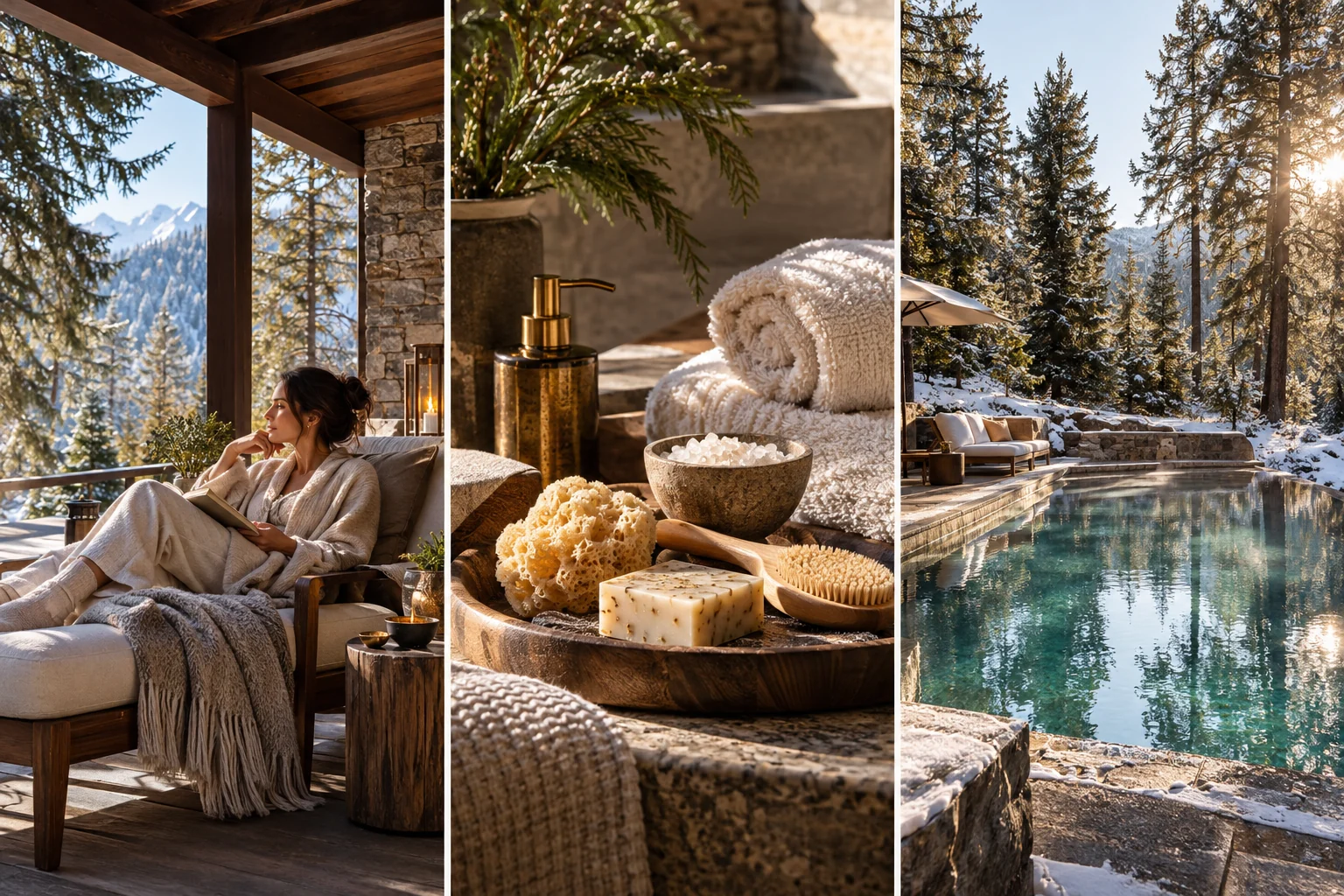
Nirva Life: The Oasis is not simply a retreat. It is the physical home of Nervous System Intelligence — a place where every space, every interaction, every meal, every conversation, every sound, every period of silence, and every moment of rest is intentionally designed around one question: what helps a nervous system feel safe enough to heal? This is not a place where people come to be fixed. It is a place where they are finally given the space to understand themselves. Nothing is loud. Nothing is rushed. Nothing is asked of you before you are ready.
The idea began years ago, in conversations with clinicians who kept returning to the same observation: their clients understood the theory. They could name their patterns, recite their triggers, map their trauma responses with precision. But understanding alone was not enough. The body needed something else. It needed an environment that did not ask it to override its instincts. It needed time. It needed permission to stop performing recovery and simply be.
What emerged from those conversations was not another wellness center. It was something quieter and more ambitious: a destination built entirely around the nervous system's need for safety, coherence, and rest. A place where the environment itself becomes part of the healing. Where you do not learn about regulation in a seminar and then return to a overstimulating lobby. Where the lighting, the acoustics, the schedule, the food, and the way people speak to you are all designed with the same intelligence.
The Oasis is that place. It is not a metaphor. It is not aspirational. It is being built now, with the same rigor and care that has defined every part of the Nirva Life ecosystem. And it represents something new in the landscape of healing: a destination that does not separate the work of recovery from the conditions required for it to happen.
Larger than trauma
The language around trauma has become both more precise and more diffuse. We speak of trauma-informed care, trauma-capable systems, trauma-sensitive spaces. These terms matter. They represent decades of advocacy and research. But they can also narrow the aperture, suggesting that healing is only for those who have survived something diagnosable, something that fits neatly into a clinical framework.
The Oasis is trauma-informed. It is trauma-capable. But it is larger than trauma. It is a destination for executives experiencing burnout so profound they no longer recognize their own thoughts. For healthcare professionals who have spent years regulating others and forgotten how to regulate themselves. For educators who give endlessly and return home empty. For first responders whose bodies have learned to stay alert long after the crisis has passed. For parents navigating the impossible arithmetic of care. For artists who have lost access to the quiet required for creation. For couples who want to understand each other beneath the accumulated static of daily life. For people navigating grief that has no timeline and no socially acceptable endpoint.
Trauma may be one reason someone comes to the Oasis. But it does not define who the Oasis is for. What defines it is a shared need: the need to step out of a life that has become unmanageable, not because of personal failure, but because the conditions of modern life are often incompatible with nervous system health. The Oasis offers an alternative. Not an escape, but a recalibration.
“You do not leave the Oasis with another wellness routine. You leave with a new way of understanding yourself.”
Healing you experience, not just learn
Nervous System Intelligence is not taught only in classrooms at the Oasis. It is lived. You experience it in the architecture — rooms that allow for both gathering and withdrawal, spaces that do not demand social performance. You experience it in the lighting, which shifts throughout the day in rhythm with circadian biology, never harsh, never fluorescent. You experience it in the schedule, which is structured enough to provide containment but flexible enough to honor individual capacity.
You experience it in the way staff greet you: with warmth, but without intrusion. In shared meals, where food is prepared to support regulation rather than stimulate or sedate. In movement practices that are offered, not prescribed. In silence that is held as sacred, not as awkward space to be filled. In creativity that is invited without expectation of product or performance. In conversations that go deeper than most people allow themselves in ordinary life, because the environment makes depth possible.
You experience it in the freedom to simply exist without having to perform wellness, productivity, or gratitude for anyone. There is no mandatory sharing circle. No enforced vulnerability. No pressure to have a breakthrough on someone else's timeline. The Oasis trusts that healing has its own intelligence, and that the role of the environment is not to force it but to make space for it.
This is what it means to live Nervous System Intelligence rather than simply learn it. Theory becomes embodied. Concepts become felt experience. You do not leave the Oasis with another wellness routine to add to an already overwhelming list. You leave with a new way of understanding yourself — and a nervous system that has remembered what safety feels like.
The entire ecosystem, one experience
The Oasis brings together the entire Nirva Life ecosystem — The NIRVA Method, The Gateway, Rituals, I'mPossible, NirvaCare, the Nirva Institute, and Community — not as separate programs stacked on top of each other, but as one integrated experience designed around a single purpose: helping people build a healthier relationship with themselves through Nervous System Intelligence.
The NIRVA Method provides the foundational framework, the lens through which every interaction is understood. The Gateway offers the initial assessment and orientation, helping each person understand their own nervous system patterns before they begin. Rituals are woven into the daily rhythm — not as add-ons, but as the structure itself. I'mPossible supports the psychological and somatic work of expanding what feels possible when the nervous system is no longer in constant defense. NirvaCare ensures continuity after departure, so that the Oasis is not an isolated experience but part of a longer arc of care. The Nirva Institute brings the research and clinical rigor that underpins every choice. And Community provides the relational container, the sense that you are not alone in this work, even when the work itself is deeply private.
This integration is rare. Most retreats offer a menu of modalities with little connective tissue between them. You might do yoga in the morning, therapy in the afternoon, and a sound bath in the evening, but each exists in its own silo. At the Oasis, every element is in conversation with every other element. The morning movement practice prepares the body for the afternoon's somatic work. The evening silence allows integration of what emerged during the day. The meals support what the nervous system is being asked to do. Nothing is random. Nothing is filler.
Modalities that meet the moment
The modalities offered at the Oasis are chosen not for their trendiness but for their efficacy in working directly with the nervous system. Somatic experiencing helps the body complete responses that were interrupted during moments of overwhelm. Breathwork offers a direct line to autonomic regulation, shifting states without requiring narrative or insight. Brainspotting sessions allow for deep processing of material that lives beneath language. Sound-informed restoration uses frequency and vibration to support the nervous system's return to baseline.
Nature immersion is not a luxury but a necessity — time spent in environments that do not demand anything from you, where your nervous system can recalibrate to rhythms older and steadier than the ones that have been driving you. Expressive arts provide a way to externalize what cannot yet be spoken, to give form to the formless. And then there are the ordinary rituals that quietly do the work: meals eaten without distraction, rest taken without guilt, and being seen without being asked to explain yourself.
These are not isolated interventions. They are threads in a larger fabric, each one reinforcing the others. The work is cumulative. The environment is consistent. And the result is not a single breakthrough moment — though those happen — but a gradual, sustained shift in how your nervous system relates to the world.
“The body needed something else. It needed an environment that did not ask it to override its instincts.”
Considered spaces
Every detail at the Oasis has been considered. Rooms are chosen for their light — not just the presence of windows, but the quality of the light that enters, the way it moves across the day. Beds are chosen for their weight and support, firm enough to provide containment, soft enough to allow release. Textures are natural: wood, stone, linen, wool. Nothing synthetic. Nothing that off-gasses or hums or flickers.
Sound levels are kept low. Not silent — silence can be its own kind of pressure — but quiet in a way that allows your nervous system to stop scanning for threat. Every space has a door that closes fully, a lock that works, a threshold you control. Privacy is not an afterthought. It is foundational.
The kitchen serves food that supports regulation: whole, unprocessed, anti-inflammatory, blood-sugar stabilizing. Meals are prepared by people who understand that food is not just fuel but information for the body. The library holds the writers who understood — Joan Didion, James Baldwin, Maggie Nelson, Anne Carson, Toni Morrison, Wendell Berry — voices that do not simplify or soothe but meet you in the complexity of being human.
These choices may seem small. But to a nervous system that has been living in chronic activation, they are everything. They are the difference between a place that says it cares about your well-being and a place that has structured itself entirely around it.
The rhythm of a day
There is no single schedule at the Oasis, because there is no single nervous system. But there is a rhythm, a structure that provides containment without rigidity. Mornings begin slowly. There is time to wake, to orient, to move gently if you choose. Breakfast is available across a two-hour window, not a fixed slot. The first formal gathering of the day is optional.
Midday includes both structured sessions — somatic work, breathwork, one-on-one time with clinicians — and unstructured time. You are encouraged to walk, to rest, to sit in the library, to do nothing at all. Lunch is communal but not performative. You can speak or not speak. You can sit with others or alone.
Afternoons are quieter. This is when deeper work often happens, when the nervous system has settled enough to access what it has been holding. Sessions are spaced to allow integration time. There is no rushing from one thing to the next. Transition is honored as part of the process, not dead time to be eliminated.
Evenings return to the communal, but gently. Dinner is longer, slower. There may be music, live and acoustic. There may be a fire. There may be conversation that goes late into the night, or there may be silence. Both are welcome. The day ends when you are ready for it to end, not when a schedule dictates.
For whom
The Oasis is designed for individuals recovering from trauma, grief, burnout, or extended dysregulation — and for the clinicians, first responders, caregivers, and healers who have quietly carried too much for too long. It is for people who have tried other things and found them insufficient. For people who know that what they need is not a quick fix but a fundamental recalibration.
It is for people who are ready to stop managing their symptoms and start understanding their systems. Who are willing to spend time — real time, not a long weekend — in an environment that will ask nothing of them except presence. Who understand that healing is not linear, not performative, and not something that can be rushed.
The cohorts are small. The stays are long. The experience is discreet, private, deeply held. This is not a place you go to network or to be seen. It is a place you go to be known — by yourself, first, and then perhaps by others who are doing the same work.
There is an application process, not because the Oasis is exclusive in the social sense, but because the work requires readiness. You must be stable enough to engage, resourced enough to tolerate what might emerge, and willing to be in community with others who are also vulnerable. The clinical team reviews every application to ensure that the Oasis is the right fit, and that the timing is right.
What you carry with you
People often ask what they should bring to the Oasis. The answer is: less than you think. Comfortable clothing. A journal if you write. A book if you read. But the Oasis is not a place where you need to arrive prepared with the right gear or the right mindset or the right language. You do not need to have done the pre-work. You do not need to be good at meditation or therapy or vulnerability.
What you carry with you when you leave is harder to name. It is not a certificate or a set of techniques. It is a felt sense of what your nervous system needs to feel safe. It is the memory of what it feels like to be in an environment that is not asking you to override your instincts. It is the knowledge that healing is possible, not because someone told you so, but because you experienced it.
You carry with you a new relationship to rest, to silence, to your own limits. You carry the voices of the people you met there, the ones who saw you and did not look away. You carry the understanding that you are not broken, that your nervous system has been doing exactly what it was designed to do, and that with the right conditions, it can do something different.
“Healing is not linear, not performative, and not something that can be rushed.”
The beginning
The Oasis is not yet open, but it is no longer theoretical. The land has been chosen. The architects are at work. The clinical team is being assembled. The first cohort will arrive within the year, and when they do, they will walk into a place that has been built entirely for them — not for the idea of them, but for the reality of what a nervous system needs when it is ready to heal.
This is the beginning of something that has been needed for a long time. A place that does not separate the theory of healing from the conditions required for it. A place that trusts the intelligence of the nervous system and builds everything around that trust. A place that is large enough to hold grief, burnout, trauma, and exhaustion — and quiet enough to allow them to transform.
Inaugural locations, itineraries, and application details are coming to these pages soon. If you would like to be among the first to receive them, notify us. We will reach out when the time comes. Until then, know that the Oasis is being built with care, with rigor, and with the understanding that what we are creating is not just a destination but a new possibility for what healing can look like when the environment itself becomes part of the work.
Before you go
Two quiet questions.
How much of what you just read named something you already know inside your own body?
How much did this open a new question you didn’t have before?
— End —
NirvaLife Magazine · January 2026