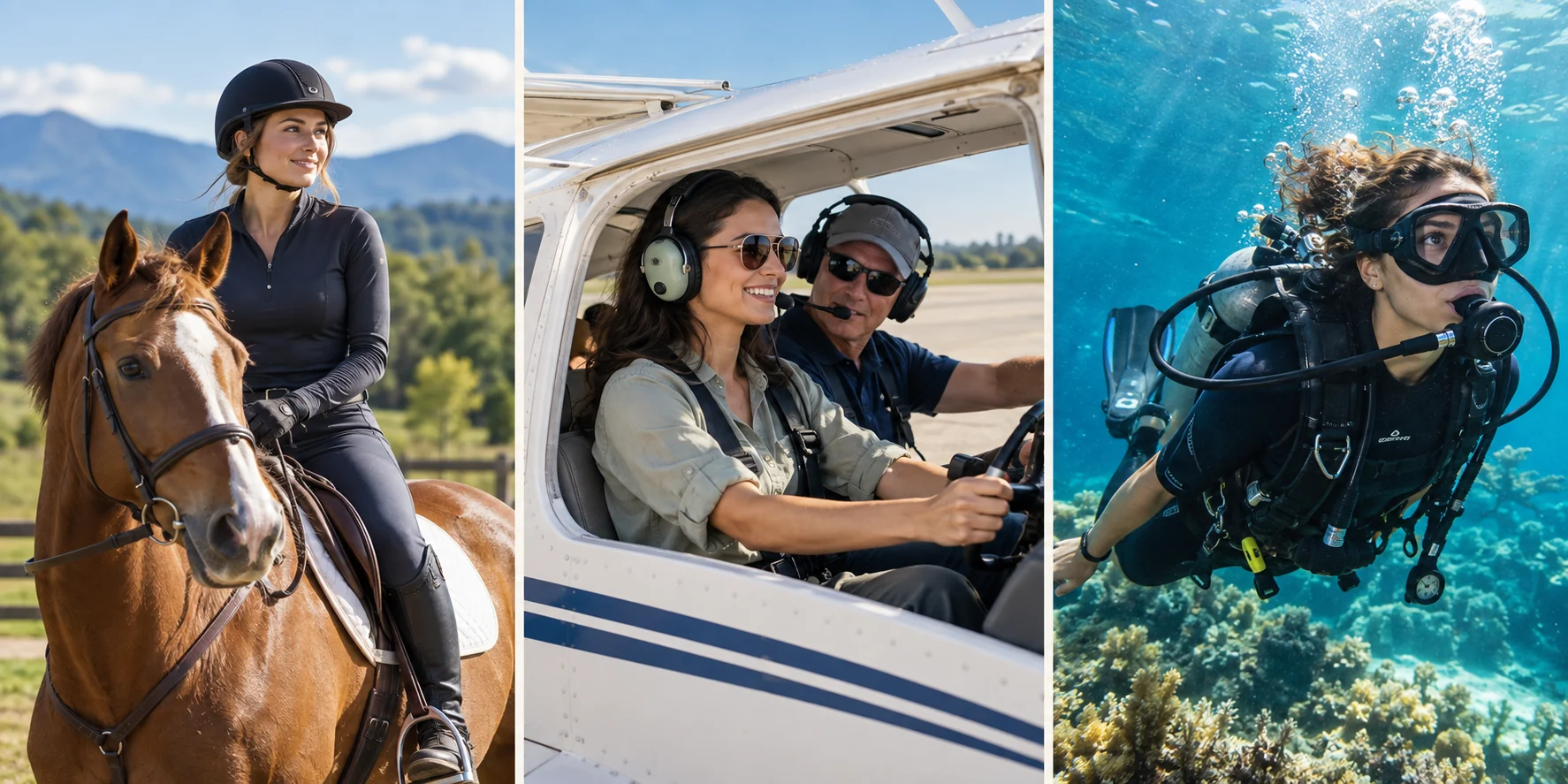
There comes a point in adulthood when life quietly becomes a list of responsibilities. Calendars fill. Obligations multiply. Weeks disappear into work, errands, and routines that hum along with the efficiency of a well-oiled machine. Somewhere along the way, many of us stop asking a simple question: What brings me joy simply because it does? Not because it advances a career. Not because it looks good on paper. Not because it might one day become profitable. Just joy, unadorned and unapologetic.
A hobby is one of the few things in life that asks nothing of you except your presence. It doesn't demand perfection. It doesn't require that you monetize it or justify its existence in terms of productivity. It doesn't need to become a side business or a social media account. It exists for one purpose alone — to remind you that life is meant to be experienced, not merely managed.
The activities that follow are not a prescription. They are an invitation. Each one offers something different: immersion, craft, connection, wonder. Some will resonate immediately. Others may surprise you years from now. If you've been searching for something that makes you lose track of time, perhaps you'll find it here.
Scuba Diving
There are few experiences as transformative as breathing beneath the surface of the ocean. The first time you descend, the world above becomes muffled, distant, irrelevant. What remains is only the rhythm of your breath and the weightless suspension of your body in blue. The underwater world moves at its own pace, inviting you to slow down and observe rather than rush.
Coral gardens stretch across the seafloor like alien cities. Sea turtles drift past with ancient, unhurried grace. Schools of fish move in perfect synchrony, their silver bodies catching light in ways that seem choreographed. Rays glide effortlessly through the water column, their wings rippling like silk. These are not things you watch on a screen. They are things you inhabit, if only for an hour.
Diving teaches you to be still. To breathe slowly. To move with intention. Panic burns oxygen; calm conserves it. The ocean rewards those who can quiet their minds and trust their training. In this way, diving becomes a form of moving meditation, a practice in presence that few landlocked activities can replicate.
Getting started requires an open-water certification course through a recognized organization like PADI or SSI. Most courses span a few days and include classroom instruction, pool sessions, and open-water dives. Rent equipment at first. The investment comes later, once you know the ocean has claimed you.
Sailing
A sailboat doesn't overpower the wind — it partners with it. Learning to read weather, trim sails, and navigate open water teaches patience, adaptability, and respect for forces larger than yourself. The boat heels. The sails fill. The hull cuts through water with a sound that is both ancient and immediate.
Every outing is different. Wind, tide, and weather ensure that no two days are ever the same. You learn to read the sky, to feel shifts in the breeze, to anticipate changes before they arrive. Sailing is a conversation between you and the elements, and the elements do not always agree.
There is also the silence. When the engine cuts and the sails catch, the world becomes remarkably quiet. No hum of machinery. No traffic. Just wind and water and the occasional cry of a gull. It is the kind of silence that makes room for thought.
“A hobby is one of the few things in life that asks nothing of you except your presence.”
Community sailing clubs and introductory lessons make this surprisingly accessible. Many cities with waterfronts offer beginner courses that require no prior experience. You don't need to own a boat to fall in love with sailing. You only need to be willing to learn.
Horseback Riding
Few partnerships are as remarkable as the one between horse and rider. A horse is not a machine. It is a sentient being with moods, preferences, and a finely tuned sensitivity to the emotions of those around it. Riding develops balance, confidence, communication, and trust while allowing you to experience landscapes from an entirely different perspective.
Horses respond to calm leadership more than force. They read tension in your body, hesitation in your hands, fear in your breath. In this way, riding becomes a mirror. It shows you who you are when you think no one is watching. It teaches you to be steady, even when you don't feel steady.
There is also the landscape. Trails that would take hours on foot unfold beneath you in minutes. Forests, meadows, hillsides — all become accessible in ways that walking cannot replicate. The rhythm of the horse's gait becomes your rhythm. The world slows to the pace of hoofbeats.
Local riding academies typically offer beginner lessons on well-trained horses. You don't need your own horse to start. You only need curiosity and a willingness to listen.
Ballroom Dancing
Grace is a skill that can be learned. Ballroom dancing combines music, movement, etiquette, and connection in a way few activities can. Whether it's the elegance of the waltz, the romance of the foxtrot, or the excitement of Latin rhythms, dance teaches confidence that extends well beyond the dance floor.
Dancing is also a language. A lead and follow conversation conducted without words. It requires listening — not with your ears, but with your body. You learn to sense intention, to respond to pressure, to move as though you and your partner share a single nervous system.
There is something quietly radical about dancing in an age of screens. It demands presence. Eye contact. Physical proximity. It asks you to be vulnerable in a way that feels increasingly rare. And when the music ends and you step off the floor, you carry that confidence with you.
Most cities have ballroom studios that welcome beginners. Group classes are common, affordable, and surprisingly social. You don't need a partner to start. You only need to show up.
Pottery
There is something deeply satisfying about shaping clay with your own hands. The wheel spins. The clay rises. Your palms guide it into form. Every bowl, vase, or mug carries the subtle marks of its maker, making each piece beautifully unique.
Pottery reminds us that beauty often emerges through patience and practice. The first dozen pieces may collapse. The glaze may crack. The kiln may reveal flaws you didn't anticipate. But slowly, over weeks and months, your hands learn what your mind cannot yet articulate. The clay begins to listen.
There is also the tactile pleasure of it. In a world dominated by screens and abstraction, working with clay is profoundly physical. Your hands get dirty. Your back aches. You smell like earth. It is grounding in the most literal sense.
Community studios and beginner workshops are widely available. Many offer access to wheels, kilns, and glazes without requiring a large upfront investment. You can start small and see where the clay takes you.
Poetry
Poetry doesn't require permission. It asks only that you notice the world a little more carefully. A shadow on the wall. The way someone laughs. The particular quality of light on a winter afternoon. Poetry teaches you to find meaning in ordinary moments, to see the extraordinary hiding in plain sight.
“The best hobby isn't the most expensive or the most prestigious. It's simply the one you'll be excited to return to tomorrow.”
Whether you're reading timeless classics or writing your own verses, poetry changes the way you think. It teaches compression, precision, rhythm. It asks you to say more with less. In this way, it is the opposite of the noise that fills most of our days.
You don't need a degree to write poetry. You don't need to publish. You only need a notebook and a willingness to pay attention. Some of the best poems are never shared. They exist only for the person who wrote them, a private record of what it felt like to be alive on a particular day.
Start with poets who move you. Mary Oliver. Rumi. Nayyirah Waheed. Billy Collins. Let their words teach you what yours might become.
Photography
Photography changes the way you walk through the world. Suddenly, light matters. Shadows matter. The angle of a street, the texture of a wall, the way rain collects on glass — all of it becomes material. The camera becomes less about documenting life and more about learning to truly see it.
You begin to notice things you once walked past. The way morning light slants through a window. The geometry of a staircase. The expression on a stranger's face. Photography trains your eye to find beauty in the overlooked, the mundane, the fleeting.
It also teaches patience. The perfect shot rarely announces itself. You wait. You watch. You return to the same location at different times of day, in different weather, until the light does what you hoped it would. In this way, photography becomes a practice in attention.
You don't need an expensive camera to start. Many photographers began with their phones. What matters is not the equipment, but the willingness to look closely and often.
Watercolor Painting
Watercolor has a mind of its own. The pigment blooms across wet paper in ways you cannot entirely predict. Instead of controlling every brushstroke, you learn to collaborate with the medium itself. The result is often softer, more organic, and unexpectedly beautiful.
Watercolor teaches you to let go. To embrace accidents. To see mistakes as opportunities rather than failures. A wash bleeds beyond its intended border, and suddenly the painting is better for it. A drop of water falls onto drying pigment, and the resulting texture becomes the most interesting part of the piece.
It is also remarkably portable. A small set of paints, a brush, a pad of paper — that's all you need. You can paint at a café, in a park, on a train. The world becomes your studio.
Beginner tutorials are plentiful online, and local art stores often offer introductory classes. Start with simple subjects — a single flower, a landscape, a cup of tea. Let the paint teach you what it wants to do.
Gardening
Watching something grow because of your care is one of life's quietest rewards. A seed becomes a sprout. A sprout becomes a plant. A plant becomes food, flowers, beauty. Gardens remind us that remarkable things rarely happen overnight.
Gardening is also humbling. You can do everything right and still lose a crop to weather, pests, or sheer bad luck. You learn to accept what you cannot control and to celebrate what you can. A single tomato, warm from the sun and eaten standing in the garden, becomes a triumph.
There is also the rhythm of it. Planting in spring. Tending in summer. Harvesting in fall. Resting in winter. Gardening connects you to cycles larger than your own life, to the turning of seasons and the patient unfolding of growth.
You don't need land to start. A balcony, a windowsill, a few pots — that's enough. Herbs are forgiving. Tomatoes are generous. Flowers are joyful. Start small and see what takes root.
Calligraphy
In a digital world, beautiful handwriting feels almost revolutionary. Every stroke becomes an exercise in craftsmanship, patience, and attention to detail. Calligraphy is slow by design. You cannot rush it. You cannot multitask. You can only be present.
There is something meditative about the repetition. The same letter, practiced dozens of times, until your hand remembers the motion. The ink flows. The nib glides. The paper fills with shapes that are both functional and beautiful.
Calligraphy also reconnects you to history. The scripts you practice — Copperplate, Italic, Gothic — were once the standard, the way people communicated across distance and time. To write them now is to participate in a tradition that stretches back centuries.
“Choose the one that makes you forget to check your phone. Choose the one that leaves you smiling on the drive home.”
Starter kits are inexpensive and widely available. A few nibs, a bottle of ink, practice paper — that's all you need. Online tutorials and local workshops can guide you through the basics. From there, it's simply practice.
Astronomy
Looking into the night sky has a way of placing life into perspective. The stars remind us that wonder is always available to those willing to look up. That the universe is vast and old and indifferent to our small concerns. That we are, against all odds, here to witness it.
Astronomy teaches you to see in the dark. To find constellations. To track planets as they move across the ecliptic. To wait for meteor showers and eclipses and the rare alignment of celestial events. It asks you to be patient, to let your eyes adjust, to sit in the cold and the quiet and simply watch.
You don't need a telescope to start. Binoculars work. So do your eyes. Apps can help you identify what you're seeing, but the real gift is the looking itself. The act of standing beneath the sky and feeling small in the best possible way.
Find a dark sky site away from city lights. Bring a blanket. Let your eyes adjust for twenty minutes. Then look up. The stars will do the rest.
Gourmet Cooking
Cooking becomes an art when it moves beyond necessity. Learning regional cuisines, mastering techniques, and sharing meals with others transforms dinner into an experience. A perfectly seared scallop. A sauce that took hours to reduce. Bread that rose because you understood the yeast.
Cooking teaches you to trust your senses. To taste as you go. To adjust seasoning, heat, timing based on what the dish tells you. Recipes are guidelines, not gospel. The best cooks learn to listen.
There is also the generosity of it. To cook for others is to offer care in its most tangible form. A meal shared is a memory made. The table becomes a place where time slows and conversation deepens and the world, for a moment, feels manageable.
Start with a cuisine that excites you. Take a class. Watch videos. Read cookbooks written by chefs who love what they do. Let your kitchen become a place of experimentation and delight.
Finding Your Hobby
Don't choose the hobby that impresses other people. Choose the one that makes you forget to check your phone. Choose the one that leaves you smiling on the drive home. Choose the one that reminds you that life is wonderfully larger than your to-do list.
The best hobby isn't the most expensive or the most prestigious. It's simply the one you'll be excited to return to tomorrow. And the day after that. And the day after that.
Because a life is measured not by the things you accomplished, but by the things that made time disappear.
Before you go
Two quiet questions.
How much of what you just read named something you already know inside your own body?
How much did this open a new question you didn’t have before?
— End —
NirvaLife Magazine · July 2026