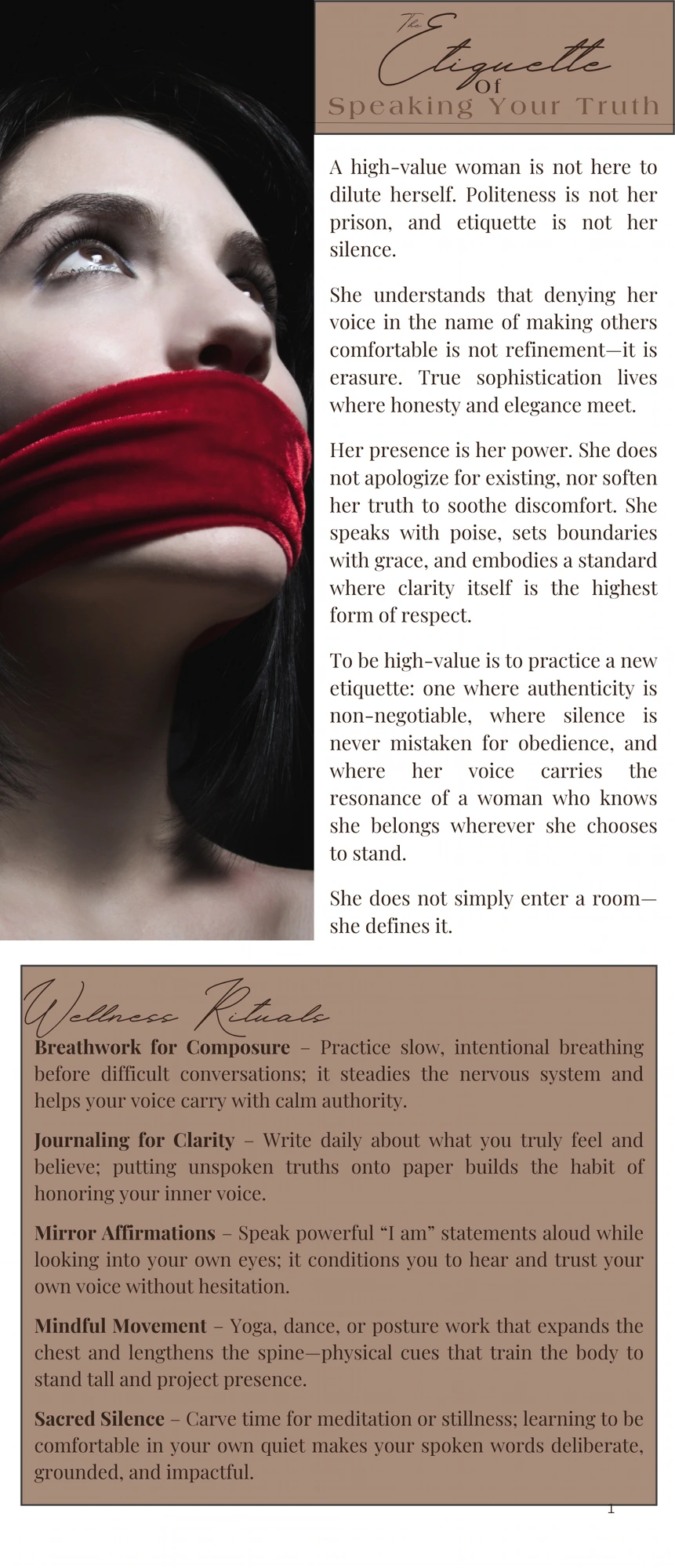
To speak your truth is not to speak loudly. It is to speak clearly, from a body that is not bracing to be liked. It is the difference between a voice that fills a room and a voice that steadies it. Between performance and presence. Between the need to be heard and the willingness to be known.
For most of us, truth was trained out of us early. We learned to hedge, soften, apologize, or perform agreement to keep the room comfortable. We learned that our actual opinion was less important than our ability to manage the emotional weather of others. We became fluent in a second language — the language of accommodation — and forgot we were translating at all.
But the nervous system remembers every time we betrayed ourselves for the sake of composure. It collects the tax with our sleep, our shoulders, and our capacity for intimacy. The body keeps a ledger of every swallowed sentence, every smile that cost us something, every moment we chose safety over honesty. And eventually, the bill comes due.
The Architecture of Self-Betrayal
There is a particular exhaustion that comes from chronic self-editing. It is not the tiredness of hard work or late nights. It is the fatigue of holding two realities at once: the one you are living and the one you are pretending to live. Of knowing what you think but saying something softer. Of feeling what you feel but arranging your face into something more palatable.
This is not about honesty in the crude sense — the person who mistakes cruelty for candor, who wields truth like a weapon and calls it integrity. That is not truth-telling. That is aggression in a virtuous costume. Real honesty requires more precision than that. It requires you to know the difference between what is true and what is merely angry, between what needs to be said and what simply wants to wound.
The women I know who speak their truth well do not raise their voices. They do not perform certainty or demand to be believed. They simply refuse to distort. They have learned, through years of small experiments, that they can say the true thing and survive it. That the room does not collapse. That relationships do not end simply because you stopped managing them with silence.
This is not a personality trait. It is a nervous-system practice. It is the slow, deliberate work of teaching your body that it is safe to be seen.
“The body keeps a ledger of every swallowed sentence, every smile that cost us something.”
What the Body Knows
Your nervous system is always listening. Not to your words, but to the gap between your words and your experience. It registers the micro-adjustments you make to keep yourself small. The slight lift in your voice when you disagree. The way your breath shallows before you ask for something. The tension in your jaw when you say yes but mean no.
As Lisa Feldman Barrett describes in How Emotions Are Made, the brain is constantly predicting what will happen next based on past experience. If you have learned that speaking your mind leads to rejection, your nervous system will begin to sound the alarm before you even open your mouth. Your heart rate will climb. Your throat will tighten. Your body will prepare for danger, even if the danger is only hypothetical, even if the danger is decades old.
This is why speaking your truth feels so physically difficult. It is not just a matter of finding the right words. It is a matter of overriding a deeply embedded survival strategy. Your body believes that silence keeps you safe. And in some contexts, at some points in your life, it was right.
But survival strategies have expiration dates. What protected you at twelve may be suffocating you at forty. The question is not whether you were right to be quiet then. The question is whether you still need to be quiet now.
The Myth of the Fearless Speaker
There is a fantasy we carry about people who speak their truth: that they are naturally bold, unburdened by doubt, immune to the need for approval. That they were born with some internal compass the rest of us lack. This is a comforting story because it lets us off the hook. If truth-telling is a gift, then its absence is not our fault.
But the women I know who speak clearly are not fearless. They are simply more afraid of losing themselves than of losing your approval. They have done the math and decided that the cost of silence is higher than the cost of honesty. They still feel the fear. They just no longer let it make the decision.
This is not about confidence. Confidence is a feeling, and feelings are unreliable. This is about practice. It is about speaking the true thing once, in a low-stakes situation, and noticing that you survive. Then doing it again. And again. Until your nervous system begins to update its predictions. Until your body learns that honesty does not equal annihilation.
The practice is small. It is saying 'I'd rather not' instead of inventing an excuse. It is naming your preference before asking for everyone else's. It is letting a silence sit instead of rushing to fill it with reassurance. It is the accumulation of tiny moments in which you choose accuracy over comfort.
Coherence, Not Confrontation
Truth-telling, properly done, is not confrontation. It is coherence. It is the alignment of your inner experience and your outer expression. It is the woman whose tone, words, and body are all telling the same story. She does not need to convince. She does not need to justify. She simply refuses to distort.
This kind of honesty is not loud. It does not demand. It does not perform. It is quiet in the way that bedrock is quiet. Unshakable not because it is rigid, but because it is true.
Stephen Porges, in his work on polyvagal theory, describes the ventral vagal state — the part of the nervous system associated with social engagement and safety. When we are in this state, we can be both honest and connected. We can speak our truth without severing the relationship. We can disagree without becoming defensive. We can hold our ground without hardening.
This is the state we are aiming for. Not the hyperarousal of anger, not the shutdown of silence, but the calm, grounded presence that allows for both truth and tenderness. It is possible to say hard things softly. To be clear without being cruel. To hold your boundary without building a wall.
“It is possible to say hard things softly. To be clear without being cruel.”
The Cost of Niceness
We are taught, especially as women, that niceness is a virtue. That our job is to make others comfortable, to smooth over tension, to absorb disappointment without complaint. We learn to prioritize harmony over honesty, to value being liked over being known.
But niceness, in this form, is not kindness. Kindness is rooted in respect — for yourself and for others. Niceness is rooted in fear. It is the performance of agreeability in exchange for safety. It is the hope that if you are pleasant enough, small enough, undemanding enough, you will be allowed to stay.
The problem is that niceness erodes intimacy. When you are always managing the other person's comfort, you are never fully present. You are monitoring, adjusting, performing. And the other person, whether they know it or not, is relating to your performance, not to you.
Real intimacy requires truth. It requires the risk of being disliked. It requires you to show up as you are, not as you think you should be. And that is terrifying, because it means you might be rejected not for your mistakes or your flaws, but for your actual self.
But here is what I have learned: the people who cannot handle your truth are not your people. The relationships that require you to be smaller are not sustainable. And the version of you that everyone likes is not the version that gets to be happy.
Learning to Hear Yourself
Before you can speak your truth, you have to know what it is. And for many of us, that is the harder part. We have spent so long translating our experience into something more acceptable that we have lost touch with the original language. We know what we are supposed to think, supposed to feel, supposed to want. But what we actually think, feel, want — that is murkier.
This is where the body comes in. Your body knows what is true before your mind does. It knows in the tightness of your chest when you agree to something you do not want. It knows in the relief you feel when someone cancels plans. It knows in the way your energy shifts when you are with certain people versus others.
Learning to hear yourself is a practice of paying attention to these signals. Of noticing what makes you expand and what makes you contract. Of asking, not 'What should I think about this?' but 'What do I actually think about this?' The answers are often quieter than you expect. They do not announce themselves. They wait to be noticed.
This requires slowing down. It requires creating space between stimulus and response. It requires you to stop filling every silence with noise, every discomfort with distraction. It requires you to sit with yourself long enough to hear what you actually have to say.
The Quiet Practice
Speaking your truth is not a dramatic act. It is not a confrontation or a declaration. It is a quiet, daily practice. It is the accumulation of small moments in which you choose honesty over performance. In which you say the true thing instead of the safe thing. In which you let yourself be seen.
Before you speak, feel your feet. Let them root into the ground beneath you. Let your body remember that it is held. Then breathe. Let your exhale be longer than your inhale. Let your nervous system downregulate, just slightly. Let yourself arrive in your body before you ask it to speak.
Then say the true, kind thing. Not the safe, small thing. Not the thing that will make everyone comfortable. The thing that is accurate. The thing that honors both you and the person you are speaking to. The thing that does not require you to disappear.
Notice that the room does not end. Notice that you are still there. Notice that the other person is still there. Notice that honesty did not destroy the relationship. It may have changed it. It may have made it more real. But it did not destroy it.
And then, gently, do it again. Tomorrow. Next week. In the next conversation. Repeat, gently, for the rest of your life.
“The version of you that everyone likes is not the version that gets to be happy.”
What Changes
When you begin to speak your truth, some things will shift. Some people will not like it. They will miss the version of you that agreed with them, that made things easy, that never asked for anything. They may tell you that you have changed, and they will not mean it as a compliment.
They are right. You have changed. You have stopped performing. You have stopped managing their comfort at the expense of your own integrity. And for people who benefited from your silence, your honesty will feel like a loss.
But other things will shift too. You will sleep better. Your shoulders will drop. You will stop rehearsing conversations in your head because you will have already said what needed to be said. You will feel less resentment, less exhaustion, less of the low-grade anxiety that comes from living out of alignment with yourself.
And some relationships will deepen. The people who can meet you in your honesty will become more real to you, and you to them. You will discover that intimacy is not about being liked. It is about being known. And that being known, even imperfectly, is worth more than being universally approved of.
The Long Game
This is not a quick fix. There is no script, no formula, no five-step process that will make truth-telling easy. It will always require something of you. It will always be a choice, made again and again, in a thousand small moments.
But over time, it becomes less effortful. Your nervous system learns. Your body begins to trust that honesty is safe. The gap between what you feel and what you say begins to close. And you begin to live in a kind of integrity that is not about perfection, but about coherence.
You become the woman whose words match her body. Whose tone matches her meaning. Who does not need to raise her voice because she is not fighting herself. Who speaks clearly, not because she is fearless, but because she has decided that being known is more important than being comfortable.
This is the long game. This is the work of a lifetime. And it begins, as all important things do, with a single breath. A single moment of choosing truth over safety. A single sentence spoken from a body that is no longer bracing to be liked.
You do not have to be loud. You do not have to be certain. You only have to be honest. The rest will follow.
Before you go
Two quiet questions.
How much of what you just read named something you already know inside your own body?
How much did this open a new question you didn’t have before?
— End —
NirvaLife Magazine · November 2025