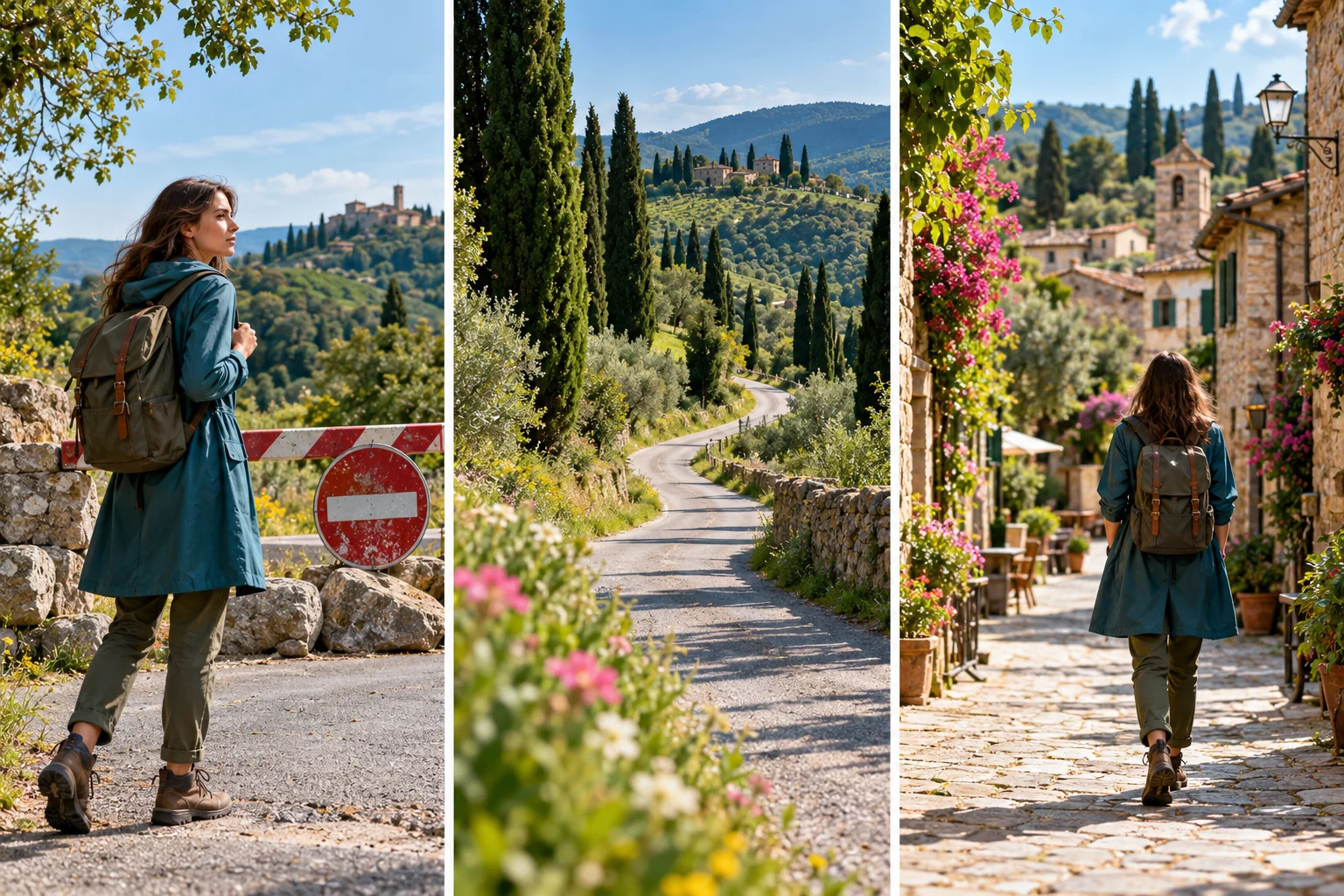
Some roads end because we choose to leave. Others end because life quietly decides we can no longer go back. There is a particular kind of heartbreak that no one prepares you for. It isn't the heartbreak of losing something. It is the heartbreak of realizing that no amount of love, determination, or hope can restore what once was. It is standing before a road you have traveled a thousand times only to discover that it no longer exists.
Part I — When the Road Disappears
The bridge has collapsed. The gate has been locked. The landscape itself has changed. You stand there anyway. Not because you believe the road will suddenly reappear. But because part of you still remembers where it used to lead.
Perhaps you've stood there before. Outside a relationship that had already ended long before either of you admitted it. Holding onto a career that had stopped feeling like your calling. Returning to friendships where history had become the only thing holding you together. Waiting for an apology that never came. Believing that if you just loved a little harder, forgave a little longer, explained yourself one more time, something would finally change.
We are taught that perseverance is noble. That resilience means refusing to give up. That love always finds a way. Sometimes those lessons serve us beautifully. Sometimes they quietly become the reason we remain lost. Because there are moments when the greatest act of courage is not continuing down the same road. It is recognizing that the road itself has disappeared.
The strange thing about memory is that it doesn't obey calendars. A single song can return you to a decade you thought you'd left behind. The scent of someone's perfume can stop you in the middle of a crowded airport. A familiar street can awaken a version of yourself you haven't met in years.
The Places We Visit Long After We've Left
The human heart is remarkably loyal. It remembers places where it once felt alive. It remembers laughter echoing through kitchens that no longer belong to us. It remembers dreams whispered into the darkness before sleep. It remembers promises. It remembers who we were when we believed those promises.
Memory is not the enemy. It is one of life's greatest gifts. Without it, there would be no traditions, no family stories, no first loves carefully preserved in the quiet corners of our minds. But memory has a curious habit. It edits. Over time, it softens the sharpest edges. It brightens certain moments while quietly dimming others. It preserves sunsets while forgetting storms.
This is why returning can feel so tempting. We are rarely trying to return to reality. We are trying to return to a memory. And memories, beautiful as they are, make terrible maps.
“We are rarely trying to return to reality. We are trying to return to a memory. And memories, beautiful as they are, make terrible maps.”
Hope Is Beautiful — Until It Becomes a Home
Hope has built civilizations. It has inspired explorers to sail toward unknown horizons. It has carried families through war, illness, poverty, and unimaginable grief. Hope is one of the finest qualities a human being can possess. But hope, like every beautiful thing, has a shadow. When untethered from reality, hope can quietly become a place where we live instead of a light that helps us move.
We begin hoping for people who have stopped choosing us. Hoping for circumstances that no longer exist. Hoping for a version of yesterday that time has already carried away. There is a profound difference between hope that moves us forward and hope that keeps us standing still. One opens doors. The other keeps us waiting outside them.
I have come to believe that many of us are not imprisoned by our past. We are imprisoned by our belief that the past can still become our future. That belief is intoxicating. It whispers, 'Just one more conversation.' 'Just one more chance.' 'Maybe this time.' It rarely announces the cost. The cost is today. Every hour spent trying to resurrect what has already ended is an hour unavailable to the life unfolding quietly in front of us.
Sometimes we don't miss the person, the place, or the dream. We miss who we were when we believed it would last forever.
Standing at the Edge of Yesterday
Imagine standing at the beginning of an old hiking trail. You've walked it hundreds of times. You know every bend. Every overlook. Every familiar tree. Then one morning you arrive to find the trail washed away. A landslide has erased it. There is no path. Only open earth.
At first, you refuse to believe what you're seeing. Surely there must be another entrance. Perhaps the map is wrong. Perhaps someone will rebuild it tomorrow. So you wait. Days become weeks. Weeks become months. Meanwhile, somewhere behind you, dozens of new trails quietly wait to be discovered. But you never turn around. Not because you lack courage. Because you are waiting for a path that no longer exists.
How much of life is lived this way? How many years are spent standing at the entrance of vanished roads? Waiting. Remembering. Negotiating with reality. The tragedy is not that the road disappeared. The tragedy is how long we sometimes remain there after it has.
Life's Quiet Intervention
There are moments that feel like punishment while we are living them. A rejection letter. A relationship ending. A closed business. A missed opportunity. A phone call that changes everything. We experience these moments as loss because we naturally measure life by what has been taken away. Only later do we begin to ask another question. 'What did this make possible?'
Had that job worked out, would you have met the people who now feel like family? Had that relationship continued, would you have become the person you are today? Had that dream unfolded exactly as planned, would you ever have discovered the one waiting quietly behind it? Perspective has a remarkable way of turning endings into beginnings. But only after enough time has passed for us to stop staring at the closed door.
Perhaps this is one of life's quietest mercies. Not that every ending makes sense. Many never will. Not that every loss becomes beautiful. Some remain deeply painful. But that life, in its extraordinary wisdom, often removes roads we would never have found the strength to leave on our own.
When the road first disappears, it feels like abandonment. It rarely feels like protection. Only much later, standing somewhere you could never have imagined while grieving what you once believed you couldn't survive without, do you begin to understand. Perhaps the road didn't disappear to punish you. Perhaps it disappeared because your life was always meant to continue beyond it. And perhaps the greatest mercy is that, one day, you stopped trying to rebuild it.
Part II — The Weight of Hope
Hope is one of the most beautiful qualities we possess. But when it asks us to remain where we no longer belong, it quietly becomes something else.
I have spent much of my life believing that hope could fix almost anything. Not because I was naïve. Because I had seen hope accomplish extraordinary things. I had watched people survive illnesses they were never expected to overcome. I had watched broken relationships find their way back to one another. I had watched strangers become family, grief become gratitude, and impossible situations become remarkable stories.
Hope, after all, is what has carried humanity through every generation. It is the reason seeds are planted before winter ends. It is the reason sailors continue sailing after storms. It is the reason parents whisper dreams over sleeping children. Hope is sacred.
But somewhere along the way, I confused hope with responsibility. I began believing that if something ended, perhaps I simply hadn't hoped hard enough. If someone walked away, perhaps there was one more thing I could have said. If a dream collapsed, perhaps I hadn't worked enough, loved enough, sacrificed enough, or waited long enough. Hope quietly became obligation. Without realizing it, I stopped asking whether something was meant to continue. I only asked what else I could do to save it.
The Dangerous Romance of 'Almost'
There is something uniquely painful about things that almost worked. Almost can haunt us in ways that certainty never does. Almost married. Almost reconciled. Almost accepted. Almost successful. Almost enough.
The human mind loves unfinished stories. Psychologists call it the Zeigarnik effect — the tendency for incomplete experiences to remain more mentally active than completed ones. We replay them because our minds naturally seek resolution. That is why we remember the conversation we wish we had handled differently more vividly than the hundred conversations that went well. It is why one unanswered question can overshadow a dozen answered ones. It is why 'almost' can occupy more emotional space than 'never.'
But life is not obligated to finish every story in the way we imagined. Sometimes 'almost' is the ending. And accepting that is one of the hardest acts of maturity we are ever asked to practice.
“Sometimes 'almost' is the ending. And accepting that is one of the hardest acts of maturity we are ever asked to practice.”
We Don't Miss Everything Equally
When people say they miss someone, I often wonder what they truly miss. Do they miss the person? Or do they miss the future they imagined with them? There is a difference.
Sometimes we grieve the life we planned far more than the life we actually lived. We mourn birthdays that never happened. Vacations never taken. Conversations that remained imaginary. The version of ourselves we expected to become. Loss has an extraordinary imagination. It doesn't only take what existed. It also takes everything we believed might someday exist. That is why grief can feel so impossibly large. It is carrying two funerals at once. The reality. And the possibility.
Most of us believe we make plans. In truth, our plans begin making us. 'I'll always be a nurse.' 'I'll always be a wife.' 'I'll always be a parent.' 'I'll always live here.' 'I'll always have this dream.'
Identity is built slowly. One decision at a time. One routine at a time. One relationship at a time. Until eventually we stop saying, 'This is something I do.' We begin saying, 'This is who I am.' Then life changes. A career ends. Children grow up. A marriage dissolves. Health shifts. A business closes. Someone dies. Suddenly we are not only grieving what we lost. We are grieving who we believed ourselves to be. Perhaps this is why major life transitions feel so disorienting. They don't simply rearrange our circumstances. They invite us to meet ourselves again.
Some endings don't ask us to find a new path. They ask us to become a new traveler.
The Cost of Looking Back
There is an old story from Greek mythology about Orpheus. After losing the love of his life, Eurydice, he was granted an impossible opportunity. He could lead her back from the underworld. There was only one condition. He could not look back. Not once.
He walked forward, trusting she was behind him. But as the light grew closer, doubt became louder. What if she wasn't there? What if he had misunderstood? What if he lost her again? So he turned. For a single moment. And in that moment, she disappeared forever. Whether the story is myth or metaphor hardly matters. Its wisdom has endured for centuries.
Not because looking back is inherently wrong. But because there are moments when constantly checking behind us prevents us from reaching what lies ahead. How many opportunities have quietly waited while we were still searching the horizon behind us? How many beautiful beginnings have gone unnoticed because we were measuring every new experience against an old one? How often have we mistaken familiarity for destiny?
Life does not move in reverse. The river never returns to its source. Not because it failed. Because it fulfilled its purpose by continuing. The seasons do not apologize for changing. Trees do not cling to last autumn's leaves. The ocean does not ask yesterday's tide to come back. Nature understands something we often resist. Growth requires movement. Not every chapter deserves an epilogue. Some simply ask us to keep turning the page.
As I look back on the roads that once felt impossible to leave, I no longer wonder why they ended. I wonder who I would have become if they hadn't. That question has changed everything. Because for the first time, I am beginning to suspect that the greatest losses of my life were never interruptions to my journey. They were the journey. And every road that disappeared was quietly leading me toward one I had not yet learned to see.
Part III — The Mercy of Closed Doors
Some doors do not close because you failed. They close because your life can no longer fit through them.
There is a moment that comes long after heartbreak. It is so quiet that many people almost miss it. Nothing dramatic happens. No music swells. No revelation arrives. No one calls to apologize. No grand explanation suddenly makes sense of everything that happened.
Instead, you wake up one ordinary morning and realize something has changed. The ache is still there. But it no longer owns the room. You make coffee without thinking about who isn't sitting across the table. You drive home without replaying old conversations. You laugh — genuinely laugh — and only later realize it has been weeks since grief interrupted the moment.
Healing rarely announces its arrival. It slips into your life unnoticed. Like dawn. You never actually see darkness leave. One moment it is night. The next, the world is full of light.
We Mistake Familiar for Safe
Human beings are extraordinary pattern seekers. Our brains are constantly asking one quiet question: 'Have I survived this before?' If the answer is yes, familiarity begins to feel comforting. Even when it hurts us.
This is why people sometimes stay in relationships that have long since stopped nurturing them. Why they remain in careers that quietly drain them. Why they continue telling themselves stories that no longer fit the person they have become. Not because suffering feels good. Because the known often feels safer than the unknown.
The familiar asks very little of us. It requires no introduction. No learning. No uncertainty. No reinvention. The unfamiliar, however, asks us to trust ourselves before we have evidence that everything will be okay. That kind of trust feels terrifying. Until one day it feels like freedom.
“Acceptance does not mean the betrayal was acceptable. Acceptance simply means we stop arguing with reality long enough to begin living inside it.”
Acceptance is one of the most misunderstood words in the human language. Many people believe accepting reality means approving of it. It doesn't. Acceptance does not mean the betrayal was acceptable. It does not mean the diagnosis was fair. It does not mean the loss should have happened. Acceptance simply means we stop arguing with reality long enough to begin living inside it.
Imagine standing in the middle of a thunderstorm, shouting at the sky because you wanted sunshine. No matter how persuasive your argument, the rain continues falling. Eventually, you have two choices. Continue arguing. Or open the umbrella. Acceptance is the umbrella. It does not stop the storm. It simply allows you to keep walking. There is remarkable dignity in that.
The Stories We Tell Ourselves
Long after events end, their stories remain. Sometimes those stories become heavier than the events themselves. 'If I had been better…' 'If I had stayed…' 'If I had seen it sooner…' 'If only…' Those two words have stolen countless years from countless lives.
If only. They create imaginary timelines where every decision unfolded perfectly. Where everyone said exactly what they should have said. Where no one left. Where every dream survived. But imaginary lives possess one extraordinary advantage over real ones. They never encounter reality.
Real life is wonderfully imperfect. It contains misunderstandings. Accidents. Timing. Human limitations. People doing the best they can with the wisdom they possess in that moment. The older I become, the less interested I am in perfect stories. I am far more interested in honest ones. Honest stories leave room for humanity.
Forgiveness is not always about releasing another person. Sometimes it is about releasing yourself from the endless trial taking place inside your own mind.
The Freedom of Not Knowing
For years I believed peace would arrive with answers. I wanted to know why. Why people changed. Why promises dissolved. Why some love remained while other love disappeared. Why certain dreams seemed blessed while others quietly unraveled. I believed that understanding would somehow remove the pain.
But life is remarkably selective about the answers it gives us. Some questions remain unanswered. Not because we are unworthy of knowing. Because certainty is not always available. Eventually I realized something surprising. Peace had never been waiting for answers. Peace had been waiting for permission. Permission to stop searching. Permission to stop solving. Permission to admit that some mysteries will remain mysteries.
The human heart is capable of carrying unanswered questions. It simply grows tired of carrying them while demanding immediate resolution. There is freedom in saying, 'I don't know.' And then continuing to live beautifully anyway.
The Garden Beyond the Gate
Imagine spending years tending a beautiful garden. Every morning you water it. Every season you prune it. Every bloom feels like evidence that your care mattered. Then one day, for reasons beyond your control, the gate is locked. You can still see the flowers through the fence. You remember where every rose bush stands. You remember how it smells after rain. But you can no longer enter.
At first, you spend every day standing at the gate. You imagine someone will unlock it. You rehearse what you'll say. You convince yourself tomorrow will be different. Months pass. The gate remains closed. Then one morning you notice something remarkable. Behind you… there is an empty field. Untouched. Waiting. Not demanding that you forget the old garden. Simply inviting you to plant another.
Most of us spend too much time mourning gardens we can no longer reach. Not enough time noticing the soil still available beneath our feet. Life is astonishingly generous that way. It rarely gives us the same garden twice. But it almost always gives us another place to grow.
There comes a day when you stop measuring your life by what you lost. You begin measuring it by what you are still willing to create. That day is quieter than you expect. It doesn't erase grief. It simply refuses to let grief become the author of every remaining chapter. And perhaps that is what healing has always been. Not forgetting. Not replacing. Not pretending. Simply deciding that what happened will forever be part of your story… but it will no longer decide how the story ends.
Part IV — The Horizon Ahead
There comes a day when you stop asking life to return what it has taken, and begin asking what it still has to offer.
For a long time, I believed courage looked like holding on. Holding on to hope. Holding on to people. Holding on to dreams. Holding on to promises that once felt unbreakable. I admired the people who never gave up. The ones who stayed. The ones who fought. The ones who refused to walk away.
And sometimes, that is exactly what courage requires. Sometimes love asks us to stay at the bedside. To weather the storm. To rebuild after the fire. To believe in another human being when they can no longer believe in themselves. But life has a way of teaching us that courage wears more than one face. Sometimes courage is not found in remaining. Sometimes it is found in releasing our grip on what no longer belongs to us. Not because it never mattered. Because it mattered enough that we must allow it to become what it was. Instead of demanding that it become something it can no longer be.
The Horizon Does Not Compete with the Rearview Mirror
Every windshield is larger than the rearview mirror. Perhaps there is wisdom in that design. The mirror has a purpose. It helps us understand where we have been. It reminds us of roads already traveled. It offers perspective. But no one reaches their destination by driving while staring only behind them.
Life works much the same way. Our memories deserve to be honored. Our experiences deserve to be remembered. Our grief deserves to be acknowledged. But they were never meant to become the landscape through which we permanently navigate. The horizon asks something different of us. It asks us to trust what we cannot yet fully see.
People often imagine that new beginnings arrive with fanfare. In truth, they usually begin almost invisibly. The first morning you laugh without guilt. The first trip you take because you are curious instead of because you are escaping. The first book that changes your thinking. The first friendship that asks nothing of you except your honesty. The first time you catch yourself making plans that no longer include waiting for yesterday to return.
These moments are so ordinary that they can easily be overlooked. Yet this is how lives are rebuilt. Not all at once. One morning. One conversation. One decision. One unexpected joy at a time. A meaningful life is rarely created through a single dramatic moment. It is composed of thousands of quiet ones.
The future rarely arrives with certainty. It arrives with an invitation.
What the Road Gave You
It is tempting to measure every ending by what it took away. There is another question worth asking. What did it leave behind? Perhaps it left you wiser. Perhaps it taught you how deeply you are capable of loving. Perhaps it revealed strengths you never would have discovered in easier circumstances.
Perhaps it introduced you to compassion. To resilience. To patience. To humility. The road that ended may not have given you the destination you expected. But it may have given you the traveler you needed to become. And sometimes that is the greater gift.
“The road that ended may not have given you the destination you expected. But it may have given you the traveler you needed to become.”
There is no finish line where life suddenly becomes free of uncertainty. No morning arrives with a guarantee that nothing difficult will ever happen again. To be human is to love, to lose, to begin again. Not once. Many times.
The remarkable thing is that the heart, despite everything it endures, continues to make room for wonder. It continues to notice beauty in unexpected places. It continues to believe that another sunrise is worth watching. That another friendship is worth forming. That another dream is worth pursuing. Hope, it turns out, was never meant to chain us to the past. It was meant to lead us toward the future.
The Mercy of an Impassable Road
Years from now, you may look back on this season with different eyes. Not because the loss will become insignificant. Some losses never do. But because time has a remarkable way of revealing what urgency conceals. You may discover that the road you once begged to reopen was not the only road available. You may discover landscapes you never imagined, people you never expected to love, and parts of yourself that could only emerge because the familiar path disappeared.
And perhaps you will understand something that once felt impossible to believe: the road did not lose its value because it ended. Its purpose was not to last forever. Its purpose was to bring you this far. Every meaningful road changes us. Very few are meant to contain us forever.
So honor the road. Carry its lessons. Remember its beauty. Grieve what was lost. Express gratitude for what was found. Then, when you are ready, lift your eyes to the horizon. There is still so much of the world waiting to meet you. There are conversations you have not yet had. Places you have not yet stood. Friendships you have not yet discovered. Versions of yourself you have not yet become.
Life is not asking you to erase your past. It is asking you not to mistake it for your entire future. Perhaps that is the mercy of an impassable road. Not that it prevents us from going back. But that it gently invites us to keep going forward. And somewhere beyond the bend we cannot yet see, another road is already unfolding beneath our feet.
Before you go
Two quiet questions.
How much of what you just read named something you already know inside your own body?
How much did this open a new question you didn’t have before?
— End —
NirvaLife Magazine · July 2026